Table 45 Launches Cultural Celebration of the Month and Sweepstakes
Zack Bruell interprets cuisines from around the world, as diners vie for a chance to win a dream vacation stay at a global destination and other valuable hotel and restaurant prizes
Table 45, renowned for its world-fusion cuisine at the InterContinental Hotel Cleveland, has announced its new Cultural Celebration of the Month promotion and sweepstakes. The celebration is an eight-month promotion featuring a different international cuisine each month as interpreted through the culinary lens of Chef Zack Bruell.
Each month starting in October, the restaurant will feature cuisine from popular up-and-coming regions from around the world to create special menu options and events, including drink and wine tastings, chef’s table specials, and cultural awareness. Zack and his team at Table 45, will consult with chefs from other InterContinental Hotels from around the globe to offer authentic regional dishes.
Cultural Celebration of the Month kicks off in October, when Table 45 takes on the distinctive flavors of Cuba. November will celebrate Moroccan cuisine, followed by Israeli, Portuguese, Ethiopian, Peruvian, Taiwanese, and the Yucatan Peninsula. Each month carries a timely cultural significance.
“We are excited to offer these one-of-a-kind dining experiences,” says Chef Zack Bruell. “It’s a way for us to engage our local international communities and offer a variety of new tastes from around the world.”
Diners and other participants will be entered in a chance to win the Grand Prize of a five-night stay for two at any InterContinental Hotel property in the world courtesy of The InterContinental Hotels Group. First place wins a free two-night stay at InterContinental Hotel Cleveland, local limo transportation to and from the hotel and dinner for two at Table 45. Second place wins a free dinner for four at the famed Chef’s Table, and Third prize is a selection of international wines from around the world featured in the Cultural Celebration of the Month promotion. With each visit, diners complete and submit tickets in their World Tour Passport for increasingly more chances to win.
“This is more than a promotion,” said Bruell, “This will be an opportunity for us to create new food each month that people won’t see anywhere else in Cleveland. And it will be incredible.”
The promotion will last 8 months starting October 2016. In June of 2017, Table 45 will host a World Cultural Celebration Reception for frequent participants and will include the announcement of the Grand Prize Sweepstakes Winner from monthly entries.For more information visit: http://www.tbl45.com/culturalcelebration
Written By: Pete Baka
About the InterContinental Hotels Cleveland
The InterContinental Hotel and Conference Center is located at 9801 Carnegie Avenue in Cleveland. The hotel features 35,000 square feet of newly renovated meeting space, including a 500-seat, state-of-the-art amphitheater, a grand ballroom and eight large meeting rooms. With 295 guest rooms and 27 suites, The InterContinental’s guest rooms have recently undergone a modern transformation to provide the best-in-class design, comfort and convenience. The InterContinental Cleveland recently received the AAA Four-Diamond Award for 2015. The hotel was also named one of the best in Ohio by U.S. News & World Report.
The nearby InterContinental Suites Cleveland is located at 8800 Euclid Avenue in Cleveland. The suites offer 162 one-bedroom rooms with living and dining room areas combined with wet bars. And the newly opened Holiday Inn Cleveland Clinic boasts 276 rooms located on the campus of the Cleveland Clinic at 8650 Euclid Avenue. This modern flagship Holiday Inn has several meeting spaces, fast casual dining and bar at Moce Café and is an affordable option to other offerings in the area.

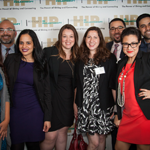
Next Generation Latino Leadership Program
Hispanics In Philanthropy (HIP) is pleased to announce the launch of the 2017 cohort of the Next Generation Latino Philanthropy Leadership Program, supported by the Cleveland Foundation and the American Express Foundation.
Applications now open to emerging Latino leaders through November 18, 2016
The year-long fellowship provides an opportunity for emerging leaders to gain the skills needed to excel as a diverse social sector leader. Targeted towards early to mid-level professionals in the nonprofit, philanthropic, and government sectors, the NGEN Latino Philanthropy Leadership Program provides access, tools, key in-person and online leadership trainings, and mentorship opportunities from seasoned leaders.
Applications are now open for those interested in gaining and strengthening the key leadership skills and high-level relationships needed to support their long-term professional growth.
Application Timeline:
- Open Applications: September 21 – November 18, 2016*
- Informational Webinar: October 25, 2016
- Decision Announcements: December 20, 2016
- Fellowship Launch: January, 2017
*Special consideration will be given to those applicants in the Midwest, particularly in the Cleveland metro area.
Please feel free to circulate this announcement within your networks and to refer potential candidates to the HIP team. We look forward to cultivating yet another cohort of diverse philanthropic leaders to strengthen the sector at-large and our greater communities.
Please contact Anne Hand, Senior Program Manager, at [email protected] or 415-837-0427 ext. 3300 with any questions.

Our International Newcomer Communities Today: Displaced Personss Welcome
Global Cleveland and The Maltz Museum of Jewish Heritage present: Our International Newcomer Communities Today: Displaced Personss Welcome?
From America’s undocumented International Newcomer population of 11 million to the Syrian Displaced Persons crisis, to the growing demand for employment visas for skilled workers, the Migration debate puts our economy, our borders and our communities under the microscope.
This presidential election is one of the most consequential of our time. America – along with our friends and allies – faces a choice between a world that is open or closed. Join us as Isam Zaiem (Council on American-Islamic Relations), Leen Midani (senior at CSU, Syrian asylee), Veronica Dahlberg (Executive Director, Hola) and Global Cleveland’s Joe Cimperman discuss some of the main Migration issues of our day.
Learn more about the components and prospects of sensible Migration reform, and hear why changes to our Migration policy are needed through the perspectives of business, technology, faith and law enforcement.
This event is FREE, but registration is required—LIMITED SEATING! Register HERE.
Sponsored by:
Margaret W. Wong & Associates and The City Club of Cleveland
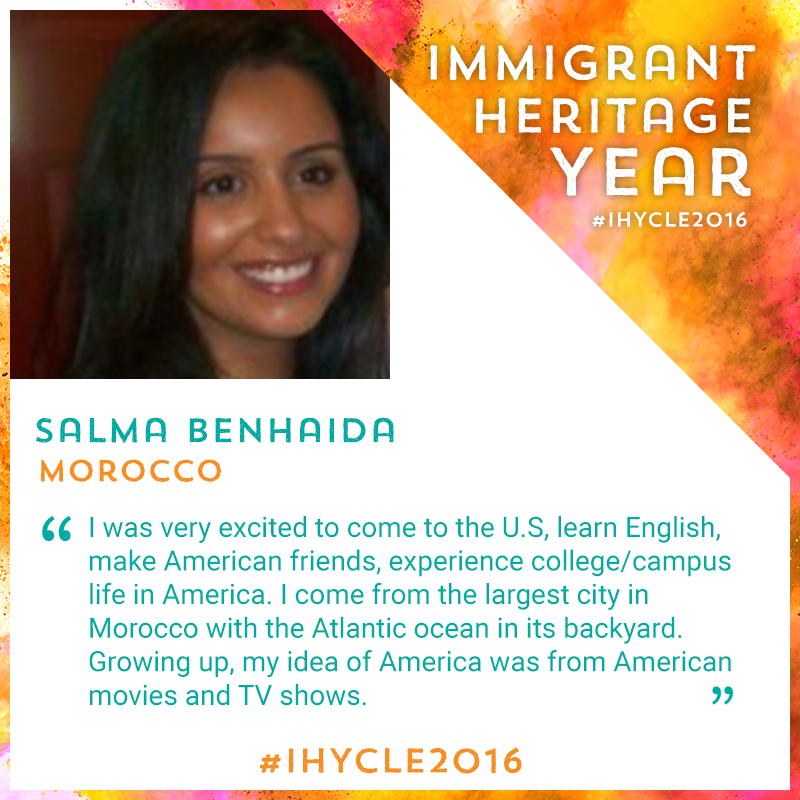
Salma Benhaida
Where are you from?
Casablanca, Morocco
What was it like growing up?
I come from a tight knit family and I have fond memories of my childhood in Morocco. The ocean, the amazing food, the family gatherings, playing outside. I try and visit once a year as my parents still live there.
What brought you to Cleveland?
After completing High School in Morocco. I moved to Northeast Ohio to attend college. A U.S degree is highly valued overseas and I could not have done it without the moral and financial support of my parents.
What were your first thoughts about coming to America? Did those change?
I was very excited to come to the U.S, learn English, make American friends, experience college/campus life in America. I come from the largest city in Morocco with the Atlantic ocean in its backyard. Growing up, my idea of America was from American movies and TV shows. So you can imagine my disappointment when I first arrived to the Akron-Cleveland area and it didn’t look anything like New York City or Chicago. It took some time to get used to the smaller pace and the brutal winters but I love the area now and I am proud to call it home.
What challenges did you face as an International Newcomer transitioning here?
Being 18 years old in a foreign country away from my parents, friends and all that is familiar presented many challenges but it also gave me room to grow and mature as a person.
What is your occupation?
I work in International Education at Kent State University.
How have other Clevelanders made you feel welcomed?
Inviting me over for holidays, expressing interest in my culture and country, introducing me to Cleveland sports (tailgating was a foreign concept to me! I also didn’t understand the rules of American Football and Baseball)
What traditions or customs do you continue to practice?
Not very many, unfortunately. It is challenging celebrating Moroccan holidays here when they are not always observed in the U.S. I also do not know very many Moroccans in the area.
What do you love about Cleveland?
The people. The sports. The culinary scene. Fall foliage in the Metroparks.
Why is it so important to welcome International Newcomers and Displaced Personss?
Diversity and tolerance are an ethical and moral obligation . Welcoming people from around the world helps create mutual understanding and foster peace on a global scale.
Why is it important to travel abroad?
You learn a lot about other cultures through travel, but most importantly, you learn a lot about yourself. Travel changes you for the better and also challenges you to get out of your comfort zone. Your outlook on life changes and you learn to connect with others on a basic human level, transcending country of origin,
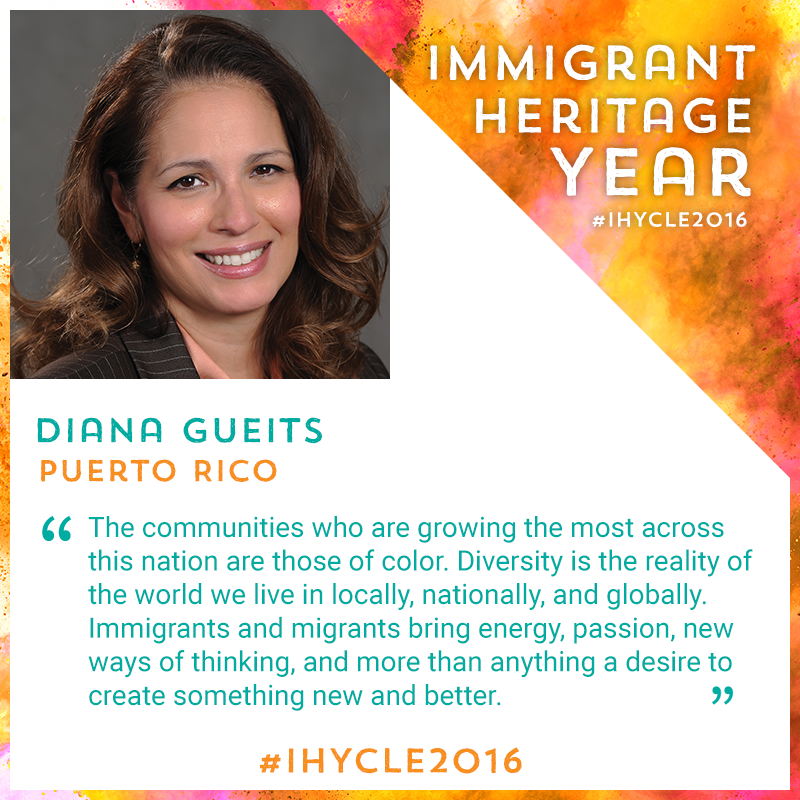
Diana Gueits
Where are you from?
My family is from Puerto Rico. Like many Puertoricans my family would migrate between Puerto Rico and the U.S. mainland. I was born in New York, however shortly after my birth my family relocated back to Puerto Rico. We came to the US when I entered elementary school.
What was it like growing up?
I have fond memories of growing up in Cleveland. Our family bought a house on E.32nd off Payne Ave. It was a very diverse neighborhood. I had Asian, Hispanic, African American, and Caucasian neighbors and schoolmates. Our families shared similar values and we in pursuit of better opportunities for themselves and their families. I attended Case elementary which offered dual education classes where newly arrived Hispanic students and the Asian students would switch classrooms and get to learn Mandarin and Spanish. I remember my teacher Mr. Lugo making home visits to help assimilate our parents to the US school system.
What brought you to Cleveland?
My mother remarried and decided to join her sister here. It was a very brave step. I don’t think that International Newcomers are recognized for the level of bravery it takes to leave everything you know and sometimes everything you own to begin a new life in an area that is completely unknown to you. I admire my mother’s bravery. She had less than basic English fluency and I know that it was difficult for her.
What were your first thoughts about coming to America? Did those change?
When we moved to Cleveland it was my first experience of not living in a Hispanic enclave. We spent some time in Chicago, however the Latino community here was not as established in other places. Although we lived in a diverse neighborhood here every time we stepped out of that neighborhood, I felt out of place.
There were places we knew were not welcoming. A great deal of other parts of the city where highly segregated. Cleveland has changed considerably and I love the energy that this city has and the strides that have been made to make Cleveland more inclusive. However there is still a great deal that needs to be done.
What challenges did you face as an International Newcomer transitioning here?
I was placed in Speech classes in elementary school here. Even though I spoke English well (at least I thought so). The speech classes was an instrument to reduce my accent. It still bothers me when I think of that, since I had no real speech impediment ever recognized by a physician.
Like many other International Newcomer children, I had to grow up very quickly and serve as the interpreter and navigator for my family from everything from getting bank accounts set up , scheduling and attending medical appointments to arranging services with the utility company.
It was like living in two worlds. The one where you have to be the family advocate and voice in the English speaking world and take on a very adult role and then having to transition to the role of a child within my culture. It was not easy for me, since the lines were often blurred.
What is your occupation?
I am one of the Directors in the Cleveland Clinic Office of Diversity and Inclusion.
How have other Clevelanders made you feel welcomed?
We were fortunate to have wonderful neighbors. Neighbors who had similar experiences and assisted in connecting us with an existing network of resources that made adapting to Cleveland much easier. These neighbors and friends became extended family members. There are people with great hearts in Cleveland.
What traditions or customs do you continue to practice?
The meals we prepare are still very traditional . Puertorican food and music are very central to our family. Respect to your elders is a stronghold in our community. I still ask for my parents blessing every time we speak or see each other. In many Latin American countries , whenever you enter a room or begin a conversation with an elder, you ask for bendicion (there blessing) as a sign of respect. I love that about our culture.
What do you love about Cleveland?
I love our Midwest values. It is a great city, full of rich history and amenities. It is a great place to raise a family. The number of organizations we have that are committed to improving the lives of our community are impressive. It is also a great place to make a name for yourself. I think we don’t capitalize on this enough when selling Cleveland , there are so many opportunities to get involved and really affect change. There is also a warmth and energy here that I have not experienced anywhere else.
Why is it so important to welcome International Newcomers and Displaced Personss?
The communities who are growing the most across this nation are those of color. Diversity is the reality of the world we live in locally, nationally, and globally. International Newcomers and migrants bring energy, passion, new ways of thinking, and more than anything a desire to create something new and better. We need that and we will always need that if we are to be relevant.
What suggestions do you have to make Cleveland a more welcoming Community?
There are many I can think of. I think we need to have some intentional strategies on how we connect and support our existing communities of color. It is inauthentic to say that we “welcome you”, when we have existing communities that we have failed to be inclusive and connected with. We need to be an example of what the definition really means.

Menila Preevanich
Occupation:
Business co-owner Rho and Rice
Where are you from?
Thailand
What was it like growing up?
I grew up in Bangkok which is a big crown and very busy in Thailand
Why did you choose Cleveland?
I came here for to get my Master’s degree.
What were your first thoughts about coming to America? Did those change?
In the beginning I was thinking just have new experience and for school but everything change when I will have my own family here in the USA so I stayed to open the business.
What challenges did you face as an International Newcomer transitioning here?
The hardest thing is living on my own no family no one who I can talked with closely. So I have to learn how to take care of myself without someone around.
What traditions or customs do you continue to practice?
I continue doing thai traditional which is hardly to do like going to thai temple and pray.
How have Clevelanders made you feel welcomed?
Yes its very nice here including people they are very nice and welcome me and my family
What do you love about Cleveland?
It’s very nice place. I like the place that not too crowd and too quiet.
What’s your favorite thing to do in Cleveland?
I don’t have much time to do things but I can tell that since I’ve been here about 10 years CLEVELAND is my home now. I have friends, a husband and my 2 kids so I love everywhere in CLEVELAND.
Why is it important to travel abroad?
Yes I think it is important. You will learn lots of thing from everywhere over the world.
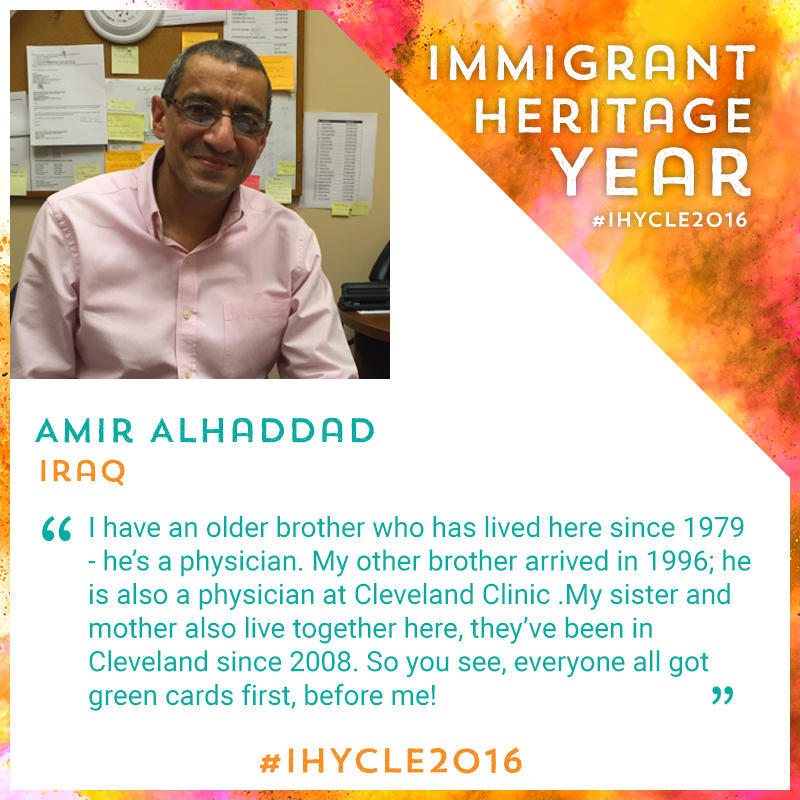
Amir Alhaddad
Where are you from?
Iraq.
Occupation:
Interpreting services coordinator
What was it like growing up?
I was born in Iraq, and I studied at a college of science and engineering. I started an electrical contracting company with a partner (we worked with diesel generators, which were in high demand because of the constant lack of power; as well as with electronic spare parts). So we ran it as a shop and a company.
I did this until 2006, which was the peak of sectarian war in Iraq. So my partner and I left Baghdad for Northern Iraq, which was safer. My partner had a lot of family there that we could stay with. After that, my family and I moved to Abu Dhabi in the United Arab Emirates, where I got a job with a consultant company after two months. In 2012, my application for a visa was approved, and I was told I had to leave in 20 days. This was a very strict deadline for me; it was very stressful because of all the paperwork needed. I also was scared telling my boss, because in UAE you have to give 30 days’ notice to receive the termination benefits. However my boss was very understanding and told me he would work it out. And then, I left Dubai and arrived in Cleveland September 14th, four years ago!
After one year here, I could apply for a green card, but it was not possible to work. The term “legal Displaced Persons” scares employers because they don’t know what it means - you’re a Displaced Persons?! I got a green card finally in 2014, so I could start looking for a job. At the end of that year, I heard about a job with a program connected to the Cleveland Clinic who needed interpreters because a lot of their clients were from the Middle East.
Then, one year later, I got this job. I had actually arrived in US through USTogether, so I had been keeping contact with them. With my job at the Clinic, I went through training as an Interpreter, which qualified me for this job. Also, my wife works at US Together too, she had started as a contractor several months earlier.
What brought you to Cleveland?
I have an older brother who has lived here since 1979 - he’s a physician. My other brother arrived in 1996; he is also a physician at Cleveland Clinic .My sister and mother also live together here, they’ve been in Cleveland since 2008. So you see, everyone all got green cards first, before me! Also, my wife’s parents are living in columbus. Living in UAE was good, but unstable. You can get kicked out any time for not being a citizen. So I was always very nervous and wanted to leave.
What were your first thoughts about coming to the U.S.? Did those change?
Back in the Middle East, everything is close together. You walk out of your home and the grocery store is right there on the street.
When I arrived in the USA, I was surprised because the houses are so far away from each other and the streets were empty. Where is grocery store?! Also, the difficulty of finding a job. I had expected it to be hard, but not this hard. So I found the place very nice, but it was much harder job-wise.
What challenges did you face as an International Newcomer transitioning here?
I did not really have any, besides the job search and waiting for a green card. Maybe I am just a special case, because I had my own company in Iraq. So money was not a huge concern, and the termination benefits helped too. On top of that, I was lucky to have my brothers’ support too.
How have other Clevelanders made you feel welcomed?
My daughter is in 7th grade now, and people are so friendly and helpful. When I first came to America in September, school had already started and I wanted to enroll my daughter. I met with the principal of the school close to my mother’s house and explained my family’s situation. You know what the principal said? “Wow, you and your daughter came from Iraq yesterday? You must have jetlag, go home and sleep!” So he was very understanding. And my daughter loves it there now. Also, it was great that I didn’t have to look for a new home, so that wasn’t as stressful.
What traditions or customs do you continue to practice?
I have so much family here, so we still practice all traditions from home in Iraq. And I am Muslim, so even the Muslim holidays. Like I still fast during Ramadan, even during work. Actually all of the people in the office prepare a huge feast for Eid! But it’s still different than how it was back home. In Iraq, work is off for eid so everyone can gather together and visit family together.
What do you love about Cleveland?
The nature. This is one of the few places I’ve seen in America - I have visited only a few other states for job fairs - but I love that I can see the four seasons. Everything is fresh! In Dubai, we called it a “hot hell.” It’s too hot to live there. Everything is temporary.
Why is it so important to welcome International Newcomers and Displaced Personss?
Well, why are they Displaced Personss? They already suffered a lot in their home country, but they are still human so they deserve a simple welcome at least. And suffering is different among places - for me, leaving was putting my bags onto a plane, but some of my other family and friends had to literally run to escape violence and war. One of my friends is in Turkey right now and he tells me about the horrible things ISIS did.
Why is it important to travel abroad?
My daughter does many activities, so I drive her around, and I talk to the people there. And it’s so surprising. They don’t really know what’s going on in the world. I told someone I was from Iraq, and she said, “where’s Iraq?” I was shocked! You have so many of your people fighting there! When I was young, my friends and I knew everything that was going on in the world. We didn’t have internet because it was banned, but we listened to the radio and read the news. I am so surprised that most of the people I talk to do not know much about the world.
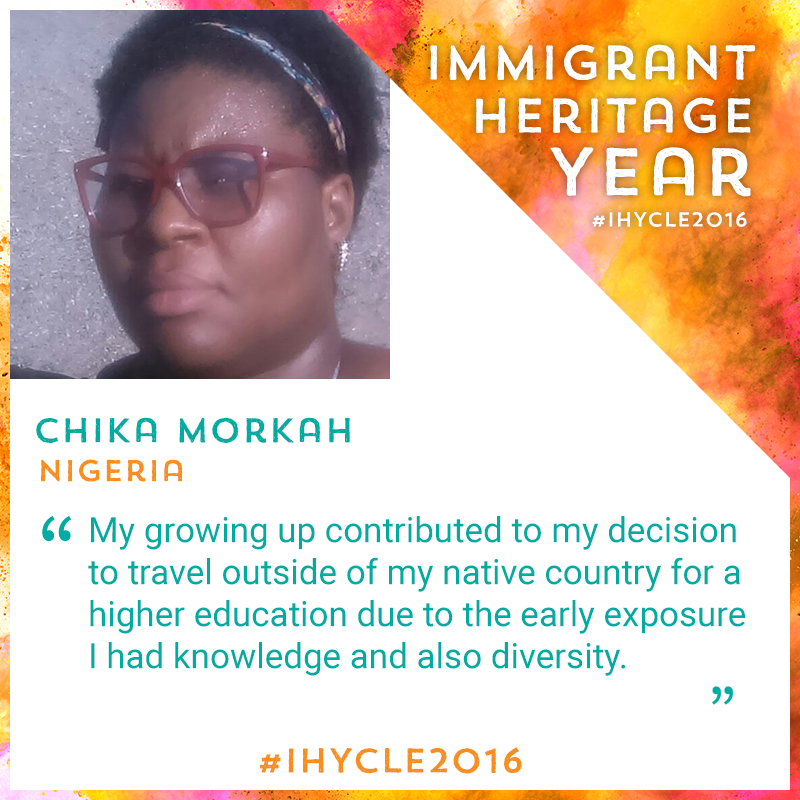
Chika Morkah
What is your name?
My name is Chika Morkah
Did you grow up outside of the US? If So, what was it like growing up in your native country?
Yes, I did grow up outside of the US. I was born in Nigeria, from the eastern part of Nigeria. I grew up amongst boys so I didn't do what girls would normally do growing up. Playing soccer, playing pranks on people and doing all kinds of sports. I am the last born in my family so I grew up around so many older people so I learnt a lot about life and saw some of it unfold.
How did you decide to attend a university outside of your native country?
My growing up contributed to my decision to travel outside of my native country for a higher education due to the early exposure I had knowledge and also diversity. My mom always taught us to love no matter the colour of the skin. She had a strong attachment to that belief because she grew up with british people who in the 1950s and 60s could have chosen to be slave drivers but were very kind to them despite the colour of their skin. She imparted that unto us her children so it stuck real strong. The school curriculum and the program was another thing that drew my attention the the outside world.
What were your first thoughts about coming to the United States? Did those change?
My first thoughts about coming to the US was a limited notion that people highly minded their business and you can easily cater to yourself. You have to ask for help when needed. The notions changed largely due to my personal experiences on arrival. I saw that most of my information was not accurate. It has been a good experience so far.
Did you face any challenges transitioning to the US or to Cleveland?
I came straight from Nigeria to Cleveland without having to live in any other city in the US yet, from my journey to settling down into the Cleveland Hostel, it was a very smooth transition. Moving on to the culture....there was no shock at all...I already knew that there is a reliable bus system even if i don't have a car and all i had to do was pay to get by, i already knew that i was coming into an entirely different system and structure of government so i had to make the adjustments in y mind before coming. So it was generally a smooth transition.
What Traditions or customs do you continue to practice?
The tradition of Humanity. Constantly reminding myself that we are all the same no matter the difference in culture and race, we are humans first before anything. In addition to loving people, sometimes it can be really difficult but with the grace of God and strength of character we can do it.
Why is it so important to welcome International Newcomers and Displaced Personss?
It helps create balance in lifestyle. It also creates options for people to adapt and interact with new cultures and traditions. We don't have to accept them but accommodating them is a good way to grow and expand in knowledge. Nobody knows everything. We learn everyday.
Why is important to travel abroad?
Diversity. Exposure to all kinds and types of character, personality, lifestyle and cultures that exist are limitless. Nobody can really know everything, travelling is a good way to find the balance that we need in life because if we try to put ourselves in people's' shoes' we might be able to understand better how they think, not to use it against them but to help nurture.

Marihan Albitar
Where are you from?
I’m from egypt, although my mom is from saudi arabia and I was born and raised there.
With the experiences that i had and with the connections that I built in all the countries I have visited/lived in, I got to know that home is not only in one place and that I could be homesick for people too!
What are some unique or experiences or memories for you, growing up?
The fact that I grew up in a very diverse environment and got to travel a lot in such a young age has to be the most unique blessing im grateful for.
How have people that you’ve met made you feel welcomed?
After a long conversation I had with one of my classmates ,during my first day at CSU, she ended up telling me "you are.... I don’t want to say an inspiration because obviously you are, but I want to say you are the world.. People like you give me hope!" I will always remember her words and her genuine smile.. I felt pretty welcomed :)
What do you love about Ohio?
If have to pick one thing that i love the most about Ohio, I would have to say 'Hiking' ❤️
Why is it so important to welcome International Newcomers?
I promote diversity because the more we know about other people's cultures, the more accepting we become of our differences. And most of the time we end up realizing that we are more similar than different... With diversity comes empathy; which the world needs more of..
Why is it important to travel abroad?
We are not alone and the world is in constant change. By traveling abroad, you get to be a part of that transformation!
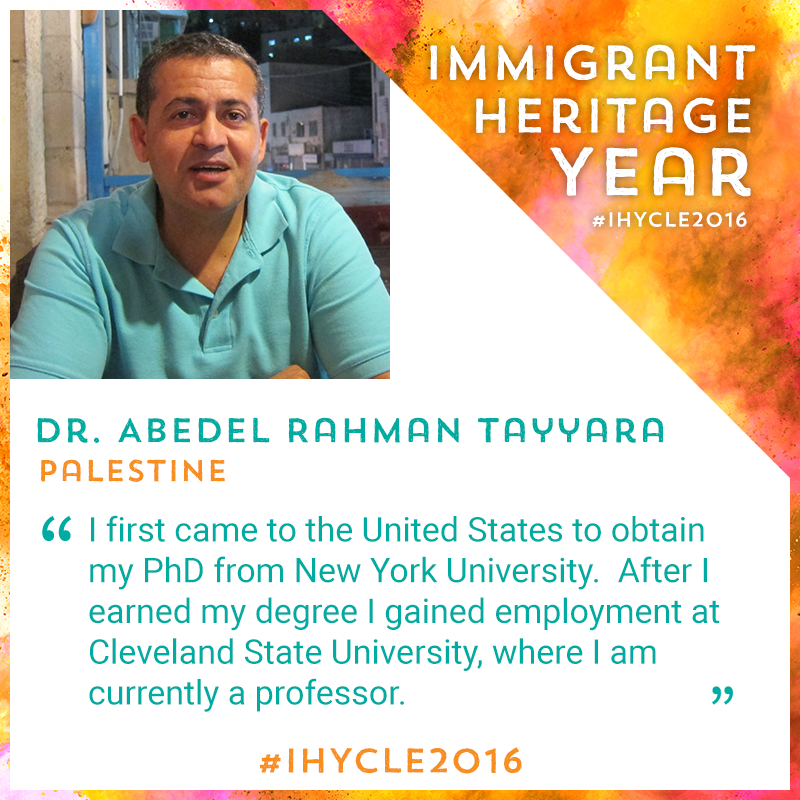
Dr. Abedel Rahman Tayyara
Where are you from?
I am from a small, Palestinian village in Israel called Kafr Qara. The name of my village means “village of pumpkin”.
What was it like growing up?
I enjoyed my childhood very much. My eight siblings and I grew up on our family’s farm. Our village did not get electricity until I was five years old, so my friends and I would play outside every day. We attended elementary school and high school in the village together.
What brought you to Cleveland?
I first came to the United States to obtain my PhD from New York University. After I earned my degree I gained employment at Cleveland State University, where I am currently a professor.
What were your first thoughts about coming to the US? Did those change?
I imagined myself going to Europe, but never to the United States. It seemed so far away. I was nervous to come to New York because of what I had seen in films. It seemed very fast paced and intimidating. Once I became more familiar with people and developed friendships, I became much more comfortable. I enjoy the individualist mindset that is so common in the United States.
What challenges did you face as an International Newcomer transitioning here?
When I first moved to New York, I found it challenging to adjust to the culture of individualism in the U.S. Life is very fast-paced here, and many decisions must be made on the spot. It was sometimes difficult to determine whether people acted a certain way because of their culture or because of their personality. I would also feel trapped many times. I was worried that I would not be able to return to my hometown, or that if I returned to my hometown, I would not be able to return to the United States. I tried to always remember to keep my passport and visas up to date, but I was still unable to return to my hometown when my parents passed.
I also struggled with the language, public transportation, and adjusting to the quick rhythm of life. I still struggle with Cleveland’s winters, which are too cold for my liking.
What is your occupation?
I am a professor at Cleveland State University.
How have other Clevelanders made you feel welcome?
Clevelanders would pitch in and help me out. When I didn’t have a car, people would give me rides. My neighbors would invite me to their houses for holidays, and they would invite my kids to come play with their kids.
What traditions do you continue to practice?
I continue to celebrate my family’s culture with my children on religious holidays. I also call each of my siblings on those days.
What do you love about Cleveland?
I enjoy the nature of Northeast Ohio. The lake, parks and rural areas are very accessible. Cleveland also offers a lot of culture for a city with such a low cost of living. The museums, theater and cultural events are all very affordable, especially compared to New York.
Why is it so important to welcome International Newcomers and Displaced Personss?
As a human, you have to help other humans in need. Displaced Personss face many unique challenges, and it is important to help them through the obstacles they face.
Why is it important to travel abroad?
When you travel abroad, you meet new people and new cultures. This enables you to look at yourself and your own culture from a new outlook. You see other people’s difficulties and become more humane. It enables you to educate other and to educate yourself. International travel challenges you and changes you in ways that broaden who you are as a person.