Visiting Cuba
Before visiting Cuba, I read three books on the rich history and almost the complete Lonely Planet guide to the island. Even with the prep and extensive experience in Latin American countries, Cuba surprised me. Cuba is like no other country and certainly a world away from Cleveland. Much of Cuba feels like walking onto a movie set of a different era. The history alone is fascinating but then; add to that, a sense walking into the past. Imagine living on a beautiful but decaying island that has only known isolation for a generation. The effects compacted over decades of stagnation is almost surreal to the average western visitor.
Visiting Cuba is much easier than most imagine. The trip is affordable and only a short flight and far more authentic (even the resorts) than the typical Cancun-like destinations. The beaches in Varadero are breathtakingly clear for as far as the eye can see. Even the sand is perfect and free of any waste or impurities. The city of Havana stands apart with the diverse mixture of architecture; everything from 15th century colonial structures to harsh uninviting Stalinist buildings scattered around the same geography. The neighborhood of Habana Vieja, is an UNESCO world Heritage site and has some of the most preserved Spanish Colonial architecture in Latin America. Yet, blocks away you can find El Capitolio, named and designed after the United States Capitol building in neo-classical style. Just one of the many structures remaining from a time when US and Cuban relations were normal.
The many dualities of Cuba are perhaps the most well-kept secrets on an island lead by one of the most private leaders in modern time. For example, there are two currencies in Cuba; the moneda nacional (MN24 = $1USD) is how Cubans are paid and is the government controlled economy. Then there is the convertible peso (CUC) which was introduced in 1994 and pegged to the USD as a currency for tourist and non-essential goods. There are modern resorts touting all the comforts of the first world but then around the corner there are kids playing barefoot in the street asking for food. Beautiful promenades and boulevards lavished in greenery a stone’s throw away from streets with trash piled high, rotting in the unrelenting heat.
Adding to the dichotomy, there are the connected and the disconnected with technology and the outside world. Cubans first got cell phones in 2009 after the ban was lifted in late 2008. The internet is still under a tight lock & key. Technically, the administration is correct, when they say that the internet is available to all. However, the real translation is that you will have to wait for an hour outside an internet café (since residences are not allowed to have internet), fill out a registration with identification; pay $3-5.00 per hour just to access the slowest broadband speed. Only a small few of locations in all of Havana had Wi-Fi (which was introduced in January, as in, only six months ago).
We think that the election and politics have consumed the media, NBA championship cities (not to name drop) and the airwaves here. In Cuba, politics are just as subversive in everyday life. From the communist propaganda peering down, watching you, from tall buildings to the quotes scribbled all over the bathroom stalls. Everywhere you look you can see the infiltration of government and politics.
While hitchhiking, riding in smushed and overcrowded buses, countless taxis (including those classic brightly colored Chevys from the 50’s) we talked to the locals while traveling the many landscapes of Cuba. Many had left their intended professions to join the tourism industry; the only foreseeable way to get ahead economically. We had teachers struggle up a hill with you in their rackety bike taxis, telling you of the harsh realities of Cuban life. Debated and talked politics with the informed populous and had the “your version and my version of history differ” moments with abuelas drinking tea late into the night. Listening to their stories of why they admire Fidel Castro. Long philosophical conversations comparing lifestyles, reforms and government structures with other tourists seeing the effects isolation of a country for the first time.
Life is improving, though at a painfully slow pace, since 2008 when Raúl Castro became the head of the government. There are no gangs, guns or drugs in Cuba. As two young females walking back to our casa particular we felt safe late at night. There was no question that the people respected the police posted at every other corner. While safety might not be an issue the economy still very much is. The median government salary is below $20 per month. This seemed surreal that the majority of Cubans are living on that wage while in Cleveland; a group is campaigning for a $15 per hour wage.
With all the ways Cuba surprised this Clevelander, it revealed something so familiar. Every country and culture is fascinating and worth exploring. Travelling teaches you something new about your world, however far away and different it might be. Travel to Cuba for the beautiful beaches, diverse architecture, and history lessons or maybe just for a fine Cohiba.
Samantha Peddicord has a certificate to teach Latin American Studies and a MA. in Humanities, International Studies. Also, she is now keenly aware that she no longer remembers how to read a map. #VIVAGPS

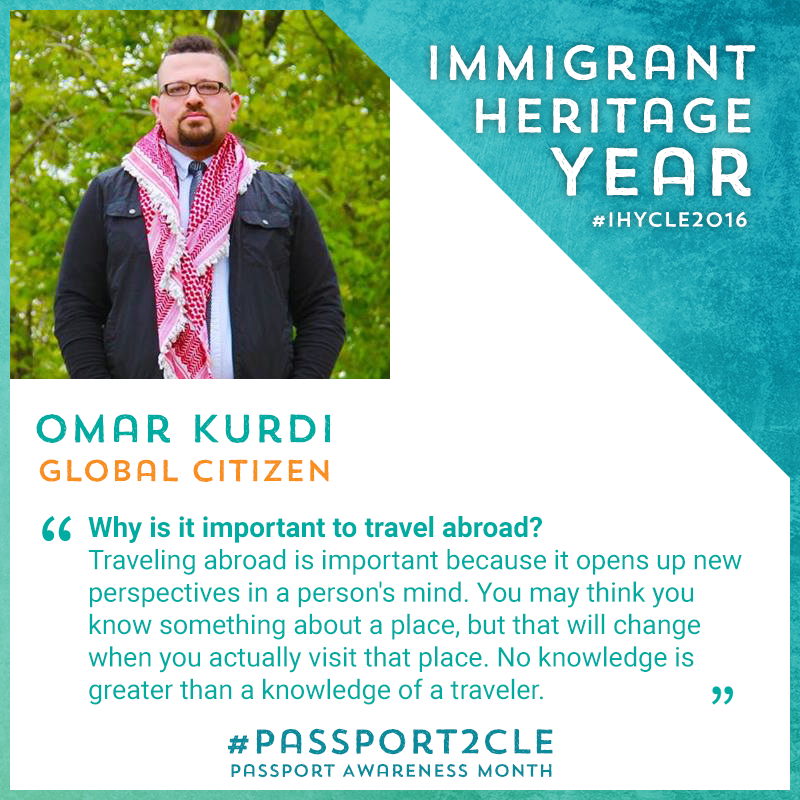
Omar Kurdi
Where are you from?
I am a very interesting mix of different backgrounds. I was born in San Francisco to Jordanian parents whom are one half Lebanese and half Kurdish, and one half Palestinian and half Jordanian. I grew up between Oman and Jordan, then moved to Cleveland in 2007.
What was it like growing up?
Growing up in the Middle East was an interesting experience. Everything there is family oriented and culturally rich. I felt the difference when I came to live in the US at the age of 16. I knew America from the movies I watched, and living in America turned out to be different.
What brought you to Cleveland?
My dad had already been living in Cleveland for few years before I moved here. My main purpose of moving to Cleveland from Jordan was to finish my senior year of high school and get a college degree then move back. I did all that except moving back. I do not see myself living anywhere else.
What were your first thoughts about coming to America? Did those change?
I was very excited and nervous at first. I had visited California in 1999 and 2000 but you know tourism visits are different than actually living here. I expected to get a lot of hate and racist remarks, but that never occurred. I always felt welcome since the first day I started high school here. It was hard for me as a high school senior to leave all my friends in Jordan and come to a whole new world. I expected to run to the mean football players in high school, but that did not happen. I expected to see segregation during lunch times in high school here, and that also did not happen.
What challenges did you face as an International Newcomer transitioning here?
I did not face many challenges as I thought I would. The biggest challenge though was accepting the cultural differences. Middle Eastern culture is a very different, rich, and unique culture. I wanted to assimilate here and adopt whatever I can to adopt to become the best citizen that I can be. It took me a while but again, the friends that I made here helped make this challenge a rewarding experience.
What is your occupation?
I am the Director of Operations for an Adult Day Services agency that works with individuals with developmental disabilities, a free lance Social and New Media strategist, and the co-founder of a new Non-Profit Community Organization called The DO Project which aims to do more good in our communities.
How have other Clevelanders made you feel welcomed?
I give credit to Cleveland though because this is where I actually grew up as a person. I gained most of my life experience in here. People in Cleveland made that transition very easy. I will never forget my world history teacher in high school who actually played a huge role in making me feel welcome. He always gave me time in class to explain things about my culture, and this allowed for productive conversations often. I will also not forget my Alma mater Cleveland State University, which helped form the person I am today. I got active on campus in CSU, and this allowed me to mingle with as many students as possible. The diversity of CSU's campus offered such a warm atmosphere for me and many other students. Moreover, being invited to Thanksgiving dinners is the best thing to make someone feel welcomed. I loved getting invites from Clevelanders to their homes for Thanksgiving. They made me feel like I'm at home, and the Thanksgiving culture grew on me to the point that it became one of my favorite holidays. Moreover, while being Muslim, I always got invitations to Christmas dinners. I loved attending those. Jordan is very known for it's coexistence culture, and I was always proud to share that with my friends here. I love how positively spirited everyone gets around Christmas. Clevelanders sharing their holidays with me always meant the world to me. It's one of many reasons why I love being a Clevelander.
What traditions or customs do you continue to practice?
I continue to celebrate our religious holidays in Islam such as Eid Al Fitr and Eid Al Adha. I fast during Ramadan every year as well. I also get to celebrate Mother's Day twice a year which is very interesting. Our Middle Eastern Mother's Day is March 21st, and the American one falls in May every year. I continue to celebrate both every year with my mother. She thinks she is very lucky for that.
What do you love about Cleveland?
I love the diversity, uniqueness, and the warmness of it's people.
Why is it so important to welcome International Newcomers and Displaced Personss?
It is very important because International Newcomers and Displaced Personss are people just like us. This amazing nation that we live in was built by International Newcomers, and continues to be the greatest nation because of International Newcomers working in it to make it so. People come to America to look for a new chance at life, and we owe it to them to give them this chance. Displaced Personss are fleeing disastrous situations in their countries, and we might be the one place to offer them that hope they need to continue living in peace. It is such a rewarding feeling to make a Displaced Persons feel welcome in a new place. This is why our first fundraiser for The DO Project is called #ClevelandForCleveland and it aims to collect donations to help Displaced Personss resettling in Cleveland, and our homeless community. This is our way to tell Displaced Personss that they're welcome here, and to also give back to our community.
Why is it important to travel abroad?
Traveling abroad is important because it opens up new perspectives in a person's mind. You may think you know something about a place, but that will change when you actually visit that place. No knowledge is greater than a knowledge of a traveler.

Global Cleveland + Tech Elevator Work Together to Bring Opportunities in Technology to International Newcomers in our Region
Stop by a Fall Open House to get Program Details!
With thousands of open technology jobs in Northeast Ohio, it’s more important than ever that we’re providing resources and accessibility to programs that upskill our workforce. Tech Elevator is Cleveland’s Coding Bootcamp teaching students how to code and get ahead in their career by providing resume and interview prep, mentor coaching and employer matchmaking.
If you’re unfulfilled in your career and considering a career in technology, stop by a Fall Open House to learn more. Open Houses are a great way for potential students to tour the space, meet instructors and ultimately decide if a coding bootcamp is right for them.
For more information visit : https://goo.gl/UHcKz1
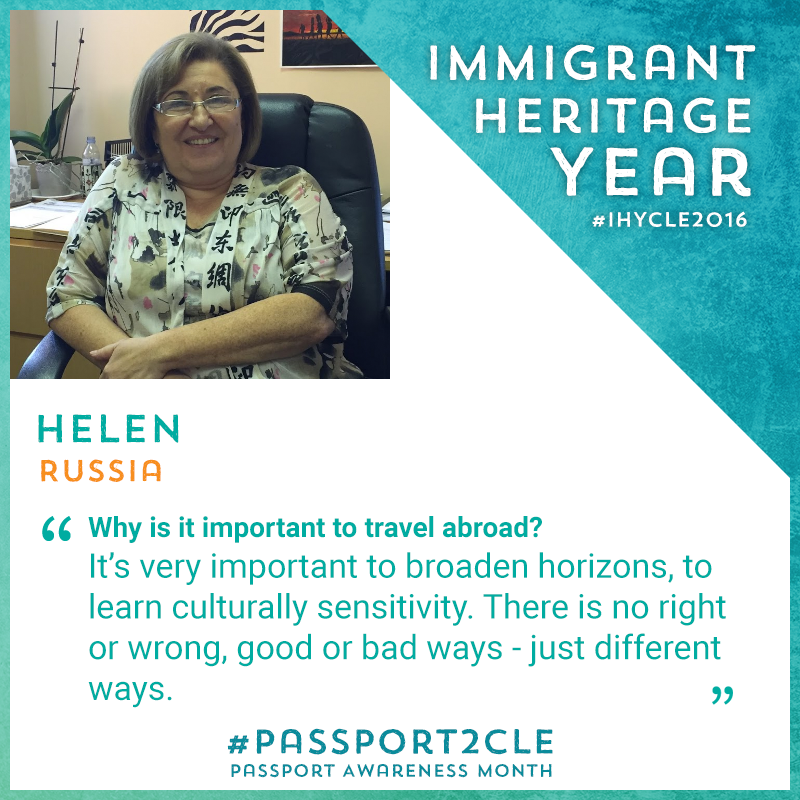
Helen
Where are you from?
Russia
What was it like growing up?
Good memories.
What brought you to Cleveland?
This is how the program works - they send you where your first degree relatives are. My husband’s relatives were in Cleveland (his father’s brother was here.). So the goal was family unification.
What were your first thoughts about coming to the U.S.? Did those change?
Coming from Moscow, I was expecting high rises everywhere. But everything was suburbia. So it was very different from how I pictured America in my mind. It was all two story buildings here! So it looks very different from where I grew up and was expecting. Also, the pace of life, dynamics; it was all very different. But I got used to it. I like it now. The lack of public transportation is very different - we didn’t drive there. Here you have to start driving, you can’t get anywhere without being able to drive! So I had to learn to drive. My mom had to learn, at 68 years old! It’s necessary for survival.
Overall it’s a far cry from what I imagined, but I got used to it. When I go to NYC, I love the urban atmosphere because it reminds me of my youth. But I get tired of it after 2 hours; it’s overwhelming because now I’m used to a different lifestyle.
What challenges did you face as an International Newcomer transitioning here?
Starting your life anew. It’s all of a sudden. You’re an adult but you’re learning to do simple things again, like a child. Everything is a challenge to learn the first time.
Also, we came as a big family - me and my parents and my husband’s parents. Everyone was elderly and going through medical problems, but our advantage was that us two spoke english. So we handled the medical appointments. On Sept 24 1994, a few days after we first arrived in the US, my father was scheduled for heart surgery.
What is your occupation?
Director of US Together Cleveland. I started working from resettlement right away - the second month I arrived. It’s actually pure coincidence because this is the same office as the Jewish Family Services! So it’s full circle.
How have other Clevelanders made you feel welcomed?
Because I started working right away, I made friends with everyone I work with. They are so supportive and friendly. People from my community, Americans - everyone was equally hospitable.
What traditions or customs do you continue to practice?
Oh yeah, of course. Food. It’s something that sticks with you - you eat the same way you have always eaten. And with globalization these days, everything is connected, so we can still watch Russian TV. And getting together and having tea, Russian style.
What do you love about Cleveland?
I would say it’s a very nice city. Not too overwhelming, the right size. There are ethnic communities, but also they are also exposed to the mainstream community. So there’s a little bit of everything. Some places are so compound that they don’t associate with others. Like in NYC, the Russian community is their own silo, having nothing to do with the rest of the country. But here it is a mix of cultures.
I also like cultural stuff you can do in Cleveland: orchestra, playhouse square, good medical institutions.
Why is it so important to welcome International Newcomers and Displaced Personss?
I don’t even question that - I think because I came here as a Displaced Persons, my obligation is to give back. There are lots of people in my community who don’t share those opinions. They’re very anti-International Newcomer and anti-Displaced Persons. But I don’t understand how you can be when you were an International Newcomer. This country opened doors for you but you can’t open them for others prob more unfortunate than you?
So it’s my way to give back to the community. It’s very healthy, it’s like having new blood into the old body very healthy for society.
Why is it important to travel abroad?
I think it’s changing a bit these days. When I compare the way that Americans looked at that 22 years ago when I first came, I think we kind of have travelled far from the status of things 22 years ago. At that time, people couldn’t think that there are other ways to do things, behave. Today, people are more culturally sensitive. They understand that not everyone does things the same way. At that time, I was struck that Americans think the only way to do things is America’s. So it’s very important to broaden horizons, to learn culturally sensitivity. There is no right or wrong, good or bad ways - just different ways.
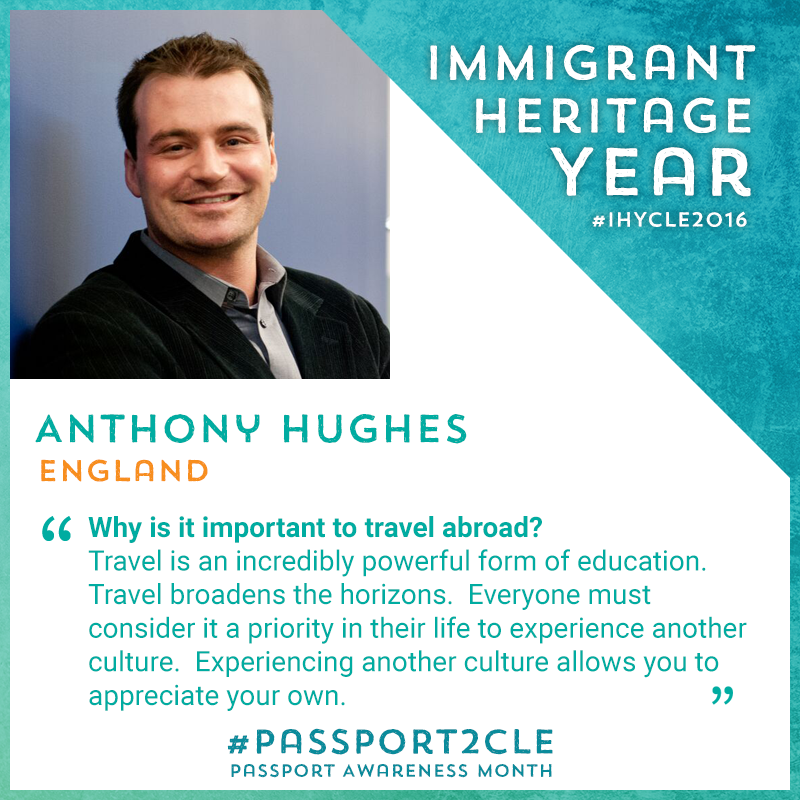
Anthony Hughes
Where are you from?
I am from England.
What was it like growing up?
I had a very pleasant childhood in England. I am not one of the International Newcomers who had to fight through a warzone to get here. It was an idyllic English childhood.
What brought you to Cleveland?
I am half American. My mother is from Milwaukee, Wisconsin. My parents divorced when I was young and I would spend my summers in Milwaukee by lake Michigan. I love the States and always imagined that I would live in this country. I studied American Studies in college to better understand the country I loved. I worked in the UK for a few years after graduating from college. I had originally wanted to work in Television and I came to Cleveland when I got a job here with the CBS affiliate. I never intended to stay in Cleveland, but ended up falling in love with a local girl and with city as well.
What were your first thoughts about coming to the US? Did those change?
My first thoughts were that this is the land of opportunity and a truly meritocratic country. I am proud of my English heritage, but England is a country entwined with tradition and social hierarchy. I had a perception from the outside that America would be completely mediocratic. I was surprised to find out that this was not true, and that some of the frustrating social hierarchies I had tried to leave exist in similar but different forms here too.
On a more positive note I was also surprised by how interested and welcoming people were towards me. They were interested in my backgrounds and experiences, frequently asking me why I moved to Cleveland. I have been very warmly embraced here.
What challenges did you face as an International Newcomer transitioning here?
I don’t know that I faced an enormous amount of challenges. I didn’t have to learn a new language. If anything, my English accent worked in my favor. One of the things I found initially challenging is that Cleveland is a big small-town. Everyone in Cleveland knows one another. This made it challenging to become part of the community’s fabric because people already had close relationships with one another. It also took me a while to open up to Cleveland. My affection for Cleveland has been a slow burn. You don’t initially understand what makes Cleveland unique. It takes time to really appreciate all the Cleveland has to offer. The Cleveland I knew when I first came here in 2004 is very different than the Cleveland of today. There is a sense of place that exists in Cleveland in 2016 that did not exist in 2004. We have so many ethnic and cultural groups in Cleveland. These components are what makes Cleveland fantastic. Very few cities have the authenticity that can be found in Cleveland.
What is your occupation?
I am the Co-founder and CEO of a company of Tech Elevator. We are a technical training program that teaches novices to become software developers to capitalize on the thousands of open jobs in this region and beyond.
How have other Clevelanders made you feel welcome?
I have been very involved in the start-up scene. Amongst entrepreneurs, there is a real sense that we have the power to change the balance of the city. There is a comradery and respect among the community of entrepreneurs of Cleveland. For many years, people considered Cleveland to be a has-been town whose glory days were long gone. Entrepreneurs have the energy and ability energy to breathe new life into this city. We feel that the best days of Cleveland are ahead of us, not behind us. We believe we can reinvent this city. At Tech Elevator we are producing the workers of the future, fueling what the city’s businesses need to grow. I gain intense gratification from participating in the entrepreneurial community.
What traditions or customs do you continue to practice?
OK so here comes the stereotype: I really enjoy tea. With a nod to that, at Tech Elevator we have lots of free tea. I grew up with many American traditions because of my mother, so I feel very familiar with all we have here. My favorite are the fall traditions, picking pumpkins and cooking a huge thanksgiving feast.
I enjoy debating politics. It is a European tradition to discuss these topics, but I’ve found this is sometimes perceived to be inappropriate in the US. I’ve been pinched under the dinner table once or twice for pushing a contentious issue. Unfortunately I have found that in the US, when you question someone’s ideas, it can be construed that you question them as a person. This is not the case in England. We can leave a heated political or religious debate as friends.
What do you love about Cleveland?
I love the energy that we have right now. There is something very special happening in Cleveland and it didn’t happen by accident. It is not the result of one person, but the result of hundreds of people carrying out their unique rolls. We are experiencing an incredibly special moment in time where things are coming together. Cleveland is finally catching the break it deserves. These are meaningful things that enact real change, not just transient things like sports championships (though they help!).
I love the authenticity of Cleveland that can’t be recreated in places like Salt Lake City, Phoenix or Vegas. Its manufacturing history gives its businesses today meaningful roots. These buildings are being given new life by the companies coming into them. Clevelanders have a great work ethic. They have a work hard, play hard work ethic. They are grounded and real. You can have meaningful relationships here.
Why is it so important to welcome International Newcomers and Displaced Personss?
It’s always surprising to be asked this question. It’s like we have the memory of a goldfish. We forget that this country was built by International Newcomers and Displaced Personss who were willing to risk everything to come here. The success of this nation is almost entirely owed to the success and determination of those who, at different times in history, were willing to move to an entirely new world. That gumption, drive, determination, has formed the genetic makeup of this nation. We need to continue to embrace that. The drive of these individuals continues to impress me. The way in which they view things provides a diversity of experience. I believe the opportunities of Migration far, far outweigh the risks.
Why is it important to travel abroad?
Travel is an incredibly powerful form of education. Travel broadens the horizons. Everyone must consider it a priority in their life to experience another culture. Experiencing another culture allows you to appreciate your own. Traveling makes me feel alive in a way that few other things do. We get into routines in life where we perform the same tasks. We fall into ruts of the expected norm. Before you know it, the baby you just had is now graduating high school and nothing has really changed substantially in life. Travel punctuates time in life. It enables you to see things you have never seen before in your life. You’ll eat food you have never tried before, hear sounds and smell things that are completely new. You’ll hear about a tradition or philosophy you have never heard of before that open your eyes. Travel gives you moments of rapid growth, it expands your mind. There’s a caveat: you won’t get the benefit if sleep at an American hotel and eat American food, or spend all your vacation on a cruise ship. There’s nothing wrong with the relaxation, but for you to really get the benefit of travel, you have to put feet on the ground, get off the beaten path and really experience the new culture.
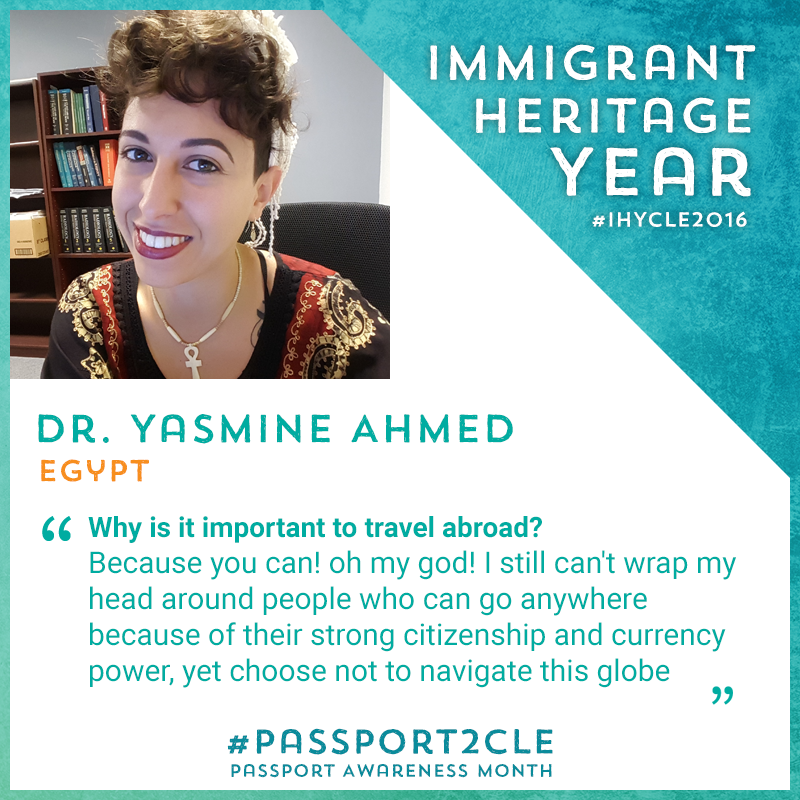
Dr. Yasmine Ahmed
Where are you from?
Cairo, Egypt
What was it like growing up?
It was ok until the time came to go to college. I was different than my female peers in med school, always wearing khakis, cursing out loud, hanging with the dudes, I couldn't make any female friends. I was one of the bros, but the bros still talked about me behind my back because I was "weird"... not wife material, if you will.
What brought you to Cleveland?
When I turned 25, I dropped my faith entirely, I was born a muslim. I also finally discovered what my sexuality and orientation were. It has been a process ever since, to unlearn social norms and discover my true nature and preferences. My identity is Queer, my sexuality is lesbian, I am also ethically non-monogamous, what is more commonly known as poly-amorous. I came to the USA seeking asylum for fear of persecution. The majority of the country believe in the death penalty for "infidels/heretics", or simply those who leave their faith. Choosing Cleveland was not premeditated, mostly. I came here with my husband, boy friend at the time, also an atheist, who always had plans to move out of Egypt. We met in the school of Medicine, he's a class older. I proposed to his hand in marriage (that's unusual), I wanted to leave too. We are still in a relationship, you could say, we are life partners. He's my best friend and the only family I've got here, well, besides my 5 months old puppy.
What were your first thoughts about coming to the United States of America? Did those change?
My idea of the USA definitely has changed dramatically after moving here. I had this notion that it was very progressive, liberal, and.. that it looked just like in the movies, lol. The north was pretty much New York or Chicago, and that the south was California. Cleveland was a bit surprising. I didn't like it in the beginning. It was cold, we were alone, and coming from a city that never sleeps (Cairo), it was a disappointment. Today, I love this city. It's affordable, cozy and peaceful. I made friends, I make good money, spend less than most other states to lead a decent life, and that proved to be an excellent quality for International Newcomers like myself.
What challenges did you face as an International Newcomer transitioning here?
Public transportation sucked! In particular spots, like university circle, you have to depend on super markets for grocery shopping like Constantino's, and it's ridiculously expensive, but it's the only one within walking distance..
What is your occupation?
I'm a clinical researcher in the university hospitals, case medical center, in the department of radiology.
How have other Clevelanders made you feel welcomed?
I'm very fluent in English, you can barely notice an accent, which was sometimes problematic. Initially, when I worked at a bakery before I found the position I hold now, co-workers used to forget I'm an expat, and wouldn't explain their jokes or comments, or they would expect me to be aware of the entire American Slang vocabulary, it's still annoying to be honest. Then, I always felt alienated because I never got the cultural references. It took me 3.5 years to finally catch up with those references, thank God for netflix, and now I'm finally making friends with confidence.
What traditions or customs do you continue to practice?
I belly dance, I play the hand drums, I cook Egyptian food, I attend middle eastern live music performances. Other than that, I'm very conscious of "traditions" and "customs" ... they remind me of oppression I faced when I was in Egypt.
What do you love about Cleveland?
I can be free here, I can be me here. I used to get cat called, and made fun of for my peculiar taste in fashion (here in cleveland!), but I no longer give a damn. I didnt’ cross oceans to hold back now, you know.
Why is it so important to welcome International Newcomers and Displaced Personss?
Because diversity is beautiful. It makes humans recognize how similar they are, and develop compassion as they do. And more importantly, realize their privilege... The American passport is a privilege that most Americans I've met are not aware of.
Why is it important to travel abroad?
A) Because you can! oh my god! I still can't wrap my head around people who can go anywhere because of their strong citizenship and currency power, yet choose not to navigate this globe...for real...why?? I haven't been able to see my family in 4 years because they have been consistently getting rejected a USA visa. Why? They were just born in the wrong place, at the wrong time...that's all.
B) Food! Try new cuisines.
C) Landscapes :D
D) It has been proven to make you more intelligent. So, pack up, and just go my American friends, just do it.
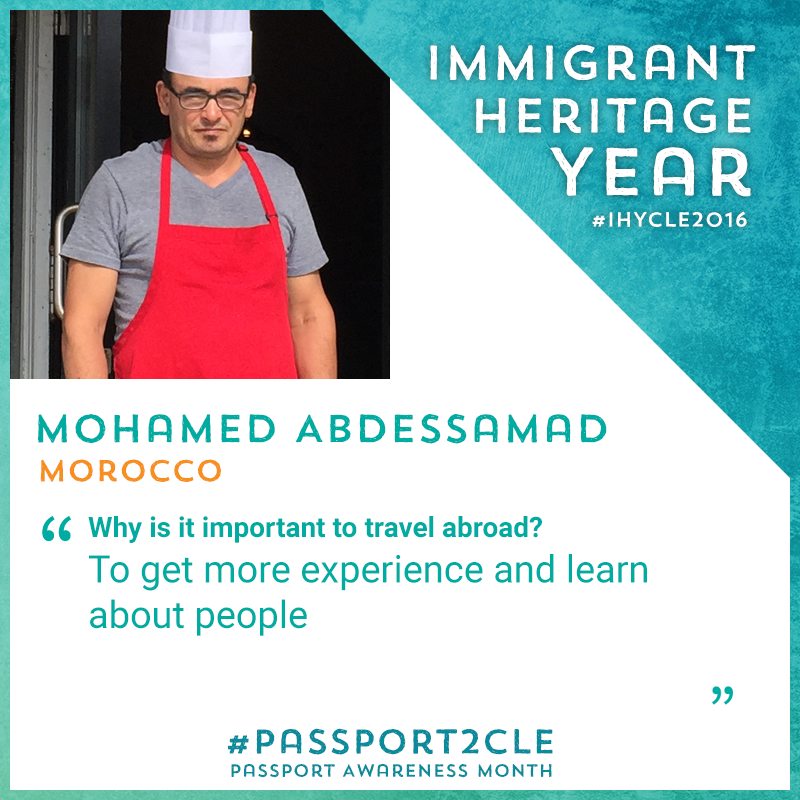
Mohamed Abdessamad
Where are you from?
I was born in Morocco, then I went to France, then Germany then to Russia former Soviet Union for 7 years. I got my degrees there and those years gave me the opportunity and the chance to travel all over central Asia – and Europe- and that’s where I learned cooking.
What is your occupation?
Owner and Chef of MoMo’s Kebab
What brought you to Cleveland?
I came to Cleveland from Washington DC to open a small business. I came in Sept. 1990 to visit my friends then I went to school to learn English in DC and decided to stay. I’m a former teacher I use to teach foreign languages in Europe and when I first came to the states. I worked in restaurants part time. But my dream was also to open a business but that was too hard in DC. I came to Cleveland because I came to a wedding here and I liked the weather so I said this would be nice.
What were your first thoughts on coming to the United States?
My first thoughts, I was not even thinking about coming here. I wanted to finish my PHD in France but my friends convinced me and I said America is too far and it’s too expensive. They told me I didn’t need a hotel I could stay with them and that America was nice. It wasn’t hard to get here academically. So I came I thought it was interesting, I learned English and I learned the society. That made me stay. Every year there is change there is something new. Going back to Morocco would be hard to find a job.
It was my dream to be successful in life. The 80’s in Morocco were very tough for my generation. I moved to Europe to finish my school and I got 2 degrees in linguistics and education.
What challenges did you face as an International Newcomer transitioning here?
My challenge in DC was English my challenge in Cleveland was the economy - in 2008 it was bad. Financially it was hard so it made me feel like I made the wrong move. Then things started changing and then I started looking for a place to open my business. That was in 2015 but I started working on it in 2014. I also bought a house so it took some time. It was a good and bad experience – I reached my goal but it was very hard to deal with the bureaucrats and banks. It took me 6 months to find a loan. They looked at me like I was different, now I’m looking for something bigger.
What customs or traditions do you continue to practice?
Except holidays nothing big.
What do you love about Cleveland?
People in Cleveland are friendly. I love the weather, I don’t care about winter but this weather here where can you find it. Winter is only here for 3 or 4 months.
Why is it important to welcome International Newcomers and Displaced Personss?
If they are good people it’s nice to get their work ethic and their talent to the contribute to the economy and community in Cleveland. It’s universal. Everyone practices his or her customs at home but in the streets we are all the same. It’s the history of the United States, it’s the only place you can see so many faces and looks. You can eat different foods. In Morocco we don’t have Japanese or Chinese cuisines. Only here in America can you have all that.
Why is it important to travel abroad?
To get more experience and learn about people
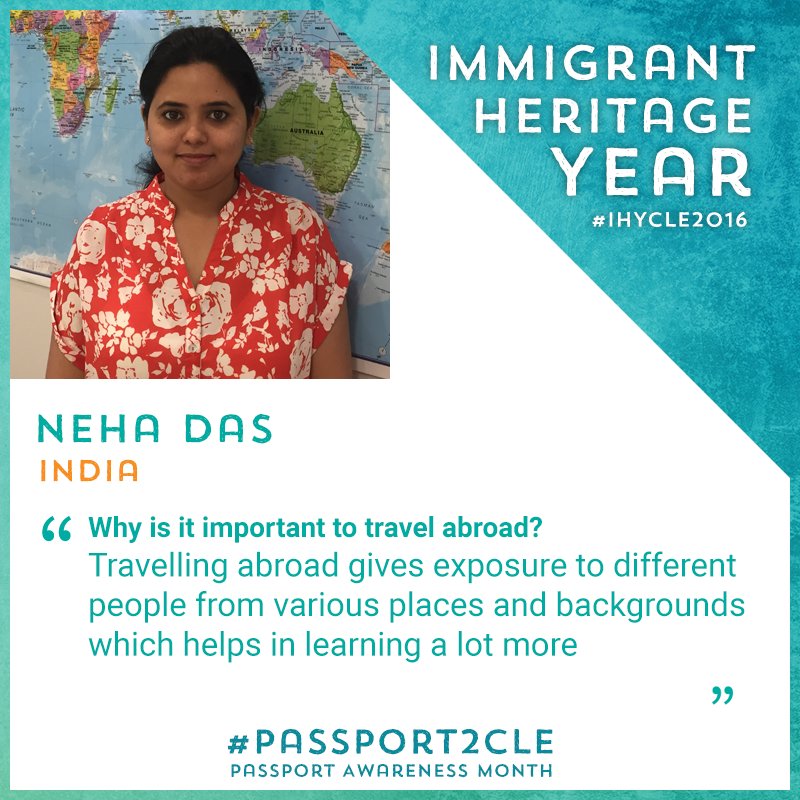
Neha Das
Where are you from?
I am from the city of Kolkata in India
What was it like growing up?
Growing up in India has given me the opportunity to get acquainted with diverse culture. Listening to Rabindranath Tagore’s songs, reading his novels, acting on Shakespeare’s plays, hearing tales about Ramayana and Mahabharata from grandma and celebrating Christmas are some of the memorable events I can think of. I have studied in a missionary school with friends from diverse cultures and backgrounds. I lived with my family who has always been very loving and caring,
What brought you to Cleveland?
I got admission in the Engineering and Management program in Case Western Reserve University which brought me to Cleveland. After coming to Cleveland, I got familiar with the place and the people here. Quite contrasting to the busy city of India, I found Cleveland to be very peaceful. Cleveland people are very welcoming too. Interaction with my friends, professors and most importantly, Global Cleveland makes me feel that every single time I meet them.
What were your first thoughts about coming to America? Did those change?
My first thoughts about America are that it is a welcoming. It did not change at all.
What challenges did you face as an International Newcomer transitioning here?
No critical challenges faced as Cleveland has been extremely welcoming and friendly. I am positive that I will have similar experience going forward.
What is your occupation?
I am currently a graduate student pursuing Masters in Engineering and Management in Case Western Reserve University. I have worked in an I.T Consultancy firm, TATA CONSULTANCY SERVICES, for almost 4 years till May 2016
How have other Clevelanders made you feel welcomed?
They make me feel comfortable and friendly. I never feel that I have come from a different place. Even the people whom I don’t know in Cleveland and meet on my way give friendly smile and at times engages in warm welcoming conversations. I really like this and feel welcomed.
What traditions or customs do you continue to practice?
I do practice most of them like celebrating the occasions I used to do in India.
What do you love about Cleveland?
I love the place and the people who are very warm and welcoming. I have been to some of the places like Lake Erie, Downtown and the museum which I thoroughly enjoyed. Apart from the superficial beauty, loving people makes Cleveland even more attractive place due to which I decided to stay back in Cleveland.
Why is it so important to welcome International Newcomers and Displaced Personss?
It helps in building trust and love which I feel are the most important aspects that helps in binding a nation.
What suggestions do you have to make Cleveland a more welcoming community?
I feel they are already very welcoming. As I am a great foodie, I would like to suggest of some more multi-cuisine restaurants !!
Why is it important to travel abroad?
Travelling abroad gives exposure to different people from various places and backgrounds which helps in learning a lot more
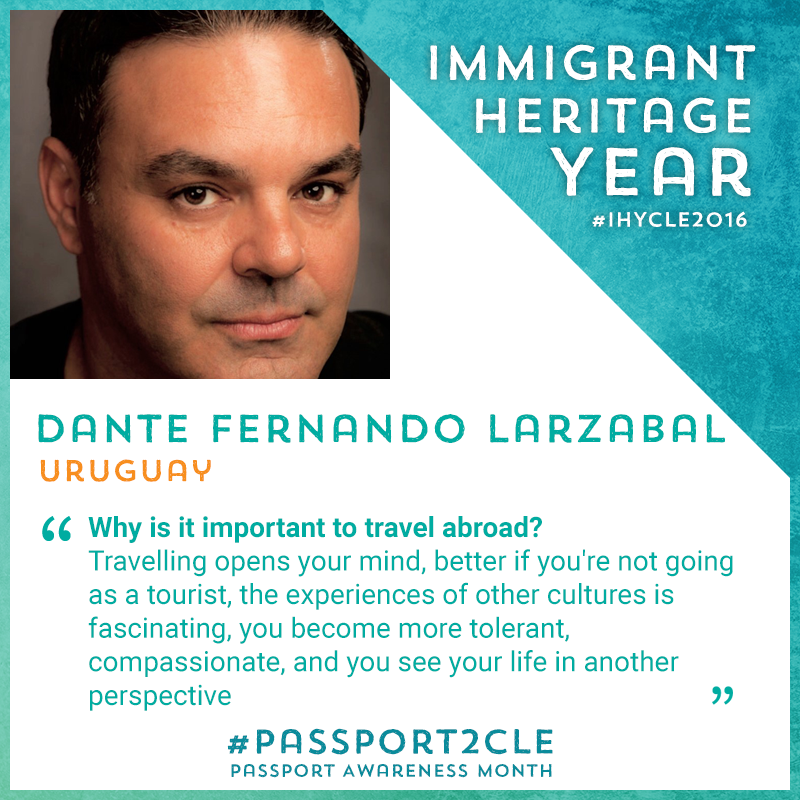
Dante Fernando Larzabal
Where are you from?
I'm from Uruguay, Las Piedras city, 20 km from the capital Montevideo
What was it like growing up?
I went to primary school and high school always in the same private Catholic College that is why I have the same friends since I was 5 years old until today,despite of the fact I am living far, I have very good memories of my childhood and adolescence life
What brought you to Cleveland?
In 2002 the economy broke in Uruguay and 200,000 Uruguayans emigrated to different parts of the world, I had my uncles and cousins living here in Cleveland
What were your first thoughts about coming to America? Did those change?
In Latin America there is the idea that life in USA is easy, but when you arrive here you can see the reality and of course there are more opportunities but not all is gold color.
What challenges did you face as an International Newcomer transitioning here?
The language and weather (winter time) but I have adapted myself very fast to the lifestyle here
What is your occupation?
I have a small landscaping company but my "true" profession is an actor and theater director I have the wonderful opportunity to work as such when Cleveland Public Theater opened the doors of the theater to Latin artists.
How have other Clevelanders made you feel welcomed?
The people in Cleveland are very pleasant and curious in a good way, but after I meet "Teatro Publico de Cleveland "everything is better
What traditions or customs do you continue to practice?
Big barbecues!! (with Uruguayan meat) with families and friends
What do you love about Cleveland?
I love Cleveland as a city to live, the culture, the art movement, and go to rehearse at the Cleveland public theater
Why is it so important to welcome International Newcomers and Displaced Personss?
Since there is a human being there are migratory flows, from the second world war is the economy and displaced by wars that created this modern Migration, there is nothing better than help, the respect and equal treatment for which comes from other lands, that makes a strong community.
What suggestions do you have to make Cleveland a more welcoming community?
Put more money for activities integrating different cultures, Cleveland Public Theater is an example forming the Teatro publico de Cleveland and that mean greater integration of Latino to the community.
Why is it important to travel abroad?
Travelling opens your mind, better if you're not going as a tourist, the experiences of other cultures is fascinating, you become more tolerant, compassionate, and you see your life in another perspective
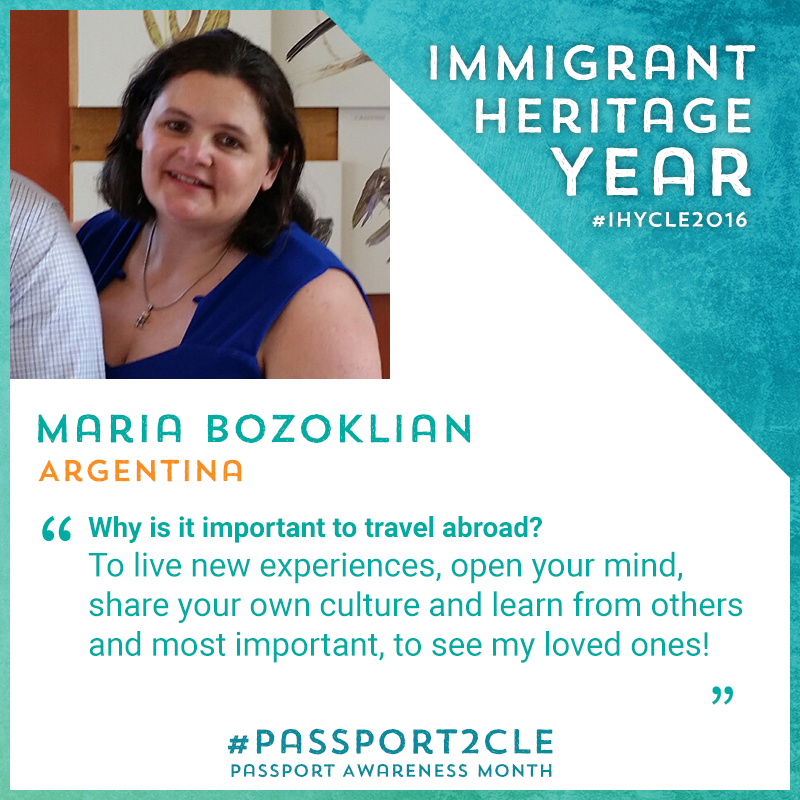
Maria Bozoklian
Where are you from?
Buenos Aires, Argentina
What was it like growing up?
Family reunions, awesome time with my siblings, disagreement with my mom, several friends, going to college, working but never seen progress or the ability to save money for a near future.
What brought you to Cleveland?
I was dating my husband who born in Cleveland but grew up in Argentina and we decided to move to the USA looking for better employment opportunities and to build our future, progressing and improving (it was hard to achieve those goals living in Argentina at that time, from our own experiences)
What were your first thoughts about coming to the United States of America? Did those change?
Opportunities for growth, better employment, extensive training and classes, open doors.
We were able to achieve all those expectations and even more.
What challenges did you face as an International Newcomer transitioning here?
The need to change careers based on the language limitations.
What is your occupation?
I am current a Bilingual Retention Specialist and also an Interpreter and Translator. But I studied Journalism in Argentina.
How have other Clevelanders made you feel welcomed?
Opening several doors, providing resources, employment, training and most important friendship.
What traditions or customs do you continue to practice?
Keep getting together with Argentinos en Cleveland to share our own experiences, and to keep our traditions and Spanish language alive. Example of cool traditions: drink mate, kissing each other, speak loud.
What do you love about Cleveland?
It's a quiet city that at the same time is growing but we love the peace, security and beauty of Cleveland.
Why is it so important to welcome International Newcomers and Displaced Personss?
Because all of us bring something unique that makes this country beautiful and diverse.
Why is it important to travel abroad?
To live new experiences, open your mind, share your own culture and learn from others and most important, to see my loved ones!
Maria Paula Bozoklian was born in Buenos Aires, Argentina and moved to Cleveland in December 2000. She has been named Ambassador for Argentines in Cleveland by Cleveland People. She is the co founder of the Yahoo group called Argentinos en Cleveland. She also created the Facebook group with the same name that has more than 135 members. Maria has organized events to reunite people from Argentina since moving to the USA.
She was a journalist in Argentina and worked in different newspapers and local radios for six years. Since coming to the US she changed careers and for the last 15 years she has assisted people in obtaining employment, providing training and coaching.
She is currently a Bilingual Retention Specialist at El Barrio/ The Centers for Families and Children. She is working there since 2010. Before that opportunity, Maria was an Employment and Training Coordinator at Catholic Charities Services for almost six years. She is fluent in Spanish and English and two years ago, she graduated from the Hispanic Alliance Leadership Development Initiative program (HALDI). She is also a former Secretary Board Member of Young Latino Network, an organization that empowers the Latino community through leadership development and civic engagement.
She received the Workforce and Economic Development Award at the Hispanic Convention 2013 and she is also a Heart, Hands and Hope Award recipient from Catholic Charities. Working as Bilingual Poll Worker, she also received an Excellence in Service Award from Cuyahoga County Board of Elections.
Maria is married to a Cleveland born but raised in Argentina gentleman named John Richard Bozoklian. She moved to the US looking for better opportunities and to explore a new life with her husband. They are blessed with their first baby after being married for 15 years: Landon John Bozoklian born last April 2016.
When she decided to move to Cleveland, it was not easy to leave her family and friends but she is grateful to this country which welcomed them with new opportunities of growth.