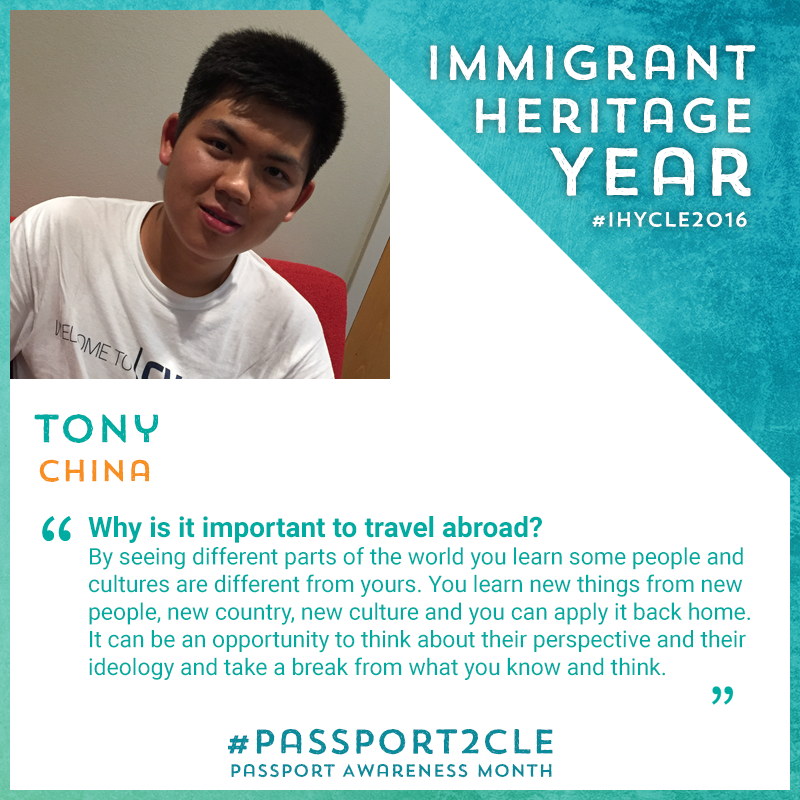
Tony
Where are you from?
China
What was it like growing up in China?
Growing up in China was very cool it was fantastic. Chinese people are very conservative.
How did you decide to attend a University outside of your native country?
I wanted to see something different from my country. I wanted to experience something new. It was an accident I ended up in the USA and at Case Western Reserve University. At first I planned to just go to school abroad in Canada or Germany, I applied at different schools and got admitted to Case. But I’m excited to be here.
What were your first thoughts about coming to the United States? Did those change?
The US is like where I’m from so the city is different like some areas developed and some not so much. You can experience a lot here like I have experienced at home. All the liquid you drink here in the USA is iced/cold pop and water- but at home we drink everything room temperature.
Did you face any challenges transitioning here?
I’m experiencing that people talk fast and some have idioms that I don’t quite get yet.
What traditions or customs do you continue to practice?
In a group of people I will observe everyone first then address my point and that’s Chinese tradition. We speak last when we don’t really know the environment.
Why should we welcome International Newcomers and Displaced Personss?
International people bring money so they contribute to the American economy.
Why should you travel abroad?
By seeing different parts of the world you learn some people and cultures are different from yours. You learn new things from new people, new country, new culture and you can apply it back home. It can be an opportunity to think about their perspective and their ideology and take a break from what you know and think.

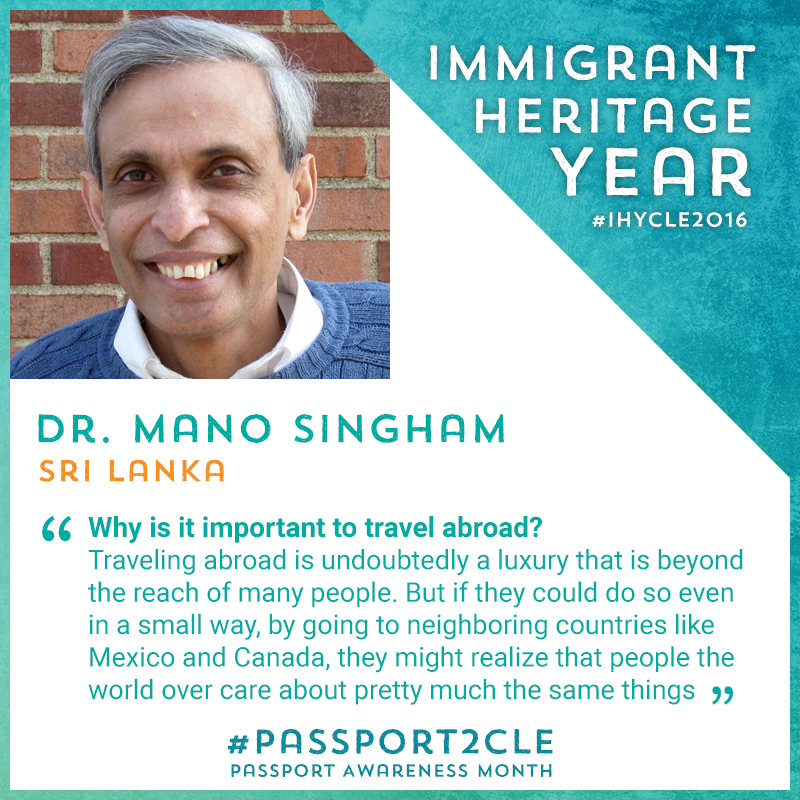
Dr. Mano Singham
Where are you from?
Sri Lanka
What was it like growing up?
There are many obvious differences between Sri Lanka and the US. Sri Lanka is a small, multi-ethnic, multi-religious tropical island in which Christians are a small minority, behind Buddhists, Hindus, and Muslims. While it is not a wealthy country, it does provide free education through university and free healthcare to all. I had a pretty ordinary middle class life, not that different from a life that someone with a similar socio-economic status in the US might have had.
What brought you to Cleveland?
My wife got a job here and so we came here in 1988 with our two daughters after having spent five years in other parts of the country.
What were your first thoughts about coming to the United States of America? Did those change?
I actually came to the US twice. The first time I was excited to come since it was to do doctoral studies in physics in the US and the US is a leader in higher education and science research. My wife-to-be arrived from Sri Lanka two years later to also pursue doctoral studies and we got married in the US. After my wife and I got our doctorates, we returned to Sri Lanka to live and work there. But the civil war that broke out in 1983 made it dangerous for people of my ethnicity (I am a member of a minority group) and so we decided to come back to the US with our older daughter who was then a newborn. Clearly the second arrival was under much sadder circumstances than the first and we arrived with considerable apprehension and facing an uncertain future.
What challenges did you face as an International Newcomer transitioning here?
Since we could speak English, are familiar with western culture, and worked in universities and research labs and other scientific environments that have quite a few visitors and International Newcomers from other countries, I cannot say that we faced many challenges. In fact, except for some very few and minor instances, we have been welcomed and treated cordially by everyone.
What is your occupation?
I am a physicist and educator.
How have other Clevelanders made you feel welcomed?
Mainly by treating me as if I belonged here. From the time we moved here to Shaker Heights, people have treated us as if it was perfectly natural for us to be here and not being treated as a foreigner is an important part of feeling welcomed. Shaker has a diverse population and our family feels like we are an integral part of the fabric of the community.
What traditions or customs do you continue to practice?
Apart from often eating food that in native to Sri Lanka, we do not practice any customs and traditions that date back to our lives in Sri Lanka. This is also partly because many customs are associated with religions and since my wife and I grew up in Christian families, we do not practice things that are associated with other religions.
What do you love about Cleveland?
It has been a very good place for us to live and work and bring up children. It has the benefits of being a city without being too big. I have found the people to be friendly.
Why is it so important to welcome International Newcomers and Displaced Personss?
I think that they add a richness and diversity to people's experiences and help remove the kind of insular thinking that can lead to tribalistic behavior. I am sometimes disturbed by what I see in the media where people seem to be so frightened by the presence of others who are not like them. Coming into daily contact with people from many different nations and backgrounds will, I hope, help to remove some of that fear and hostility.
Why is it important to travel abroad?
Traveling abroad is undoubtedly a luxury that is beyond the reach of many people. But if they could do so even in a small way, by going to neighboring countries like Mexico and Canada, they might realize that people the world over care about pretty much the same things such as making a living, taking care of their families, enjoying the company of friends, contributing to society, and things like that. This is easy to forget when the media bombards us with the differences among us. People might also learn that some other countries actually do some things better than the US, such as providing better health, education, and social services to all their people.
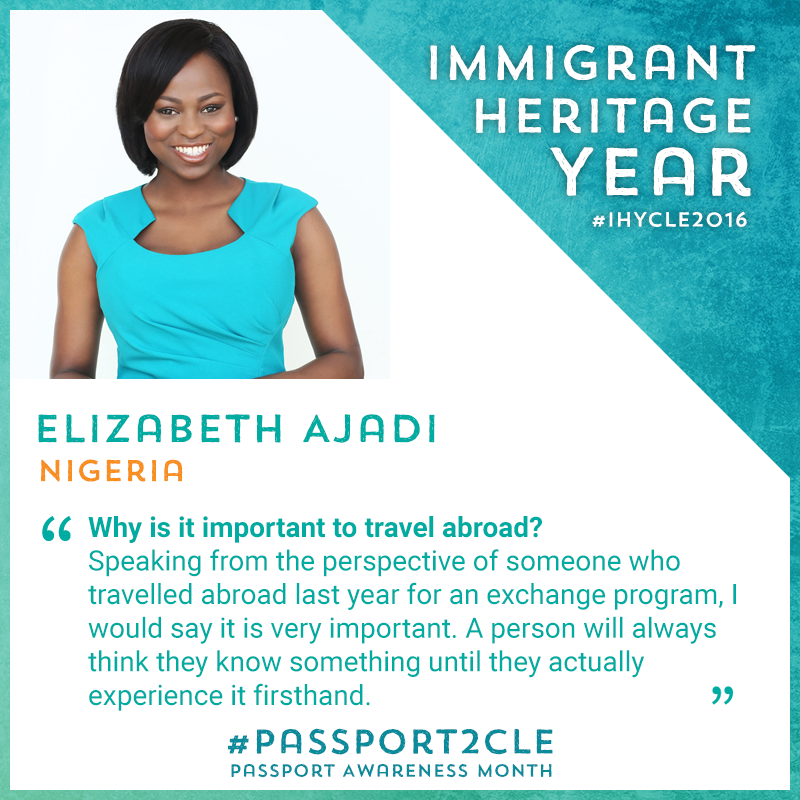
Elizabeth Ajadi
DID YOU GROW UP OUTSIDE THE US? IF SO, WHAT WAS IT LIKE GROWING UP IN YOUR NATIVE COUNTRY?
Yes, I did. I grew up in Nigeria and the lifestyle is very different from here. It is more carefree and even though it wasn’t always comfortable, it was home and that feeling is not overrated.
HOW DID YOU DECIDE TO ATTEND A UNIVERSITY OUTSIDE OF YOUR NATIVE COUNTRY?
It was my father’s idea. I had trouble gaining admission into the University back in Nigeria, it is very competitive to get into state and federal funded universities because they are inexpensive and private universities are very expensive. When my my father saved enough, I started at a private university but when my visa application fell through a year later, I transferred here.
WHAT WERE YOUR FIRST THOUGHTS ABOUT COMING TO THE UNITED STATES? DID THOSE CHANGE?
OMG!!! I was ecstatic. It was my first visa ever and getting the visa is the most difficult ordeal. I had high hopes and expectations but those quickly changed when I set foot in New York and I saw how the subway looked - the grime and dirt of the streets. I thought to myself, this is no better than my Ibadan and the streets are not lined with gold...lol. However, when I arrived in Cleveland, that perception changed slightly and I have since realized that though it is the land of opportunities it is professed to be, you have to fight for what you get just as it it back in my home country.
DID YOU FACE ANY CHALLENGES TRANSITIONING TO THE U.S, OR TO CLEVELAND?
Changing how I spoke and wrote English. I still have to correct my spelling of honor vs honour, or labor vs labour every time. The most difficult transition however was understanding that being black was actually an issue. I never saw racism as a thing, tribalism - yes but issues with color was never an issue because I understood the biological reason why we are different and I embraced that but like I tell people “I never felt black until I came to America."
WHAT TRADITIONS OR CUSTOMS DO YOU CONTINUE TO PRACTICE?
Speaking my language every chance I get, wearing my traditional attires on special occasions - it’s a big thing back home.
WHY IS IT IMPORTANT TO WELCOME International NewcomerS AND Displaced PersonsS?
Asides from the fact that this is a country built on International Newcomers - the melting pot its called. I believe every country should welcome International Newcomers and Displaced Personss because that is the meaning of globalization. Besides we thrive from learning from one another and what goes around comes around.
WHY IS IT IMPORTANT TO TRAVEL ABROAD?
Speaking from the perspective of someone who travelled abroad last year for an exchange program, I would say it is very important. A person will always think they know something until they actually experience it firsthand. I met someone during my study abroad program and the entire time she knew me, she always thought I was tanned (she didn’t know I was naturally black). She was so shocked that she lost her sense of coherent speech when she saw me dressing up one day. When she was finally able to talk, she asked how I tanned my entire body without getting tan lines, it was my turn to loose my train of thoughts because I didn't even know where to begin. I then explained that I was black because I had a lot of melanin. It was quite an educating experience.
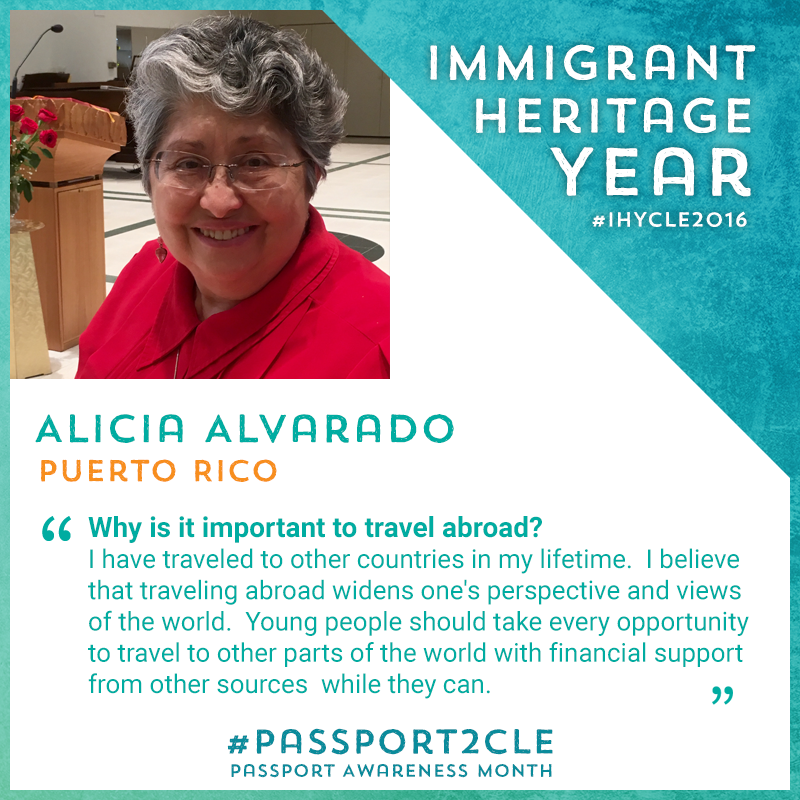
Alicia Alvarado
Where am I from?
I was born in Barrio Semil, Villalba Puerto Rico, Isla del Encanto(Isle of Enchantment). Growing up among the flora and fauna was a true gem, luscious waters, and wonderful weather. I was 6 years old when I came to America.
What brought me to Cleveland?
My father Felipe came in 1953 to work with the Ford Motor Company. When he got settled he sent for his wife Rosa Maria and his three daughters, Carmen Maria, Rosa Alicia & Lourdes Ana in 1956. It was a very cold November day and I was very stressed out for I walk up and down the aisle and I did not like the cold air.
At first I did not care for the cold and the environment. When I got out from the plane onto the tarmac and I could see my own breath. I got worried about what was coming out of my mouth, not understanding it was my own breath, so my dad had to explain it to me. And what I said to my dad, I will forever remember: Papi(daddy) “I hope the people are not as cold as the air I feel!” Some people were as the air I felt day but over time it all changed.
What changes did I face as an International Newcomer transitioning here?
Learning English language. I had to learn it fast for my mom who did not speak English. I became her interpreter while dad worked. I was put in a public school when I arrived where children called me names & was bullied. One day my mom went to the school and brought me home. You see my sister Carmen was 8 years old and special needs and Lourdes was 3 and not yet in school. Mom said “Alicia I am going to put you in a school where they can understand you. She put in a Catholic School where the sisters(nuns) would be more understanding. The Ursuline sisters help me to learn English so well. By third grade I received a religious medal for being the best speller. By middle school our family moved to a different neighborhood. We were renters and moved a lot. I cannot count the different places we rented. I attended St. Patrick parish school, an Irish parish and I thrived there. I loved the people and neighborhood. My parents were able to buy a home at W. 31st Place & Franklin. They bought a big house for by then the family had grown to be 7 children. 4 born in the USA. Phillip Martin, Jorge Luis(George), Alberto Luis and Lucia Maria.
My occupation today is being a woman of deep faith instill in me by my mom. Now I belong to the Dominican Sisters of Peace. My education in Catholic Grade & Middle School and HS was very instrumental. I was Rosa Alicia but in HS I became simply Rose. I did not like it at all. It was all for convenience & to fit in. I went to TRI-C . My parents really made some sacrifices and sent me and Lourdes to Catholic Schools. They said that would be their gift to us. They would not be able to send us to college. My sister Lourdes did not go to college but she is very smart and has worked herself to retirement from being at a parish office. So I really had to do it on my own. From TRI-C for 2 years I went to Cleveland State for another 2 years and got a degree in Spanish Secondary Education. I got my Masters in Social Work & Community Development from Case Western Reserve University. From all my siblings I have the most education. There were challenges doing it but I pulled through it
How have other Clevelanders made me feel welcomed?
I love my hometown I got involved with other Young Latino professionals going through the same experiences. So we all got together and formed organizations that would eventually help other give them the opportunities that we lacked when we were beginning to go through college. Today we have the Spanish American Committee, Esperanza, Hispanic Roundtable, Young Latino Network and more. One only has to plant the seed.
What traditions or customs I continue to practice?
Keeping my Spanish sharp. Staying in touch with Latino Restaurants especially the Puerto Ricans ones. My mom told all her children English in school, Spanish at home so we are all bilinguals because of it.
What do you love about Cleveland?
Everything. Its diversity of people, its acceptance of others different from the rest. It’s educational possibilities , its offering of the different sports, churches, it’s music & songs.
Why is so important to welcome International Newcomers and Displaced Personss?
because it is in my blood. I learned from my parents that were so welcoming to others. We would take in families that needed help and once they got to be on their one we would send them with God’s blessings. It is super important to welcome International Newcomers & Displaced Personss because Cleveland is made up of all the different s countries, all over the world to for what is now called “Cleveland home to many”
Suggestions to make it better: continue to accept the different cultures, languages, religions. I would say the more the merrier for Cleveland is the best location in the nation.
Why is it important to travel abroad?
I have traveled to other countries in my lifetime. I believe that traveling abroad widens one's perspective and views of the world. Young people should take every opportunity to travel to other parts of the world with financial support from other sources while they can. I will not be traveling abroad except my dream is to go to Africa, but I think that will have to be in my dreams.
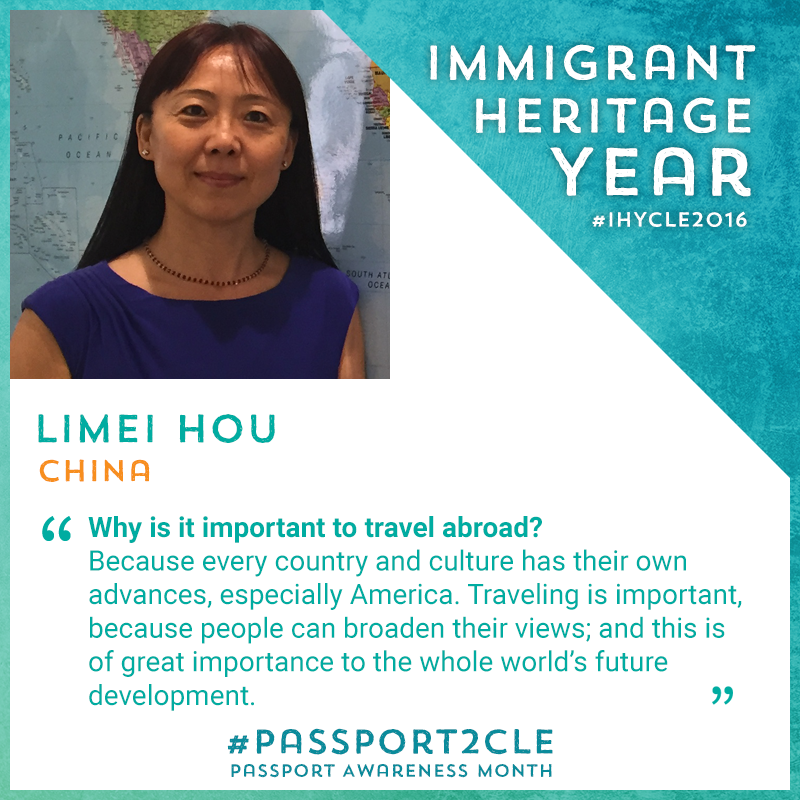
Limei Hou
Did you grow up outside of the US? If so, what was it like growing up in your native country?
I was born in Shenyang, China. It is an old industry city that has developed very fast in the past years. I studied in the college there, worked in the college there; I’ve lived in that city for 38 years before I moved to the US. Shenyang has a long history full of culture diversity, especially all the historical sites including the palaces built by the emperors from Qing dynasty. It also has a good number of well-known universities, countless shopping centers, and a very rich food culture.
How did you decide to attend a university outside of your native country?
I finished my master’s degree in computer engineering, and am right now completing my PHD at CSU. US has many higher education institutions with great reputation, so I accepted the offer.
What were your first thoughts about coming to The United States? Did those change?
There are not many people, but lots of grass and trees around. It is very peaceful. The universities here have rich resources, complete and advanced facilities, all very nice. I met a lot of nice people when I first arrived here. They helped me overcome the difficulties I encountered as a newcomer, and helped me adapt to the culture. There hasn’t been much changes regarding my thoughts about the US nowadays. I still think that all the advantages I saw are real. The only change I would say is that I now know more about the US culture, and I enjoy the life here even more.
Did you face any challenges transitioning to the U.S., or to Cleveland?
The biggest challenge I once faced was the language. Although I have learnt some basic English back in China while attending college, my listening and speaking were far from good. I still remember that the I made a joke when the driving coach told me to make a “U-turn”, and I replied with “Why is it my turn?”.
What traditions or customs do you continue to practice?
We still cook Chinese food at home, and we celebrate the major traditional Chinese holidays such as the spring festival, moon festival, dragon boat festival etc.
Why is it so important to welcome International Newcomers and Displaced Personss?
Because when people move to a totally different environment, they usually face great changes from all life aspects; all people will more or less encounter a variety of difficulties. Thus, it is crucial that they can receive warm welcome and the assistance they will need when they come to the new country. It will have a huge influence on their current life, as well as their future development.
Why is it important to travel abroad?
Because every country and culture has their own advances, especially America. Traveling is important, because people can broaden their views; and this is of great importance to the whole world’s future development.
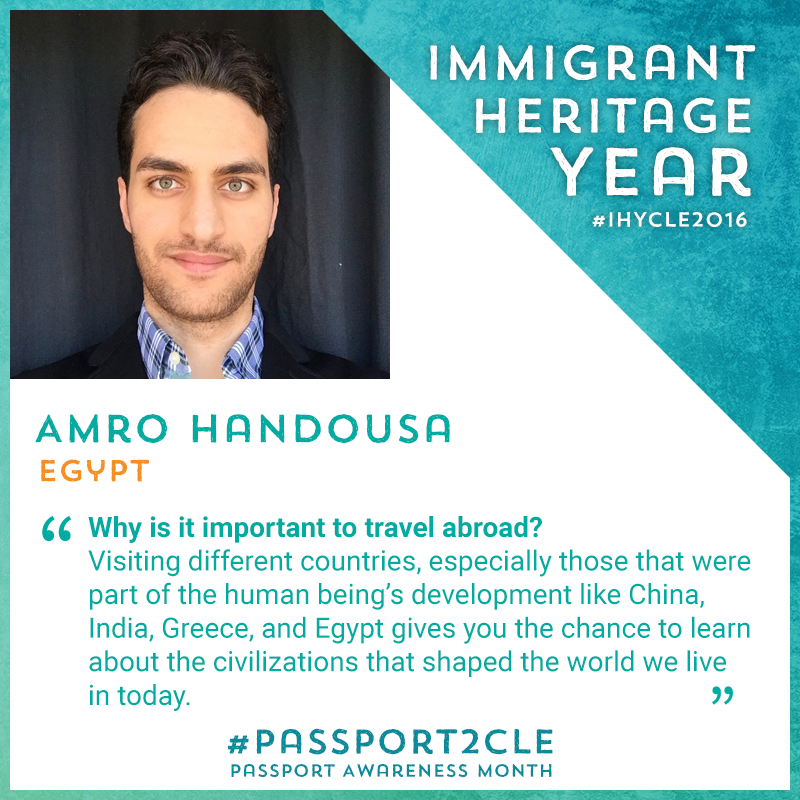
Amro Handousa
Where are you from?
Planet Earth, but if you want to know where I lived before coming to the United States, and where my parents were born; then the answer is Egypt.
What is your occupation?
Currently I am a Masters student studying electrical engineering at Cleveland State. I am also an entrepreneur who is in the process of starting something new in social media.
What was it like growing up?
Multicultural experience since 4th grade. As an international student since I was 10 years old, I grew up confident, open minded, accepting differences, and always ready to learn something new without losing my values or compromising my beliefs. Fearless and away from my comfort zone is one of the traits that have always distinguished me throughout my academic, professional, and personal life.
What brought you to Cleveland?
I would like to start with “why did you come to the United States?” For the past four years since I came to the US, I have been asked this question many times. My answer was “Why not?” The US felt like my school, but in a larger scale. I really wanted to travel and see the world, and I thought of the United States as my first location, since I wanted to see how different groups of people can come and live together, and what are their drivers and motives that at some point made them appear to the world as one unit. I started looking for schools in the United States that offer accredited engineering programs within my budget, and Cleveland State happened to be one of them. I applied to the university and got accepted, then I started the process of moving to Cleveland.
What challenges did you face as an International Newcomer transitioning here?
Absolutely nothing; besides adjusting my budget and making sure that I am financially stable. I would say that might have been because of the international experience I had since I was a kid in my school. It helps me find a room to exercise my beliefs and yet also enjoy learning more about others, and I am delighted to answer any questions because it makes me feel that I am bridging the gap between different cultures. There is nothing wrong about asking questions, as this is how we enrich each other with knowledge and we can live a better life when we know a little bit about each other.
What traditions or customs do you continue to practice?
Everything. I never felt that I had to compromise anything.
What do you love about Cleveland?
I love the summer in Cleveland; the green space, the parks, libraries, and theaters. I have also enjoyed that different cultures get to celebrate their special moments, cuisine, and holidays here. Like the Greek festival, little Italy, Chinese new year festival, Muslim holidays, and Indian Diwali festival. Cleveland is a growing city with great investments opportunities especially in the real-estate market.
Why is it so important to welcome International Newcomers and Displaced Personss?
Because America in a land that is based on Migration. This planet is for all the beings who live in it, since none of us “the human beings” created it. If someone believes that they can do better in a different place with a certain group of people, they have the right to join them as long as they accept their culture and abide with their set of laws. Everyone in this world have the potential to add a unique value to the human society and make this world a better place if we give them the chance.
What suggestions do you have to make Cleveland a more welcoming community?
Essentially continue your hard work in reaching out to international college students and the universities that hosts them. Young talents are the future of this world, and they have invested so much to come to the United States with great ambition and energy to make a difference, and become the best of themselves. Make Global Cleveland easier to approach for non-American investors and help them know more about the markets available, and the rules and regulations.
Why is it important to travel abroad?
Why not. It is amazing to see that you are not alone in this world. Reading about it, or watching a documentary is not enough; living the experience is different and very satisfying. You will have the chance to enjoy their food, arts, music, religions, and traditions. I can promise you that you will leave it with a different perception than the one you had before visiting it. Visiting different countries, especially those that were part of the human being’s development like China, India, Greece, and Egypt gives you the chance to learn about the civilizations that shaped the world we live in today. Modern transportation means made it easier to connect, even though it could sometimes take more than 21 hours to reach your final destination. Acceptance or at least tolerating the different, because when you are a visitor to a different culture, your beliefs and culture is different to them and the last thing you would want is to be treated as an outsider. Business and educational opportunities; just like you cannot find all your groceries in one place, you cannot find all the opportunities in one country. It is fun, and a excellent relief from work tension, and routine life. You will love it, just plan it right!
Disclaimer: sometimes it is expensive, but if you are good with managing your funds; you will do just fine.
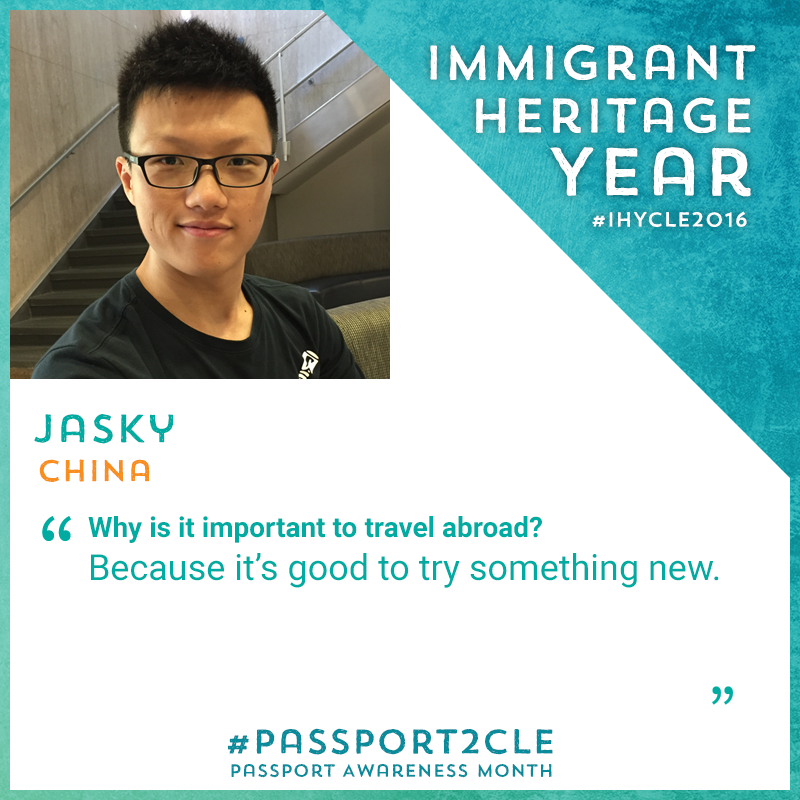
Jasky
What was it like growing up?
Chinese education is important so I spent a lot of time studying for exams.
Why did you decide to leave your home country and study in the United States of America?
I was tired of education in China, I wanted to try something new and decided to come to America.
What were your first thoughts about coming to the United States of America?
New countries, new language I was excited but a little nervous.
There are a lot of things different than China, like taking the bus, living in a dorm room. There’s just a lot that’s different.
People are here and they never force me to do anything that you don’t want to do.
Why should we welcome International Newcomers and Displaced Personss?
Because we need to increase the diversity and study new people and cultures.
Why is it important to travel abroad?
Because it’s good to try something new.

Tamsin Astor
Where are you from?
London, England
What was it like growing up?
Heavenly! The buzz of central London with loving parents and a brother. The weekends and holidays with grandparents and cousins, riding horses and bikes, climbing trees, feeding baby orphaned lambs, board games by the fire with some International travel to see the broader world.
What brought you to Cleveland?
My ex-husband got a tenure-track job at CWRU. We had been in St Louis for 5 years doing Post-doctoral fellowships.
What were your first thoughts about coming to America? Did those change?
I was excited - I had backpacked around America as a teenager and I was amazed by how the states each had their own personalities. My first few weeks in America involved me trying to understand what people were saying (which surprised me because - hey - English is English, right?!), checking out the crazy food (cheese in a can?!) and huge portion sizes, and the fact that people asked my name and remembered things about me, which, coming from London felt very strange! I was really struck by the extremes here - weather, politics, healthcare, religion - the polar extremes of acceptability in the culture!
What challenges did you face as an International Newcomer transitioning here?
None of my challenges were huge. I was struck by the huge cost of health care, the complicated tax codes and the extremes of the right and left in terms of politics, womens rights and so on. Language oddly was a small but present challenge - not being understood, which is strange given I am a native English speaker. I found the expectation of sociability in the workplace (the expectation that you should socialize more during your working day) much more present here than in the UK. The expectation of longer working hours, less vacation-time are still something that concerns me, but I create my own schedule, so that’s not my personal concern anymore.
What is your occupation?
I am an entrepreneur - I run a Coaching company. I help busy professionals organize themselves so they have time for what they need and want and time for fun. I am your Chief Habit Scientist, wrangling your habits around food, sleep and exercise. This career evolved out of my experiences.
How have other Clevelanders made you feel welcomed?
I have had a number of very supportive moments here in the CLE, from the small things like people remembering my name and how I take my coffee, to what my children like to do or eat to the bigger moments. When my 2 year old son was diagnosed with Cancer in 2008, my neighbors of about a year, many of whom I did not know, delivered food to our door every night for the first two weeks after his diagnosis. When my marriage ended and I was packing up and moving out of the family home, and drowning in lawyer fees, my friends suggested I host packing parties - and my friends came, with their kids too and helped us pack up our home.
What traditions or customs do you continue to practice?
I eat marmite on toast at least once a week and I like to have afternoon tea!
What do you love about Cleveland?
CLE is FANTASTIC! I love the people - engaged, political, interested in the world and how they can make Cleveland thrive. Many people have lived elsewhere, but choose to come back to Cleveland, which tells a powerful story. The food & music and events around town - like the PechaKucha events and City Club etc keep me engaged and the metro parks, museums and schools are varied and wonderful. The quality of life here is very high and I couldn’t be more thrilled to be raising my children where there is enough variety and buzz, but the people are kind, compassionate and connected.
Why is it so important to welcome International Newcomers and Displaced Personss?
We are a global economy. The world is now smaller and we should allow people to flow between places - either because they have skills and expertise that they want to share for everyone’s benefit or because they are being persecuted and we can help support them as they transition to safety, stability and eventually productivity.
Why is it important to travel abroad?
Apart from the fact that the world has so much to offer - so many fascinating people, sites to explore, traveling changes who you are. Putting yourself in a situation where everything is unfamiliar - language, food, transport, practices requires you to develop tolerance, open-mindedness, humor and compassion. Extending one’s own feelings allows one to feel compassion and understanding for those who arrive here with nothing familiar. We can all learn to be graceful. My three children have all joined me to travel abroad and get a sense of other parts of the world, because I feel it is even more important now, because the world is shrinking, in part due to social media. Actually being in these countries and grappling with the feeling of being in the minority, being misunderstood and so on, is vital for their development as global, compassionate citizens.
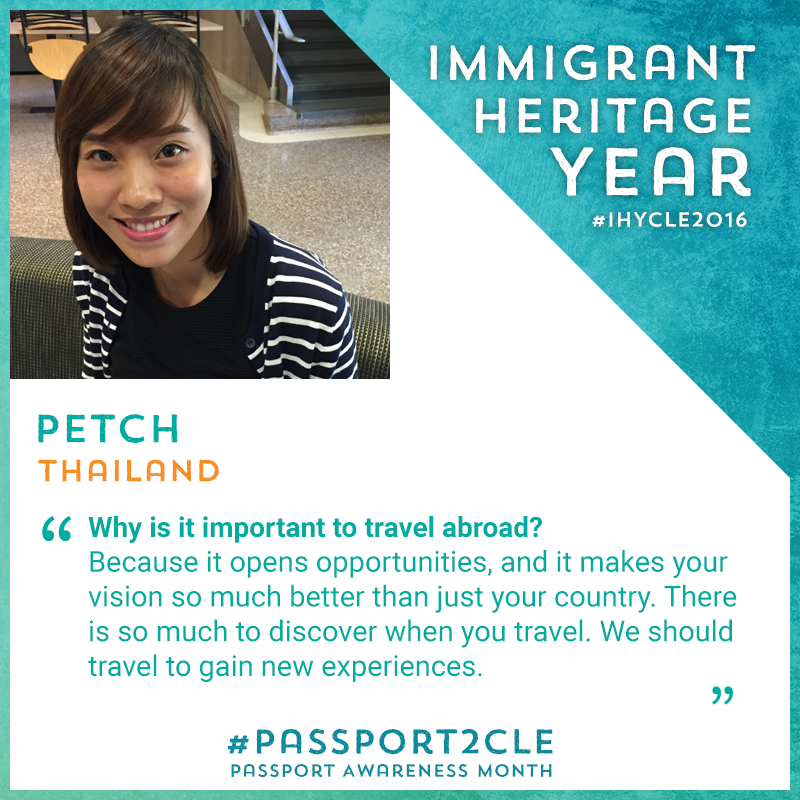
Petch
Where are you from?
Thailand
What was it like growing up?
I lived with my family in the capital city of Thailand and I went to school by bus close to home. I had dinner with my family everyday. My parents told me education is important and they encouraged me to practice English and apply for many scholarships.
What brought you to Cleveland?
I got a PHD scholarship from the government to study abroad. I chose the USA because it’s the greatest country in the world. The many technologies, research - everything in my field comes from the USA.
What were your first thoughts on coming to the United States of America? Did those change?
I was excited to come here and be here. This is my first time being here, I’m alone and I have to study for 4 years without my friends and family so I have to adapt a lot, but I’m excited. I had heard that the culture was totally different but I didn’t know until I arrived. I learned quickly people don’t take of their shoes. In my country soda is not popular but here people drink it. Native people here speak very fast and they have a lot of slang. I also noticed people don’t use an umbrella in the sun, we take one everywhere when the sun is out but here not so much but I’ve only been here 5 days. I have to walk a lot and this place is very quiet. I compare it to my town which is dark. The sunsets very late here. It affects my sleeping and it’s just different from home.
What traditions and customs will you continue to practice?
I will cook here, that’s the only one I have to continue. Nothing special I just want to learn to cook different types of food not just my country.
Why is it important to welcome International Newcomers and Displaced Personss?
Because we don’t know a lot of things. We are foreign and our English might not be good and we might not have any friends, but if someone welcome us it is very useful and helpful.
Why is it important to study abroad?
Because it opens opportunities, and it makes your vision so much better than just your country. There is so much to discover when you travel. We should travel to gain new experiences.

Gundeep
Where are you from?
New Delhi, India
What was it like growing up in India?
It was great! I was there my entire life. The best part was that the people around me were just like me. You played cricket and they don’t play that here in the U.S. I got training and became the school captain. Case Western Reserve University (CWRU) now has a small club and I’m looking forward to joining.
What brought you to Cleveland?
10 years ago my aunt filed a sponsorship for my family and then 2 years ago we moved here. I don’t know why, I went back to India to finish high school. I started college there last year, then the US embassy sent me a letter saying I must come back if I wanted to keep my green card status. So I came back and came to CWRU, but it’s so much more expensive. I have grants and scholarship but it’s still not enough. India was practically paying me to be there. It’s a public institution and not many Indian scientist studying there. All of the scientist there come here. So essentially we moved here for the hope of better future and successful career.
What were your first thoughts on coming to the United States of America and did those change?
We had tickets to come here and I was very excited. I expected America to be developed, clean, full of smart people and have better facilities. I didn’t expect to meet many from my community here but eventually I did. I went to the Sikh temple and I met so many people there.
What challenges did you face as an International Newcomer transitioning here?
First of all nobody could pronounce my name properly I have to repeat it and spell it out. It was a complete cultural shock we don’t smoke and we don’t drink and everyone here just wants to party and drink. I wear a turban so sometimes people look at me different. There was also a shock in the US education system because they test you on your English skills and not your science skills. It’s not fair because it’s not reflective of who I am. The ACT and SAT were important and even with my AP distinction I didn’t’ test well. I didn’t’ like that. Back home the test are tough and English is not a part of it.
What traditions or customs do you continue to practice?
I continue to practice my religion and I will as long as I’m alive. I won’t try to get into the Americanized standards I don’t plan to drink or smoke, I’ll be the same person I was in India here.
How have other Clevelanders made you felt welcomed?
The indian community is very welcoming they invite me to dinner and they just accepted us. The native americans are also very supportive and welcoming to the International Newcomers.
What do you love about Cleveland?
The people here are more generous. When I talk to Indians they judge me on my English but American’s don’t do that and I like it. People come to me on their own to talk to me.
Why is it important to welcome International Newcomers and Displaced Personss?
The entire globe is expanding and you don’t want one type of people to stay in their place and ignore everyone else. We are mixing together and that is important. We should welcome everyone, no two individuals are alike everyone has their own mind and abilities. A diverse group helps us to progress. That’s how you make America great again!
Why is it important to travel abroad?
It is important to travel abroad because it gives you an idea of what the world actually is outside of your own perspective. Traveling allows you to explore different areas, people and communities.