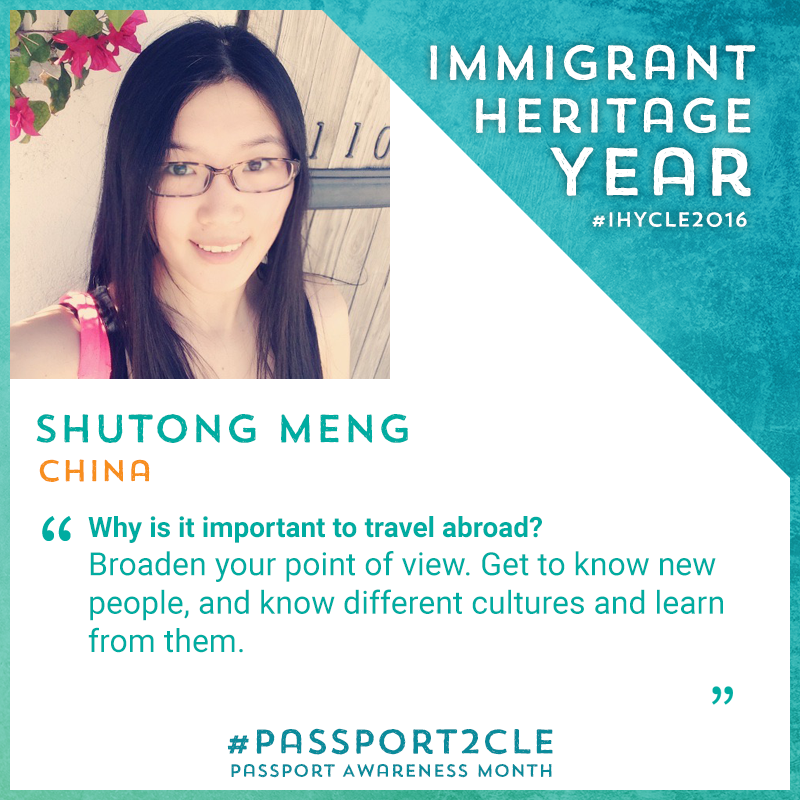
Shutong Meng
Where are you from?
I was born in Beijing, the capital of China. There are a lot of places for entertainment and nice restaurants. The part I miss most in China is Chinese food, I went out for dinner almost everyday when I go back to China.
What brought you to Cleveland?
I got an offer from Case Western Reserve University and I think it is a pretty cool city to stay.
What were you first thoughts about coming to the United States of America?
My first stop in America is East Lansing in Michigan where is totally different with my hometown. My hometown has large population while I never saw crowd of people in the street here.
What challenges did you face as an International Newcomer transitioning here?
I was not good at speaking English before I came to United State. So language is probably the most difficult part for me at that time, but as time goes by, I feel much more comfortable to stay here, and language does not bother me anymore.
What is you occupation?
Student in CWRU.
How have other Clevelanders made you feel welcomed?
I joined several volunteer events in Cleveland and get to know many people live here. They were all glad to introduce me some nice places to go and some of them invited me to join them for hiking.
What traditions or customs do you continue to practice?
I cooked Chinese food a lot at home.
What do you love about Cleveland?
I love the Cleveland Orchestra here! I am a classic music fan and I played piano since I was a child, so I went to see their performance once a month.
Why is it important to welcome International Newcomers and Displaced Personss?
I believe that people from different countries will bring some new ideas based on their own cultures and backgrounds and it is a good thing for the development of U.S.
Why is it important to travel abroad?
Broaden your point of view. Get to know new people, know different cultures and learn from them.


Isabel Galvez
Where are you from?
I am from Lima, Peru.
What was it like growing up?
I grew up in a nice neighborhood in Miraflores, Lima, blocks away from the beach. My parents worked and we would walk to school every day. We knew many people around our “barrio” (neighborhood) and we felt safe. During the summer we would walk to the beach and hang out with friends there. We grew up surrounded by loving relatives and friends. I remember there was always a place at the table, if I was visiting at somebody’s home; I was always asked to stay for lunch or dinner. At home we would do the same, inviting our friends to share a meal, watch TV, listen to music, play guitar, etc. My school was a Parish school with an intensive English program. We received a solid and intensive bilingual education and were fluent in English by the time we graduated from high school.
What brought you to Cleveland?
We left Perú with our 3 children looking for a safe place where our family could live in peace, afford good education and have more opportunities. Our family relatives in Cleveland had offered us a place to live until we were on our feet. The cost of living in Cleveland and school tuition for our three children was very reasonable compared to schools in Lima.
What were your first thoughts about coming to the United States? Did those change?
One of the first things I discovered was that Americans call this country “America,” instead of calling it the United States of America. It was also interesting to learn that most Americans are proud of their heritage, but they will say that they’re Italian, Russian, French, Irish, Polish, etc., even though they were born in the US! This was new to me because in Perú, regardless of your race or where your grandparents came from, you are still Peruvian.
What challenges did you face as an International Newcomer transitioning here?
Fortunately, I was able to find jobs in good organizations. My challenge was to wait for my work permit before I could accept any of the wonderful job offers I was receiving! On the language side, initially, I helped my children to immerse themselves in the English language so they could function and integrate faster in school. Once they became fluent, their Spanish started to fall behind, so we needed to reinforce it by exposing them to Peruvian and Latin events, trips, and Spanish-speaking relatives. I also realized my English was academic, and my challenge was to learn the everyday, informal English. On a cultural aspect we had to acknowledge that we had been raised with different values and traditions. We learned to embrace the US Holidays so that our children would relate to them, i.e., Thanksgiving, which is an American tradition. Finally, I find the weather to be challenging… I don’t think I will ever get used to it!
What is your occupation?
I currently work for the Retail Marketing Department in Sherwin-Williams. I have a degree in Marketing Communications. I am also the Owner & CEO of a translation business, IG Global Solutions. I do translations in English, Spanish and Portuguese. I am part of the Advisory Committee of Teatro Público de Cleveland, a Latin American theater group created by Cleveland Public Theatre. This group seeks to enrich and transform the Cleveland theater experience by exposing audiences to Latin American artistic talent, traditions, and the Migration experience. At work, I am part of the Board of Mix-In, Sherwin-Williams’ diversity employee-based initiative called Mix-In.
How have other Clevelanders made you feel welcomed?
I remember clearly that at our first rental apartment a black family gave us a bag full of toys for our children, and when we purchased our home a nice Jewish lady welcomed us with cookies. The pastor of our church gave us a generous discount to help us with school tuition. But my Cleveland relatives made all the difference welcoming us; giving us a place to live, furniture, advice, and the family environment that we were much in need of. I try to find opportunities to give back when I see families that are starting out.
What traditions or customs do you continue to practice?
Spanish continues to be my main language. I pretty much only speak English for work. My Peruvian culture, music, food, values, and Catholic faith are always present and continue to be a big part of our lives. Because of this, our children grew up loving Perú and its culture.
What do you love about Cleveland?
Cleveland was a great place to raise a family. I love the diversity and access to multi-cultural events. I love the Cleveland museums, Cleveland Orchestra, and theaters. Coming from Miraflores, in Lima, only blocks away from the ocean, it was great for me to find out about Lake Erie, and we would take our children to the lake every weekend during the summer. We loved the Library and the city pools. The cost of living was very reasonable here, from food to cars to Catholic schools.
Why is it so important to welcome International Newcomers and Displaced Personss?
I believe we become better human beings when we learn from each other; when we are able acknowledge and appreciate what is unique in our culture as well our differences. I think we can learn a lot from every International Newcomer group in our city. On a corporate level, organizations with diverse talent are richer, stronger and more capable to grow and sustain themselves in a global economy. International Newcomers bring a huge economic power, values and work ethics, they work constructively in all occupations, building, energizing and humanizing society at every level.
What suggestions do you have to make Cleveland a more welcoming community?
Education is key. We need to educate children to appreciate their own and everybody’s cultural heritage, spiritual and artistic traditions. Schools need to do a better job of teaching foreign languages. So many people will tell you that they studied French or Spanish in high school but did not learn anything. A better learning of a foreign language will make children and adults more comfortable to work or study with people from other countries. Governments need to acknowledge the economic impact of International Newcomers and stop viewing Migration as a problem but as an opportunity. Governments need to realize that the growth of the International Newcomer economy is the growth of our nation’s economy too.
Why is traveling abroad important?
Traveling to another country expands your vision, your horizons on all levels. You get in contact with the country's culture, history, geography and most important, its people. There is many ways to travel inexpensively and people are traveling much more than before. I have an airbnb in Lima, Peru and it’s great to see how many Americans and people from all over
the world visit Peru, basically, to learn, to be in contact with Peruvian culture, people, history, food! Trips to any continent, will change you a little, make you a better human being. You become a little more understanding, tolerant, more open, welcoming, and less afraid because you know that even with cultural differences and language, you can appreciate the human being, and connect, no matter where you go. Listening to somebody with an accent, or international news, becomes easier, you can put things in perspective, you realize you are a part of a universal community, and how much the world has to offer, one country at a time.
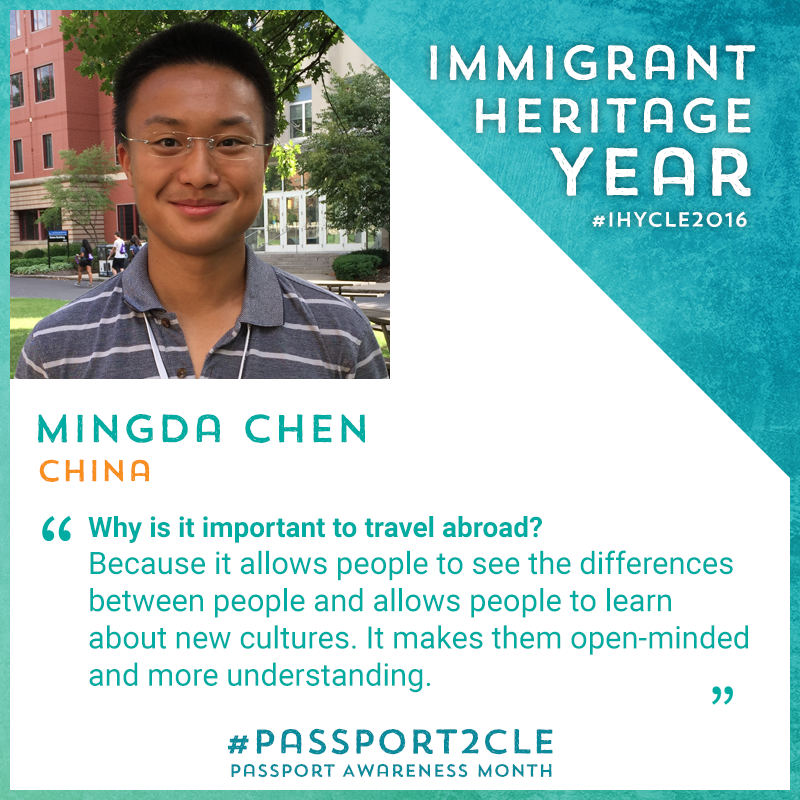
Mingda Chen
Did you grow up outside of the US? If so, what was it like growing up in your native country?
I was born in Beijing, China. I spent my childhood there, and moved to the States with my parents at the age of elementary school.
How did you decide to attend a university outside of your native country?
My parents moved here to Cleveland. I chose CASE specifically because it has a good academic reputation and a friendly atmosphere.
What were your first thoughts about coming to The United States? Did those change?
I was a little scared. My English was not well, and I was confused a lot by the surroundings back then. It changed after my English got better. I was then able to understand the cultural aspects better. My parents were busy, and I had some trouble at school back then because I didn’t understand their “cultural attitude”; I am trying to get used to it nowadays.
Did you face any challenges transitioning to the U.S., or to Cleveland?
The first big challenge I faced was the food at school. The cuisine is new, and I am not used to it. But now I am more exploring, and could accept it pretty well. Another challenge was trying to understand the very different set of personal values here compared to China.
What traditions or customs do you continue to practice?
My family still shop at China Town. We cook Chinese food at home. And we go to the annual Asian festival in Cleveland.
Why is it so important to welcome International Newcomers and Displaced Personss?
Because it adds different views, and introduces diversity into the society. By welcoming International Newcomers and Displaced Personss into our community, people can get a view on how others’ values are and respect their lifestyles.
Why is it important to travel abroad?
Because it allows people to see the differences between people and allows people to learn about new cultures. It makes them open-minded and more understanding.
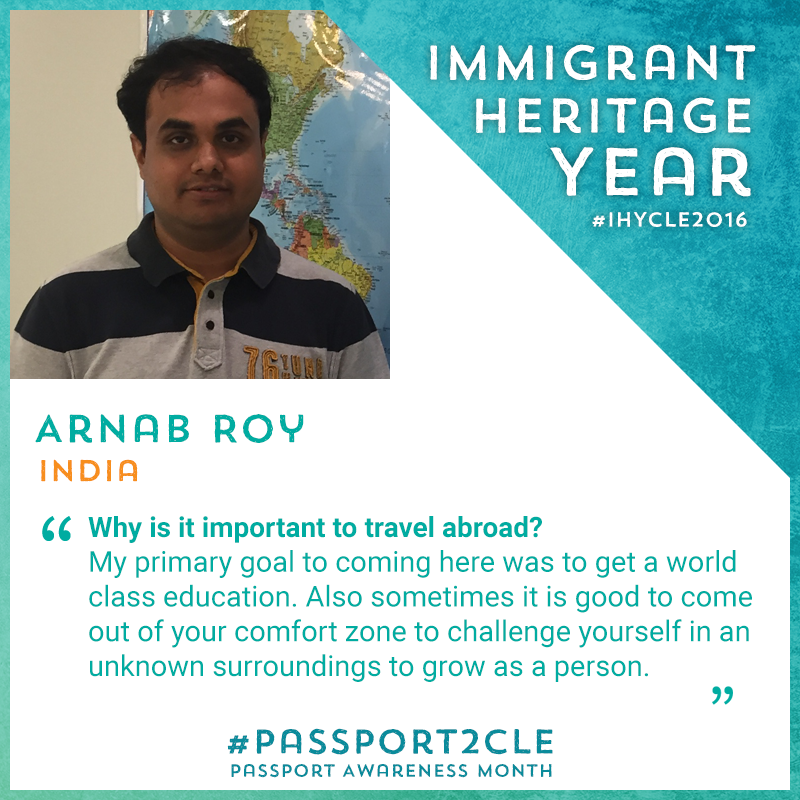
Arnab Roy
Where are you from?
India
What was it like growing up?
I had a great childhood. I grew up in a big family with my grandparents and uncles and cousins. We all are very close to each other. Since my childhood I have been taught to live my life with great values of humanity, empathy and integrity and I have tried to stand by it. Also my childhood has been full of funny incidents. So overall, I had a fantastic childhood.
Why did you choose Cleveland?
It was mainly because Case Western Reserve University. We had never been to the USA before. So didn’t have much idea about different places. As our program (MEM) offered by CWRU is one of the best in USA, so we chose to come here.
What were your first thoughts about coming to America? Did those change?
To be honest, I was very excited and scared about it. Coming to an unknown place, far from your own country, your family was not easy. But yes, I was very happy at the same time that I am going to one of the best places in the world to fulfil my dream and to improve myself as a person.
What challenges did you face as an International Newcomer transitioning here?
Primarily I had to learn about the culture here as I am from a different country. Second, I would say was the food (as I am a big foodie!!). Meeting different people in my class and also outside really helped me to get acquainted with the place. I also visited the nearby places which I liked very much.
What traditions or customs do you continue to practice?
I am a spiritual person. I try to do ‘pranayam’ (a form of yoga) every morning once I get up. Also I do worship my God every day.
How have Clevelanders made you feel welcomed?
Every person I met, since I arrived here, have been very welcoming to me. I could feel the warmth once I meet them, be it my classmates or some other people. This approach has actually helped me to get settled in this foreign country.
What do you love about Cleveland?
I liked almost everything. This has been my first foreign trip and I like Cleveland a lot that I sincerely hope to get settled down and stay back here with a good job. I really liked the weather once I arrived here (on May 31st 2016). The people are very welcoming and nice. It has some really rich heritage places to visit. I found Cleveland to be a very cultural place which I really liked.
What’s your favorite thing to do in Cleveland?
Visit to downtown and just sit in the public square with a book and read it. Also I really like the Edgewater Park and Lake Erie. I also like music a lot. So I am planning to hear a live concert at the Severance.
Why is it important to welcome International Newcomers and Displaced Personss?
I feel it is very important to welcome International Newcomers and Displaced Personss to make them feel easy in a non-native place. It helps people like me to feel a part of this place. Also as International Newcomers and Displaced Personss bring different culture from different background, so it is important to introduce them to the culture of the city to have a healthy cultural exchange which will only increase the cultural diversity which is important and also the new person can be involved to the overall growth of the place.
Why is it important to travel abroad?
My primary goal to coming here was to get a world class education. Also sometimes it is good to come out of your comfort zone to challenge yourself in an unknown surroundings to grow as a person.

Humberto Sanchez
Where are you from?
Naguanagua, Carabobo State, Venezuela
What was it like growing up?
Naguanagua is a college town, home of the University of Carabobo, one of the most important university in the country. Growing up I was always surrounded by college students - the university does not house students in its campus, so students from other cities usually stay with relatives or rent a room with a local family. At the time, the town still maintained some of its old traditions, many of which are long gone now due to the fast growth the the city experienced in since the 1980’s. As a kid, we played in the streets or in each other’s homes and looked forward to be the first one in the family to go to college. As a teenager, we had our “groups” in school that studied together during the school year and shared summer activities in the summer. I did very well in school, completing high school Magna Cum Laude, which provided additional options for college. Although we had an excellent university in town, I longed to attend a school abroad, perhaps an influence of many American and British movies from the time. Looking back I believe that part of the allure to study abroad was to experience something larger that what i expected to experience had I stayed in my hometown.
What brought you to Cleveland?
I chose Computer Engineering as my major shortly after completing high school- in Venezuela it was the norm at the time to declare a major prior to enrolling in college. Case Western Reserve University was the institution to accept my application, and also the one with the Computer Engineering program that I preferred.
What were your first thoughts about coming to America? Did those change?
Having watched a lot a American TV as a kid, it did not seem such a foreign culture once I got here. I spent my first months at en English academy in Chicago prior to coming to Cleveland, and I recall that the school had a network of local families who would always host students from the academy for events and holidays. The academy was also housed in the campus of a local college, which allowed interaction with its students (dorm life, cafeteria, school facilities and events). CWRU had a very diverse student body, faculty and staff. I do recall my first learning about racism, not as a personal experience, but through learning of the US history, and was surprised that it still remained. I had a hard time understanding it, having been raised in a country that also experienced a fusion of many cultures in the 19th century, and which continued in the 20th century with many European International Newcomers.
What challenges did you face as an International Newcomer transitioning here?
Finding the culture more formal in its social mores. For example, it is perfectly normal in Venezuela to just stop by a friend’s house unannounced and visit. I recall some reactions when I did the same here after I graduated from college. Learning the subtleties of the language was also a challenge. And as expected, being the only one of my family, I always experienced the sense of longing for your family, home and friends. I was fortunate in that I never really experienced any direct discrimination. Studying and working hard, as well as being respectful to your friends and colleagues, seemed to always gain the trust of others.
What is your occupation?
Technology Management Consultant.
How have other Clevelanders made you feel welcomed?
As one of their own. It helps that Venezuela has a large baseball culture, which provided many things in common with Clevelanders. In addition, always being asked to Thanksgiving dinner and other holidays always made me feel as part of the family and the city.
What traditions or customs do you continue to practice?
Venezuelan and US culture had many elements in common. I continue to prepare Venezuelan dishes, which have become favorites to many of my friends. My hometown holds annual festivities in honor of Our Lady of Begoña, the patroness of Naguanagua. The center of those holidays is a mass and procession on August 15th, which happens to be the same as the Feast of the Assumption in Little Italy, so participating in that event is to carry on a tradition of my childhood. I have a collection of small and miniature nativity scenes, which was an important part of the Christmas holidays in my family, and a tradition that I share with my sister. It was a tradition to invite the local priest - back then everyone knew everyone in Naguanagua - after purchasing or moving to a new home to have it blessed, I think I continued that tradition adopting one from the Jewish culture: I affixed a Mezuzah to a doorpost in my living room.
What do you love about Cleveland?
The fact that Cleveland despite being a large U.S. city, does not have the chaos of other large U.S. metropolitan areas. Being an avid gardener, I think June is perhaps the best month to be in Cleveland, when the temperature are warm, but the heat (or humidity) of the summer has not yet come, and the city is at its greenest. I appreciate the fact that there are so many cultures here, and with that the accessibility to their customs and holidays. I live in Cleveland Heights, which I found to be an extremely welcoming community. I once had the opportunity to relocate to Colorado and went there to check out housing, and while the magnificence of the Rockies was right there, there was a big part missing, at the end I decided to remain in Cleveland. Upon returning to Cleveland and making the approach to Hopkins, I realized that the big missing part was having Lake Erie at our doorstep.
Why is it so important to welcome International Newcomers and Displaced Personss?
The world has been changing more rapidly, and the improvements in communications and accessibility to travel have a created an ease for people anywhere to follow their choices, which often means moving to another country. Sadly, because of today’s conflicts abroad, for many people the choices become life-or-death choices. This country at one point experienced a spike in Migration; International Newcomers that then built this country through their crafts and the contribution from their own home cultures. However, Migration is not a one-time event, but rather an ongoing process. If we are going claim that the U.S. is the greatest country in the world, there with that comes a responsibility of welcoming those that can continue making this country. The ancestors of everyone in this country, except perhaps Native American, come came from other countries and continents, and were once International Newcomers themselves.
What suggestions do you have to make Cleveland a more welcoming community?
Encourage local city councils to have orientation programs and education for its residents to learn about other cultures so that their residents can be better prepared to welcome International Newcomers and ease their first interaction with their new home community
Work with local organizations, including churches, to maintain an ongoing dialogue about what it means to welcome International Newcomers
Encourage all media to highlight the individual ethnic festivals that take place throughout the greater Cleveland area.
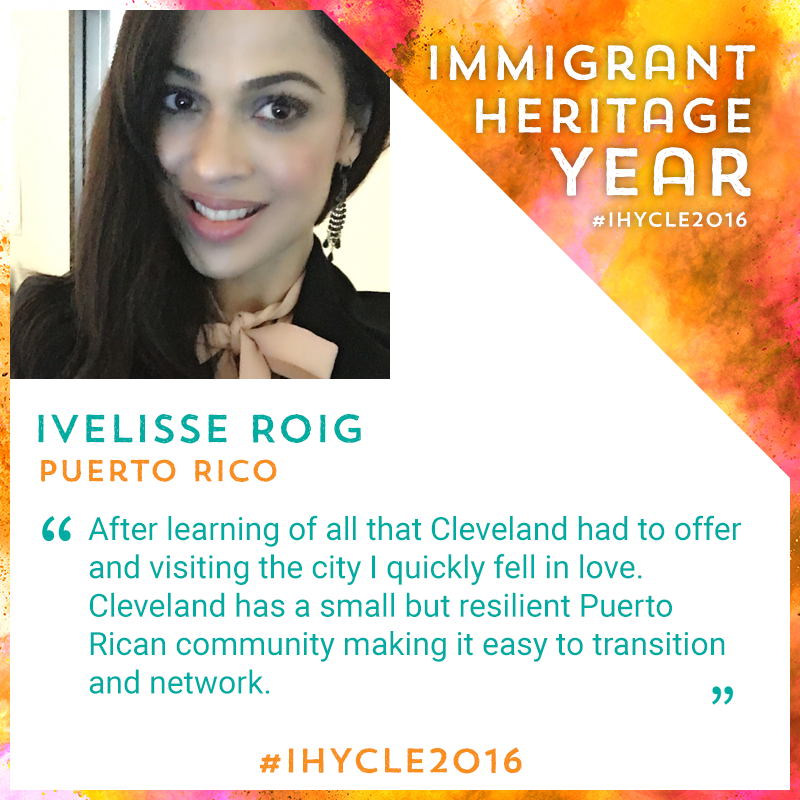
Ivelisse Roig
Where are you from?
I am from Yauco, Puerto Rico
What was it like growing up?
I grew up in southwestern Puerto Rico close to the coast in a very traditional and conservative family. Growing up in Puerto Rico was amazing and I would not change it for anything in my life; I remember going to the beach with my family and friends almost every weekend. We visited my grandparents on the countryside every Sunday after mass. I remember the wonderful tours my grandfather took us on around the farm and eating fruit right off the trees like mangos, passion fruit , and acerola. Christmas was my favorite season, they were very festive, fun and full of traditions. The weather is nice year round and we barely notice seasonal changes. I went to public schools, our school district was very good, and we took an English class as part of our curriculum. I remember spending my summer outside with friends from the neighborhood. I got involved in sports, study groups, leadership and art. I really love our culture, our festivals etc. I had lots of friends. Education and learning to be bilingual in English and Spanish was very important to my father so he made sure that I got a good enough primary education to continue my studies in college. I went to the San German Interamerican University of Puerto Rico and completed my Bachelor's Degree in Psychology. After graduation, I took a leap of faith and decided to move to the United States to pursue life in the mainland, a decision I have never regretted.
What brought you to Cleveland?
After learning of all that Cleveland had to offer and visiting the city I quickly fell in love. Cleveland has a small but resilient Puerto Rican community making it easy to transition and network. No one would believe me, but the snow and change of climate was also factored into my decision. I have always wanted to build a snowman, make snow angels, and have a snow ball fight. Additionally, Cleveland has rich educational, cultural and social institutions that I wanted to take part in and that I saw myself raising a family in.
What challenges did you face as an International Newcomer transitioning here?
From the moment I stepped foot into Cleveland Hopkins Airport upon my permanent arrival, I was intimidated by all of the differences I noticed. I experienced confusion and frustration, by the changes in my traditional lifestyle. Different social norms (West side was for whites and Latinos; the East side was for African Americans) were hard to get used to. Being away from family and friends was very challenging. But the most challenging part was my lack of language proficiency. Not being fluent was keeping away from getting a good job.
What is your occupation?
I work at the Cuyahoga County Board of Elections as a Bilingual Election Program Coordinator
How have other Clevelanders made you felt welcomed?
I was very blessed to have a friend in Cleveland here who was familiar with area nonprofits and services and was able to guide me to those services. I was guided to organizations like El Barrio and the Spanish American Committee. These organizations had people that spoke my language and provided me with a sense of direction and hope. I got information related to ESL classes and job search. In Cleveland, I was not ashamed to speak Spanish, and found stores, restaurants and other places where I was able to find Latino products, food and people who looked like me and spoke the same language.
What traditions or customs do you continue to practice?
My Spanish language, food, music, three kings, holydays, art etc.
What do you love about Cleveland?
All of the endless opportunities presented to me to succeed as a professional. I was able to accomplish my professional goals such as learning English and earning my master’s degree in Business Administration. I love it because I was able to connect with people from my country and culture and keep enjoying my traditions. I love the Lake the different neighborhoods, it is a great city to raise your children and my son was born here so it’s his city.
Why is it so important to welcome International Newcomers and Displaced Personss?
Because they want to feel like home, now they are part of our community and it is our responsibility to be inclusive; International Newcomers are looking for a better future, they sacrifice lots of things to come to the unknown, like me, and it is our job to show them empathy and give back to the community by making them feel welcome and provide the tools and resources to make their dreams come true.
What suggestions do you have to make Cleveland a more welcoming community?
I think that it is important to collaborate with every organization in our community including the churches to ensure they learn about the great services Global Cleveland has to offer.
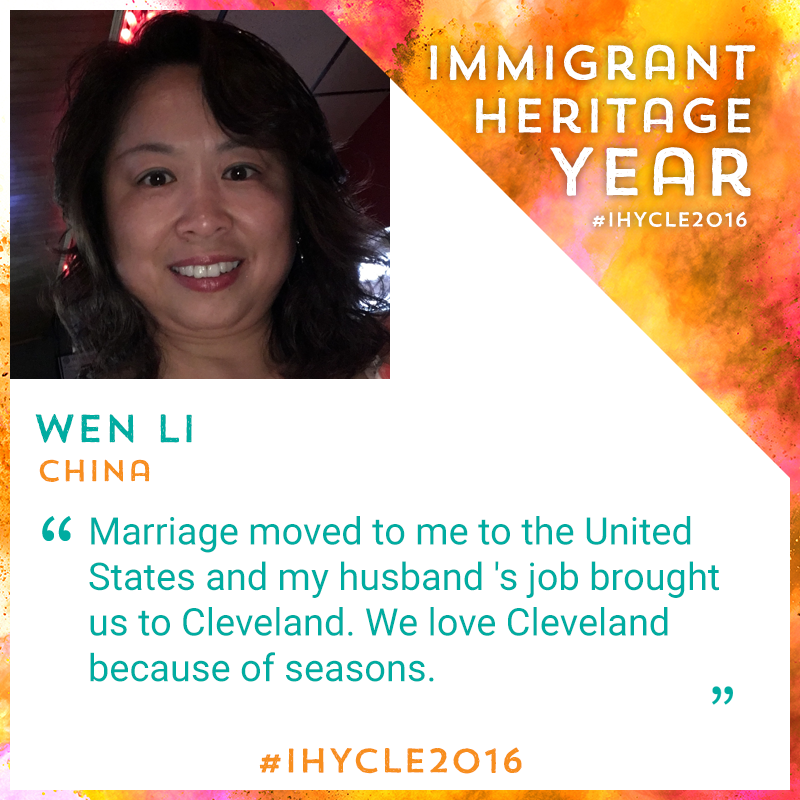
Wen Li
I am from China. Marriage moved to me to the United States and my husband 's job brought us to Cleveland. I was grew up in the city. We love Cleveland because of seasons. There are beautiful seasons throughout the year. Migrating from another country is not easy and I believe many people have the same thought as me. I am very glad be here enjoying life with my husband and our child. We continue following Chinese and an American traditions.
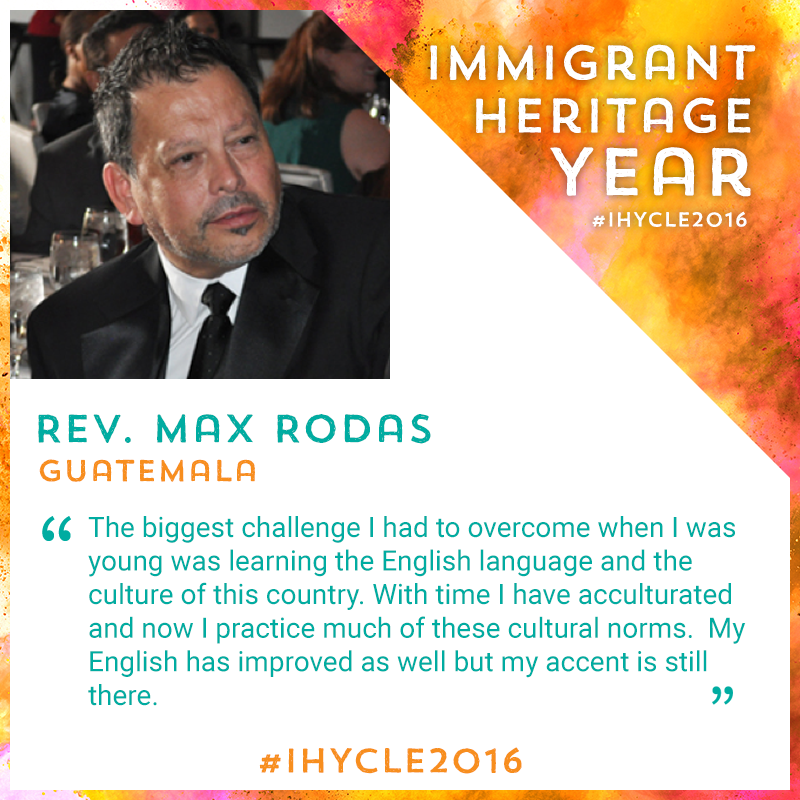
Rev. Max Rodas
Where are you from?
I am from Guatemala, Central America.
What was it like growing up?
Growing up in Guatemala was a lot of fun. We did not have a lot of money but we were wealthy as it relates to family, friends and a rich culture.
What brought you to Cleveland?
I was brought to Cleveland by my uncle and his wife because my mother became ill and my father was not around much. I was 12 years old when that happened. I went back to Guatemala after a year in Cleveland and came back for good when I was 18 years old.
What were your first thoughts about coming to America? Did those change?
I thought that coming to the USA would be fun and had some misconceptions of this country. After over 35 years in this country, I have learned to love and respect this country but I am puzzled with all the anti-International Newcomer rhetoric we hear today.
What challenges did you face as an International Newcomer transitioning here?
The biggest challenge I had to overcome when I was young was learning the English language and the culture of this country. With time I have acculturated and now I practice much of these cultural norms. My English has improved as well but my accent is still there.The sheer individualism of this country is always a concern for me because Latinos/a are more group oriented and have a high propensity toward being gregarious and experience collective reality.
What is your occupation?
I am a Clergyman and the Executive Director of a local non- profit -- Nueva Luz Urban Resource Center.
How have other Clevelanders made you feel welcomed?
Clevelanders have always being welcoming and accepting to me and my family.
What traditions or customs do you continue to practice?
I am still big as it relates to family, faith and friends -- a description of the values I received from my cultural experience. I understand that these values also describe other cultures as well. I still love black beans, white rice, tortillas and hot peppers.
What do you love about Cleveland?
I love everything about Cleveland especially the blue collar mentality of the folks that have live here for many years. I like all the cultural influences that I encounter and experience in CLE. Cleveland to me is the center of the universe -- the best place to live and raise families. It's a city of Champions and my home!
Why is it so important to welcome International Newcomers and Displaced Personss?
It is of paramount importance to welcome International Newcomers and Displaced Personss because of many reasons. From a social justice perspective is the right thing to do and from an economic growth angle, you cannot afford not to be welcoming to these folks. Just look at the progress of the cities that have been openly and concretely welcoming and those that have not. Given the growth that is expected in the Great Lakes Super Region in the next 20 years we should make this welcoming strategy front and center. I can say so much here but suffice it to say that " to be welcoming should be part of the DNA of this city, region and nation."
What suggestions do you have to make Cleveland a more welcoming Community?
There should be more conversation about this with community stakeholders. Also, there should be a target conversation with African Americans and Latinos/as so that there would be no misunderstanding or a sense of competition but rather a commitment to inclusion which will benefit all of us -- even the dominant culture.
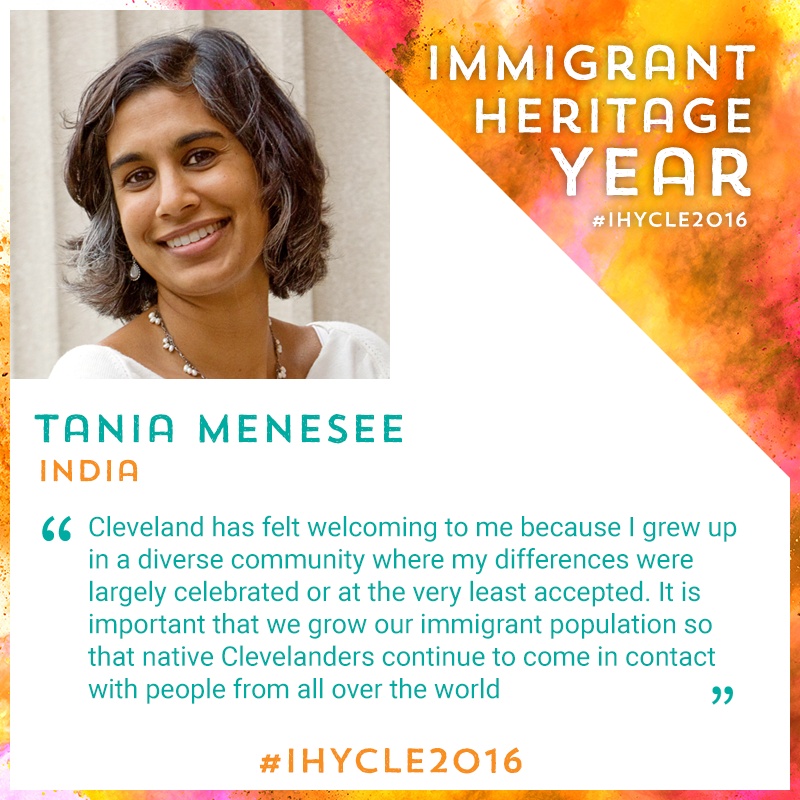
Tania Menesee
Where are you from?
Goa, India but I was born in Bombay
What was it like growing up?
We moved to Shaker Heights when I was four so for the most part, I’ve felt like a Clevelander first and an Indian second.
What brought you to Cleveland?
My father had a green card through Diamond Shamrock’s chemical division
What were your first thoughts about coming to America? Did those change?
I don’t remember as I was just four when we moved here
What challenges did you face as an International Newcomer transitioning here?
I didn’t face too many challenges. My mom tells a story about me coming home from school in Kindergarten declaring that we either needed to be White or Jewish and she had to patiently explain to me that that wasn’t in the cards for a Catholic Indian family. My brother who was 11 when we arrived in Cleveland had more issues assimilating but we always felt welcome in Shaker Heights because even in the 70’s, it was a pretty diverse community.
What is your occupation?
Director of Economic Development, City of Shaker Heights
How have other Clevelanders made you feel welcomed?
Cleveland has felt welcoming to me because I grew up in a diverse community where my differences were largely celebrated or at the very least accepted. It is important that we grow our International Newcomer population so that native Clevelanders continue to come in contact with people from all over the world and don’t become insular in their thinking.
What traditions or customs do you continue to practice?
We are Catholic, not Hindu, so I’ve honestly never felt too tied to the Indian Community in Cleveland. We travel to Goa every three years and I cook a lot of Indian food.
What do you love about Cleveland?
I love Cleveland’s east coast sophistication, culture and architecture combined with Midwest manners and hospitality. I love the neighborhoods of Cleveland and the first suburbs and all the cultural and community festivals and celebrations that have cropped up over the years
What is your favorite thing to do in Cleveland?
One of my favorite events is Larchmere Porchfest. I love walking to the Shaker Square Market on Saturday morning and bumping into neighbors and friends. Cycling to University Circle for an event or just to get ice cream is also a summer highlight.
What is the best thing about living in Cleveland?
Small town friendliness with all the amenities of a big City.
Why is Global Cleveland a great resource?
We need students and professionals who are here for a job to experience how friendly and open the community is and all it has to offer. It is their families that will decide if they stay in the region or move onto the next job opportunity. If they are connected to cultural communities that feel like home and put down roots in the community, they are more likely to stay. On the flip side, we need to help small and medium sized companies navigate the cultural and bureaucratic barriers involved in hiring International Newcomers and Displaced Personss. If they get through the process and have a support system for cultural or linguistic challenges, they will hire more International Newcomers – absent the help, their jobs remain unfilled.
Why is it so important to welcome International Newcomers and Displaced Personss?
There are few issues in Cleveland and NEO that wouldn’t be alleviated with a growing population. Displaced Personss are ready and willing to rehabilitate houses in our most disadvantaged communities. More specifically, research shows that International Newcomers bring new ideas, energy and perspectives that are critical to communities that have seen little population churn. The innovation, new businesses and capital are critical to sustainable growth in Greater Cleveland.
What suggestions do you have to make Cleveland a more welcoming community?
Multilingual signage in the airport and along the RTA rapid routes would be a small but important gesture. Seeing the Global Cleveland agenda carried through GCP, the County, City and Team NEO.

Conversations with Cleveland's International Newcomer Communities Today
Begin the conversation. A novel concept in today’s hyper-partisan world filled with sound bites, slogans, and news so fast if you blink you miss it. The concept of simply sitting in a room to have a discussion about who we are and where we are going may appear quaint . . . even antiquated. What we have discovered is that nothing could be further from the truth. The Maltz Museum of Jewish Heritage and Global Cleveland are collaborating to deliver a five-part series focused on conversations with International Newcomer communities in Cleveland today. To date, we have delivered two: one focused on Arab International Newcomers and one on the Pan-Asian community.