
Zulayka Ruiz-Nieves
Where are you from?
I am proudly from Juana Díaz, Puerto Rico.
What was it like growing up?
I have great memories about my childhood! I grew up in a place called La Plena and Sabana Llana. I spent most of my life in the southern coast of the island. I enjoyed my life surrounded by my family, friends, pets, and beautiful natural views and environments. I used to go to bed to the “coqui” (puertorican frog) song and woke up with the “gallos” (roosters) crowing. For me Puerto Rico is full of my most beautiful memories. I went to school, college, got married and a lot of other good things happen there for me. Remembering my life in Puerto Rico makes me very happy and proud!
What brought you to Cleveland?
My husband and I made the decision to move to Cleveland 5 years ago when we were looking for better work opportunities. My husband holds a BA in Civil Engineering and I hold a Masters in Special Education. I don’t regret my decision because a lot of good things happened and still happen for us here in this amazing city. We love Ohio and it is our second home!
What were your first thoughts about coming to America? Did those change?
It was very hard. I was leaving behind my loves ones and my country. I left behind part of my heart and learned how to be strong and more positive. When we moved here we were very clear that we want to succeed and make this hard move worth it. I still miss my family, friends and the island I left dearly. I am blessed knowing that I can travel and spend time with friends and family.
What challenges did you face as an International Newcomer transitioning here?
My biggest challenge was the language and how to find a job based on my qualifications. My other challenge was the process of acculturation and get used to the seasons.
What is your occupation?
I work as the Assistant Director of Programs at Esperanza, Inc. I support the Director of Programs in overseeing Esperanza’s educational programming to ensure top quality execution and best practices in program design.
How have other Clevelanders made you feel welcomed?
I am blessed because of the time I have been in Cleveland I have known great people that have supported me and helped me to get to where I am now. I like to focus on the good experiences.
What traditions or customs do you continue to practice?
We keep our traditions no matter where we move. In my family we cook the same things that we used to eat in Puerto Rico. We celebrate Three Kings Day, or Epiphany, which is one of the most important holidays in Puerto Rico. On that day we exchange presents and cut grass for the camels.
What do you love about Cleveland?
Cleveland has a lot to offer. There are a lot of things that I love about Cleveland. In this city you can find beautiful places to enjoy a quiet time with your family. I enjoy going downtown, parks and lakes and to enjoying a beautiful day or night with my family. Cleveland is a city full of great people where you can achieve your dreams.
Why is it so important to welcome International Newcomers and Displaced Personss?
It is important to welcome International Newcomers and Displaced Personss because that’s what makes the United States rich in diversity. We have people coming from all over the world to contribute in the medical, financial, education, other fields.
What suggestions do you have to make Cleveland a more welcoming community?
My suggestion for Cleveland to be more welcoming is that we need a Welcoming Center where people can go and learn about the services available. We also need a place that provides orientation regarding degree validations because sometimes people have the perception that International Newcomers are not educated and I have news we have people that are very well educated in their countries and come here to contribute to the city.

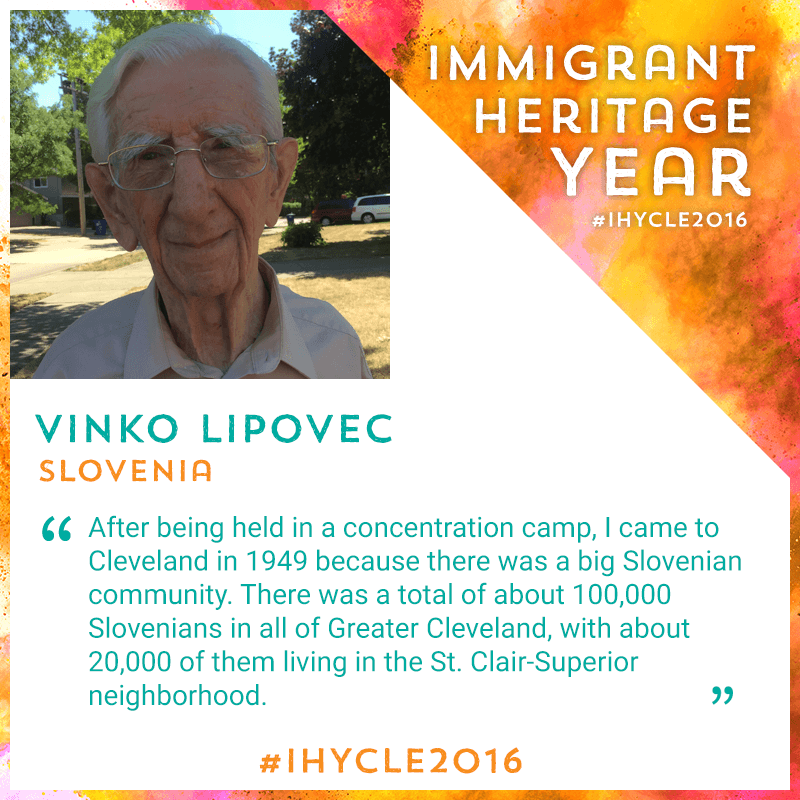
Vinko Lipovec
After being held in a concentration camp, I came to Cleveland in 1949 because there was a big Slovenian community. There was a total of about 100,000 Slovenians in all of Greater Cleveland, with about 20,000 of them living in the St. Clair-Superior neighborhood.
Where are you from?
I am from Slovenia. I came to the United States in September 1949. A few years prior to this, I was held at Dachau [concentration camp], then liberated by the Americans.
What was it like growing up?
When I grew up in Slovenia, the country was about 84% farmland. Now, it is largely industrial. I graduated from the university in the capital of Slovenia, where I studied history and geography. Then, I taught at a junior college.
What brought you to Cleveland?
There was a big Slovenian community. There was a total of about 100,000 Slovenians in all of Greater Cleveland, with about 20,000 of them living in the St. Clair-Superior neighborhood. Later, most Slovenians in the region moved east to Mentor and Geneva. At one point, there were four Slovenian parishes in the area. Today, just two remain: St. Vitus and St. Mary’s.
What were your first thoughts about coming to America? Did those change?
I knew America quite well, because I had studied history and geography. It was not something new to me.
What challenges did you face as an International Newcomer transitioning here?
The politics of the United States differed from Slovenia. Slovenia was communistic. The United States was not.
What is your occupation?
I am retired now, but from 1950 to 1980, I was the editor of Ameriska Domovina (or American Home), a conservative Catholic Slovenian daily newspaper. Today, I am still somewhat active in the Slovenian community and stay informed of current events.
What do you love about Cleveland?
It’s a nice place to live. The climate is okay, and the people are nice. Cleveland, Ohio is surely a good place.
Why is it so important to welcome International Newcomers and Displaced Personss?
That’s the way the United States began. This is a country of International Newcomers. This is tradition.

Ingrida Bublys
Where are you from?
I was born in Siauliai, Lithuania
What was it like growing up?
Due to Soviet occupation my parents had to flee their beloved homeland to escape being deported to Siberia. Since I was a very young girl I do not recall the horror of war and fleeing ones homeland. My parent’s settled in a Displaced Persons camp in Diepholz, Germany. We lived in army barracks. Thus fortunate to have private rooms for my father was a principal of the school that was established for the Displaced Personss. United States had a program for accepting Displaced Personss from Eastern and Central Europe. My parents decided to immigrate to the States. A US sponsor was required. Our family was sponsored by a Catholic priest from Pittsburgh ,PA./ He was not a relative nor we knew of him before he provided the sponsorship. Our first USA home was Pittsburgh, PA.
What brought you to Cleveland?
There was a shortage of jobs in Pittsburgh plus we learned that there was a larger Lithuanian community in Cleveland. My family moved to Cleveland for job opportunities and to have their children be part of a Lithuanian Community where Saturday Schools, folk dancing and ensembles provided integration into the community as well as upkeep of language and traditions.
What were your first thoughts about coming to America? Did those change?
I thought I was coming to a country where the streets were paved in gold. Getting off the boat in New York we saw that the streets were just full of papers flying around, but still it was a promise land full of opportunities.
What challenges did you face as an International Newcomer transitioning here?
I had to learn the language in order to go to school.. It was a very interesting experience. Started in the first grade being third grade level. Classmates would bring me candy and popcorn.
What is your occupation?
I run my own company, IB International and serve as the Honorary General Consul of the Republic of Lithuania in, Ohio, Indiana and Kentucky.
How have other Clevelanders made you feel welcomed?
Growing up in a Lithuanian- American community it was like home away from home. It was very different for both of my parents who were college educated teachers and they could not have jobs in their profession. Until they learned the language they had to do menial jobs.. Even later they never obtained jobs equivalent to their education. They were determined enough to make a good living and educate all four daughters through college. Had time for their children and the kept up with the Lithuanian traditions. Our neighbors respected that we spoke another language and in some cases learned a few Lithuanian words.
What traditions or customs do you continue to practice?
All Lithuanian traditions are kept up in our household. Most interesting ones are Christmas Eve dinner, Easter, Various customs like St Johns Day, Velines “Remembering the Dead”, Uzgavienes, before Lent. Etc.
What do you love about Cleveland?
I lived here for the larger part of my life. Have been educated here , started my carrier here and got married and raised 5 children, whom are all bilingual. It is my second homeland. Cleveland has so much to offer and so much to enjoy.
Many great educational institutions, museums, and Erie shores. A city with all seasons and many opportunities.
What is your favorite thing to do in Cleveland?
My favorite thing is Cleveland Orchestra concerts, Blossom in the Summer, various cultural events and fine restaurants.
What is the best thing about living in Cleveland?
Cleveland is a very economical town a great place to raise a family. Outstanding educational institutions as well as cultural; Great communities with many trees. No wonder it is called the Emerald Necklace.
Why is Global Cleveland a great resource?
Cleveland being a ethnic mosaic with various nationality centers and organizations but it always lacked a center were International Newcomers that were settling in Cleveland could get assistance which their communities may not have the resources.
Why is it so important to welcome International Newcomers and Displaced Personss?
USA is a country of International Newcomers they came from various countries of the world since the country was founded and the tradition continues even today, A welcome is always the first impression of a city and a attraction to settle.
What suggestions do you have to make Cleveland a more welcoming community?
Global Cleveland should hold open houses and others activities which would translate into a very welcoming Center. Most importantly to be a Cent
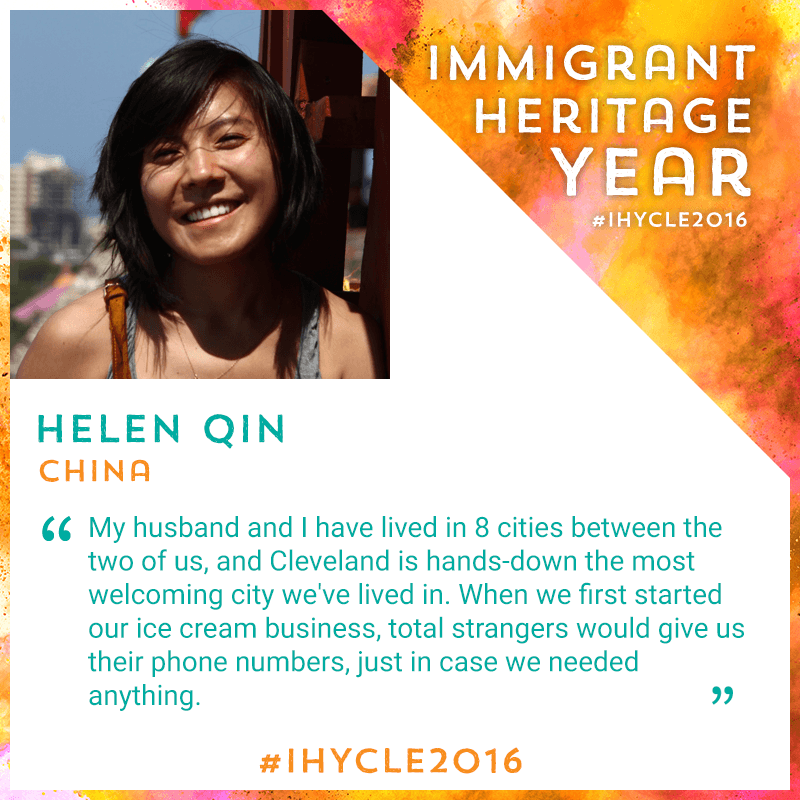
Helen Qin
Where are you from?
Chengdu, China
What was it like growing up?
Chengdu is known for its very spicy Sichuan style of cooking. I moved to the United States at the age of 6 with my family, but still recall my parents rinsing off spicy dumplings and noodles in water for me so that I could eat them as a child. The food was my favorite part of growing up in China.
What brought you to Cleveland?
I was living on the West Coast and took a job offer in Cleveland within my former company, partly because my husband is from here and partly because we were tired of paying half our paychecks to rent.
What were your first thoughts about coming to America? Did those change?
I remember thinking how wide open and spacious everything is in America. China is very densely populated and there's not a lot of nature and green spaces in the cities. As a kid here, I loved chasing after squirrels in the park and feeding ducks in the ponds. I still appreciate the open space, and try to make it out to the Metroparks when I can. I don't like the squirrels as much anymore, because they drive our dog crazy!
What challenges did you face as an International Newcomer transitioning here?
I didn't speak English, but luckily it's fairly easy to pick up when you're that young. Mostly I just stayed very quiet and tried to not look as out of place as I felt. My parents faced much bigger challenges though, like raising a family on my dad's student stipend as a grad student and my mom's waitressing tips.
What is your occupation?
I co-own an ice cream shop called Mason's Creamery with my husband, and also work for Associated Bank in their commercial real estate financing group.
How have other Clevelanders made you feel welcomed?
Yes! My husband and I have lived in 8 cities between the two of us, and Cleveland is hands-down the most welcoming city we've lived in. When we first started our ice cream business, total strangers would give us their phone numbers, just in case we needed anything.
What traditions or customs do you continue to practice?
Mostly eating lots of Chinese food. We eat at a lot of the restaurants in Asiatown, and are always happy to see something new pop up.
What do you love about Cleveland?
I love the people!
Why is it so important to welcome International Newcomers and Displaced Personss?
While Migration has become a political hot-button these days, it's good to remember that the United States was built by International Newcomers seeking a better life, and ended up creating a beautiful country to grow up in. International Newcomers have contributed so much to this country, and most of us hope to be able to keep contributing to it for our children to have better lives here too.
What suggestions do you have to make Cleveland a more welcoming community?
Access and education about resources like Global Cleveland is a great place to start, and meeting people who understand what you might be going through a good way to make the unfamiliar less scary.
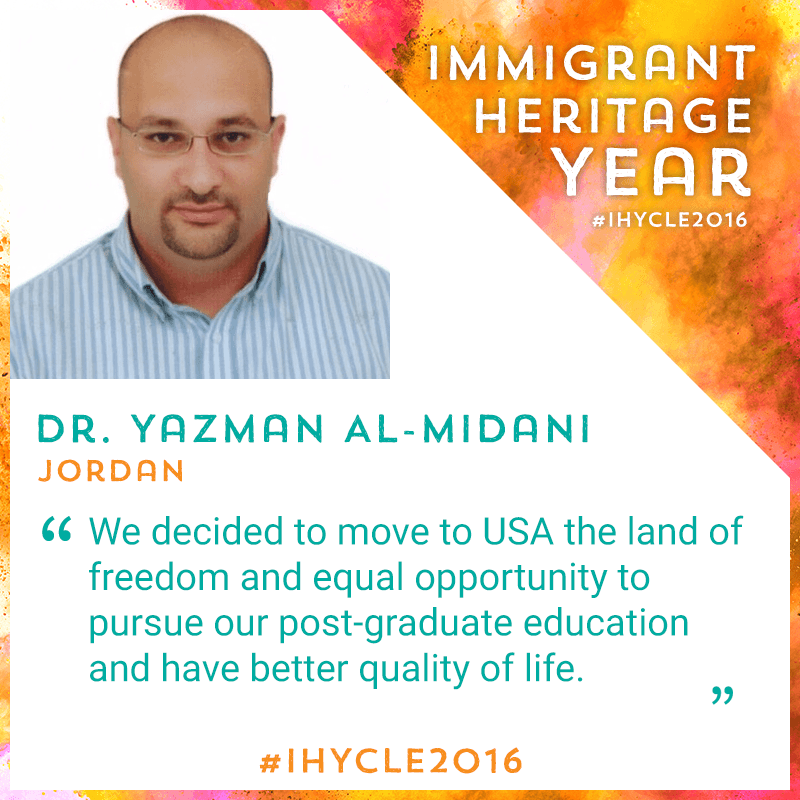
Dr. Yazman Al-Midani
Where are you from?
I was born and raised in a small city, Madaba-Jorda, 25 miles south the capital Amman. Madaba, the city of the churches, where there are a lot of old churches, especially my church, ST. George church, which it is very famous with the mosaic map it has, where tourists all over the world come to see it, and I named my son, George after it.
What was it like growing up?
I graduated from school of dentistry in Amman-Jordan, where I met my beautiful wife there, then we started our journey together. We both worked in Jordan and KSA, then we decided to move to USA the land of freedom and equal opportunity to pursue our post-graduate education and have a better quality of life.
Why did you #Choose CLE (What brought you to Cleveland?)?
When I first moved to USA, I spent one year in LA-CA, the city of the dreams, but I have better opportunities in CLeveland, and I do believe that Cleveland is a better place to raise our family.
What were your first thoughts about coming to America? Did those change?
"Home is not just the place where you born, its the place where you become yourself"
"We do not choose our mother, but we love our mother no matter what, but we choose our wives"
We wanted to move to the land of the freedom and opportunities, which I do believe that USA is.
What challenges did you face as an International Newcomer transitioning here?
I moved from small city, where all people know each other, to a large city where the population in it more than my whole country. Also the cultural and tradition difference played a big role in adapting to the new life we have here.
What is your occupation?
I'm a dentist, I worked in Jordan and KSA and I worked about nine years in in the MetroHealth Medical Center, and currently I'm partner owner in three dental offices in Cleveland area, where we serve the community the best we can.
How have other Clevelanders made you feel welcomed?
In the beginning it was hard, because we did not know many people around us, but with time we feel Cleveland is our home although we do not have immediate family here.
What traditions or customs do you continue to practice?
The Jordanian community in Cleveland is very small, but still we keep some of our traditions, especially regarding our main dish, The Mansaf in certain occasions.
What do you love about Cleveland?
Cleveland became our new home, White Christmas was a dream since I was small kid and it became true here! The thing I like most to do in Cleveland is drinking my favorite coffee from starbucks and watching the sunset on lake Erie.
Why is it so important to welcome International Newcomers and Displaced Personss?
I do believe that help our city in various ways like diversity, more cultural traditions and customs, and I believe that will help our city in all aspects.
What suggestions do you have to make Cleveland a more welcoming community?
In general Cleveland is very welcoming community, but we can put some more efforts through the various diverse communities we have to facilitate and improve the opportunities for well qualified people to move in our city.
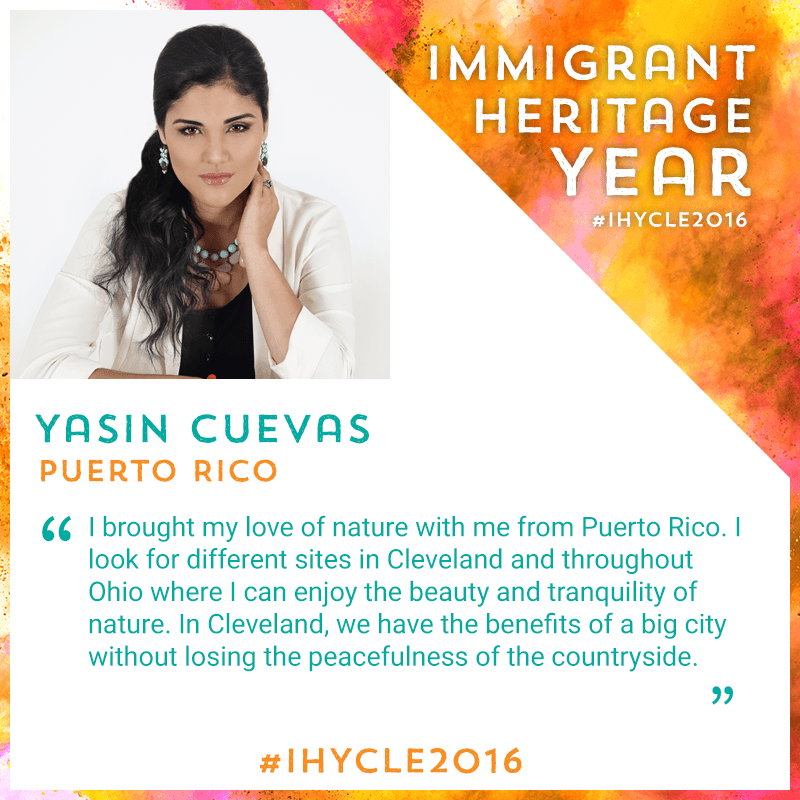
Yasin Cuevas
Where are you from?
I am proudly from Utuado, Puerto Rico.
What was it like growing up?
I grow up in Utuado, Puerto Rico, a town located in in the central-western mountainous region of the island. Growing up around mountains gave me the opportunity to appreciate and love the natural environment as well to understand that happiness comes from simple moments.
What brought you to Cleveland?
Years ago, my father was diagnosed with cancer and Metro Hospital provides some of the best care for cancer patients. He died 3 years after but we were all so grateful for the amazing care he received while there. My mother decided to stay in Cleveland and I moved here with her in 2006.
What were your first thoughts about coming to America? Did those change?
I had the impression that it was a community separated into groups and culture, a fast-living country where work came first and family was the last priority. With time, I have learned that the communities are actually trying to break these barriers and become more united. I still continue to believe that work is a high priority but it is up to each individual to find the balance between work and family time.
What challenges did you face as an International Newcomer transitioning here?
Learning the language was a big challenge. Understanding that no matter how much try, you may never completely learn the language. This has always been a frustration but I continue to improve in my interactions with others.
What is your occupation?
I work as a Program Coordinator at Esperanza, Inc. helping high school students to create and reach for their own personal educational and community goals. I am also the founder of Project Model Institute and the Director of the Miss Ohio Latina state pageant where the queens represent each state at the Miss US Latina competition.
How have other Clevelanders made you feel welcomed?
I have received a lot of support for many of my projects and initiatives from the Cleveland community.
What traditions or customs do you continue to practice?
I continue to celebrate Three Kings Day/ El día de los tres reyes magos which we celebrate each year on January 6th. We received our Christmas gifts on that day, in commemoration of the Magi's visit. On La Víspera de Reyes (the Eve of Three Kings Day) we cut grass to put in a shoe box under our bed for the camels to eat and in exchange for the gift we receive. I don’t cut grass anymore but we do continue the tradition in our family.
What do you love about Cleveland?
I brought my love of nature with me from Puerto Rico. I look for different sites in Cleveland and throughout Ohio where I can enjoy the beauty and tranquility of nature. The Metro Parks and University Circle are some of my favorite areas in the city. In Cleveland, we have the benefits of a big city without losing the peacefulness of the countryside. It’s the best of both worlds and I feel like sometimes those who have lived here for many years do not appreciate it.
Why is it so important to welcome International Newcomers and Displaced Personss?
International Newcomers to our country bring so much knowledge and so many talents along with their culture and their perspectives on diversity. I have found that International Newcomers find great value in the benefits and the opportunities here in the United States.
What suggestions do you have to make Cleveland a more welcoming community?
I think Cleveland should work to better promote their services available to International Newcomers and Displaced Personss so that the community knows more about what support is offered. I also think that assistance with transportation is necessary for our International Newcomers so that they are able to find services that will help them to establish their new lives here.
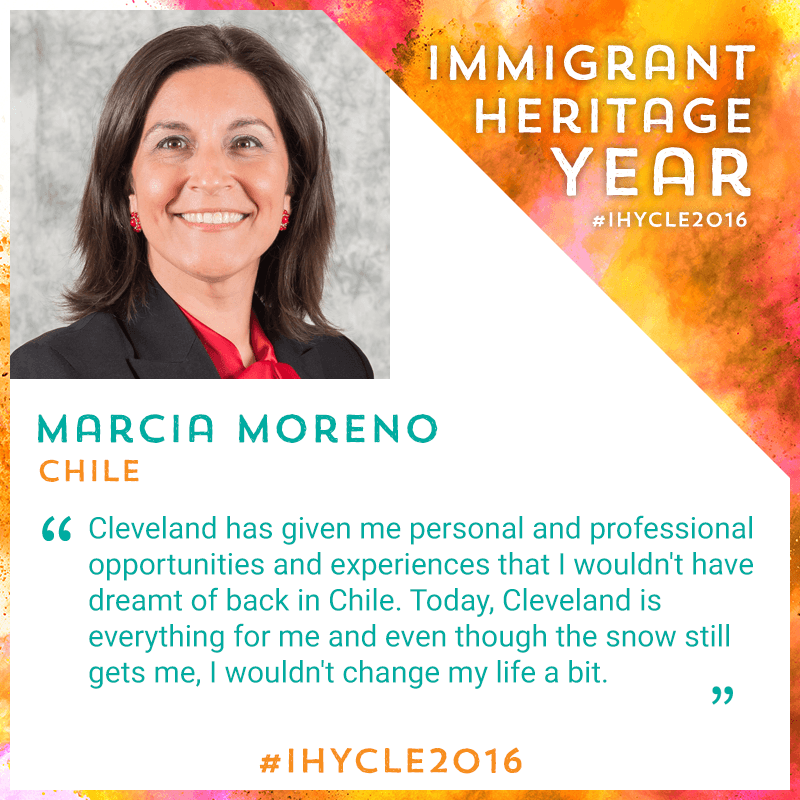
Marcia Moreno
Where are you from?
I am from Chile
What was it like growing up?
I grew up in the 80s under Pinochet's dictatorship but most of my teen years were under a democratic government. I was raised in Santa Cruz, Chile's central Valley, wine country today. I had a pretty happy childhood, very sheltered, family oriented. I went to Catholic school and then for College, I went to Universidad de Concepcion, and studied Journalism. Even though my parents were never involved in politics, music was their way to show me and express what their values, ideas and principles were at that time, and now. It is a happy memory now but it was not at the time, when I would wake up to the music of Victor Jara, Violeta Parra or Inti Illimani a very early Sunday morning, and both my parents would sing their songs and would tell me that one day I would love it too... and I did, I do.
I did not have the things kids have now either, of course. We only had 2 national TV stations with very restricted programming: the National TV and the Catholic TV; our main entertainment was going outside to play with my neighborhood friends and renting a VHS movie for the weekends. We travelled often to visit family in other towns and that was also a highlight of my childhood: my cousins, who I still love and miss with all my heart.
What brought you to Cleveland?
During my years at Universidad de Concepcion I had a professor that had a working relationship with the Dean of the College of Business at CSU. After working on a few research projects together, we became friends, and he and the College of Business gave me an opportunity to come to CSU to pursue my master's degree under an international exchange program between both universities. That was 11 years ago, this August. I was given an opportunity and I took it. Almost like Cleveland chose me, in a way.
What were your first thoughts about coming to America? Did those change?
I was supposed to come to Cleveland for 2 years, get my master's degree, and head back home, where a job at the University of Concepcion was waiting for me. I did not see myself living in the US, at all. I wanted to take advantage of a once in a lifetime opportunity to learn English, advance my academic career and go back. It was especially hard for me to adjust the first few years, and the weather and living Downtown did not help. I wanted to leave. So my experience here was always feeling like a passenger, not in a long term relationship with Cleveland, or the US. and that was 11 years ago…
Those first 2 years have been the hardest of my entire life, but at the same time, they taught me so much and they made me the person I am today, the person that decided to stay here in Cleveland, and form a family. And yes, my first thoughts about US and Cleveland DID change, a lot!
In Cleveland I met the 2 loves of my life, my husband, Joe, and almost 4 years ago, our son, Teddy. Cleveland has given me personal and professional opportunities and experiences that I wouldn't have dreamt of back in Chile; In Cleveland I met my best friends, my sisters, and they have been my back bone to endure some of the hardest lessons in life. Today, Cleveland is everything for me and even though the snow still gets me, I wouldn't change my life a bit.
What challenges did you face as an International Newcomer transitioning here?
I see mainly two biggest challenges: the language and the customs, norms, rules of the day to day living in another country. I was proficient in English but mostly at a technical, academic level that allowed me to pursue my degree; day to day English was super hard for me, as I did not have much experience with it. Speaking was also a lot harder to overcome than writing or reading. Language barriers, when mixed with a total disconnect from the customs, is not a good start. And yes, people may think they know a lot from movies and the internet; but you don't live in a movie: you need to rent a house, get a phone, pay your bills, order food, get a credit card, pay your taxes, and you have NO idea how to do that and nobody teaches you that! How things work in a country are the hardest to learn, and understand, because people were born with those rules, norms, traditions, customs and they seem so obvious and common sense, but they are not if you have not lived here before.
What is your occupation?
I am the Diversity and Talent Manager for Thompson Hine, LLP.
How have other Clevelanders made you feel welcomed?
Most of the "Clevelanders" I know are International Newcomers that settled in Cleveland, just like me. Most of them are from Latin America. And, since they have lived what I lived first hand, they have been the best at making me feel welcomed. I was always invited to family reunions, parties, networking events, that allowed me to meet new people and broaden my network, but mostly, feel at home. Later on, my husband and his family opened their doors and hearts and welcomed me to their lives. I think that being invited to family events, traditions or national holidays makes you feel like being part of something bigger, and I have appreciated that immensely.
What traditions or customs do you continue to practice?
As many as I can but in practice two: Celebration of Independence of Chile, in September 18, and celebrating Christmas on December 24, at midnight. The Chilean independence is one of the biggest celebrations in Chile and I have tried to maintain it with my family and friends. We usually get together with other Chilean friends and have a barbeque, music and drinks. The Chilean flag hangs out our front door all month, in honor of my home country.
For Christmas, we invite my in laws and we have a Chilean style dinner at our place on December 24, and later, we open presents. It has worked perfectly for us (and specially for our son), because we get to celebrate, eat and open presents twice: Christmas Eve and Christmas Day.
What do you love about Cleveland?
The different foods and restaurants you can try; the Metroparks; Blossom and the orchestra; the libraries, the big and strong non profit community and the importance of charity, volunteerism and support to people with needs.
Why is it so important to welcome International Newcomers and Displaced Personss?
I know it is a cliché but is true, everybody in this country is an International Newcomer and International Newcomers made and continue making this country great. We need to become part of this community, contribute to it, make it richer and stronger, and in order to do that we need to be at our fullest; if we feel like we belong and that our lives matter we will soon become advocates and contributors, and not a burden. We don't want to be a burden, but without a welcoming community, it is harder to reach our potential.
What suggestions do you have to make Cleveland a more welcoming community?
After 11 years in Cleveland I would like to say that I am proud of living here, as a first generation International Newcomer. I feel welcome and appreciated. However, there is still a lot of misinformation and ignorance about international professionals and the options for work visas. My one suggestion would be to those companies that are still reluctant to hire professionals from other countries:the only way to remain competitive and relevant is to bring to the table people with different backgrounds ideas, opinions and worldviews, and allow them to be creative and, again, reach their potential. Take a leap of faith and more often than not, you will be extremely surprised.
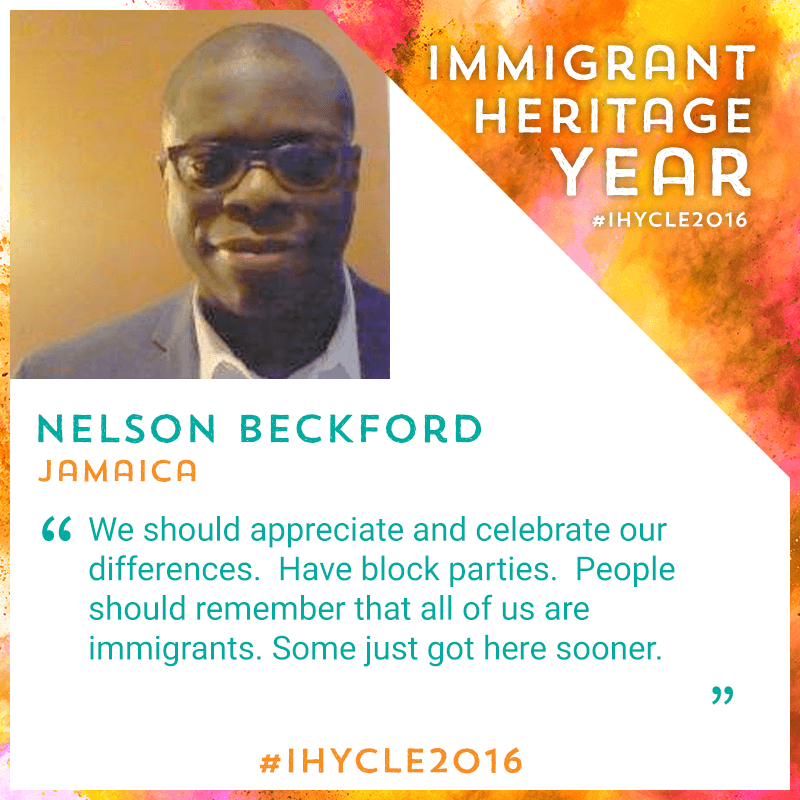
Nelson Beckford
Where are you from?
Kingston, Jamaica
What was it like growing up?
I recall feeling connected to my neighborhood, a place called Elleston Flats. I remember block parties and street festivals. Music. Lots of music at home and outside. I also remember my school (Hope Valley Experimental School) which promoted the educational and emotional development of disabled and able-bodied children simultaneously. I learned about empathy.
What brought you to Cleveland?
This girl and college. The girl is now my wife.
What were your first thoughts about coming to America? Did those change?
I lived in Queens, NYC before Cleveland. My first thought: cold and snow. I learned to love the change of seasons especially the fall. I can now tolerate the cold.
What challenges did you face as an International Newcomer transitioning here?
Minor ones. I was lucky. I grew up in Queens which is so multicultural - I did not stick out.
What is your occupation?
I work for a local foundation and do foundation stuff.
How have other Clevelanders made you feel welcomed?
A pivotal invite came to me from an elected official soon after we moved to Ohio City in 1998. This high energy official invited me to a meeting. I also got to know and become friends with some of my neighbors – some truly incredible people.
What traditions or customs do you continue to practice?
This notion of community – people that live close to another should and must help one another.
Also the idea of celebration; taking time to live, laugh and appreciate the moment.
What do you love about Cleveland?
It’s spirit, history, neighborhoods, and its natural systems.
Why is it so important to welcome International Newcomers and Displaced Personss?
Because the economic development case for it has already been proven. In terms of social justice, it is the right thing to do.
What suggestions do you have to make Cleveland a more welcoming community?
We should appreciate and celebrate our differences. Have block parties. People should remember that all of us are International Newcomers. Some just got here sooner.
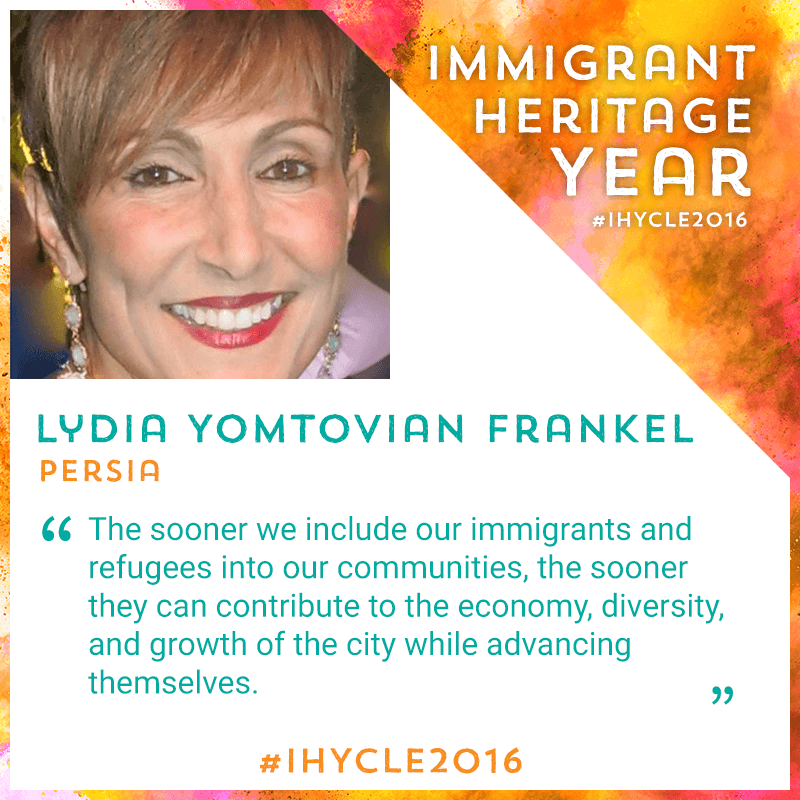
Lydia Yomtovian Frankel
Where are you from?
I am from a lot of places, multiple countries, cultures and languages. I was born in Tehran/Persia to a family that can trace its roots in Persia for at least 11 generations. We moved to Israel when I was 7 years old. Most of my parents’ family moved to Israel once the Jewish state declared its independence in May, 1948.
What was it like growing up?
Fortunately, I grew up in a warm and loving family with a very large extended family in Tehran/Persia. We celebrated Jewish holidays at my parents’ house with all of my uncles, cousins, and grandparents (over 50 people at least). However, at an early age I remember my Muslim classmates and teachers treating me as a Jewish kid – second class. I was never invited to birthday parties and no classmate was willing to come to my house. Teachers would single me out as a Jewish student. As a young child who was born and raised in a discriminating environment, sadly, I accepted it as the norm. My father talked about moving to Israel for over 7 years before he actually cut our strong roots from Iran and moved to Israel. I was 7 years old when we moved and I was very eager to finally be part of the Jewish state. However, I had no knowledge of the Hebrew language and culture so again, I was a minority. But after a short period of time I was able to speak the language fluently and gradually felt Israeli, making friends for life.
What brought you to Cleveland?
When I decided to move to the USA, I moved to Minnesota and graduated in computer science and engineering from Univ. of Minnesota. Once graduated, I wanted to move as far away from the harsh winter of Minnesota as possible. Luckily, I got a position at NASA Ames in Silicon Valley, CA and had no intention of ever living in a place that gets snowy and below 32F again. I had never expected that my future husband would have been born and raised in Cleveland and would absolutely love Cleveland. He is its biggest advocate and can convince anyone that Cleveland is heaven on Earth. Therefore, in the end, I made my way to a place that has some serious lake effect snow and very long, cold winter days.
What were your first thoughts about coming to America? Did those change?
I thought of educational opportunities and personal growth. These thoughts never changed.
What challenges did you face as an International Newcomer transitioning here?
Moving to any new place away from family and friends is very difficult, especially during holidays. In particular, the challenge is finding a supportive community.
As an Israeli, I continuously face unbalanced news and feel the heavy responsibility of advocating for Israel.
I find that even after 20+ years in USA, I am still treated as an outsider. Most American are less in tune with different accents, so even if a person speaks the language very well, he/she still gets this puzzled expression on his/her face when a word is not accented ‘correctly.’
Moving to Cleveland and finding a high tech position was very frustrating and difficult. Still today, there are very few high tech companies and very few networking opportunities in this industry in Cleveland. I found my first job in Cleveland through my connections in Silicon Valley.
Clevelanders have very short memory of the winter season here. They never prepare you for the very long, harsh, and icy roads that are prone to accidents.
What is your occupation?
I worked as a computer engineer with an emphasis in numerical analysis, which was the more scientific end of computing. I worked at NASA Ames in California and later at NASA Glenn until I moved on to a full time lay leader in the Jewish Community.
How have other Clevelanders made you feel welcomed?
At first, it was very hard to break into the rooted Clevelanders’ community, especially as a professional and a recent married women. People were nice but most Clevelanders are born and raised here, and have established life-long friendships or have so much extended family here it seemed as though they didn’t feel the need to make any new friends. Only after having children did I start to feel more connected to Cleveland, and through them I was able to build amazing and supportive friendships and feel part of the community.
What traditions or customs do you continue to practice?
I continue celebrating Jewish holidays adding on my Persian/Israeli customs and traditions; hosting Shabbat dinners with family and friends with the traditional Israeli/Persian cuisine.
What do you love about Cleveland?
It is one of the best places in the USA to raise grounded, highly educated children committed to giving back to their communities and who have high values. Cleveland has wonderful parks, arts and culture, and it is very easy to get around.
What is the best thing about living in Cleveland?
Cleveland offers easy and affordable access to one of the best national and international arts and cultural programs, parks, sport teams, and great Jewish community.
Why is it so important to welcome International Newcomers and Displaced Personss?
The sooner we include our International Newcomers and Displaced Personss into our communities, the sooner they can contribute to the economy, diversity, and growth of the city while advancing themselves.
What suggestions do you have to make Cleveland a more welcoming community?
Any city in the USA will benefit from extended knowledge of other cultures, countries and languages in order to be more effective in transitioning new-comers to the existing communities. If the environment is built to give these new-comers more opportunities to succeed in the US, then they will be a great asset to our cities and our communities.
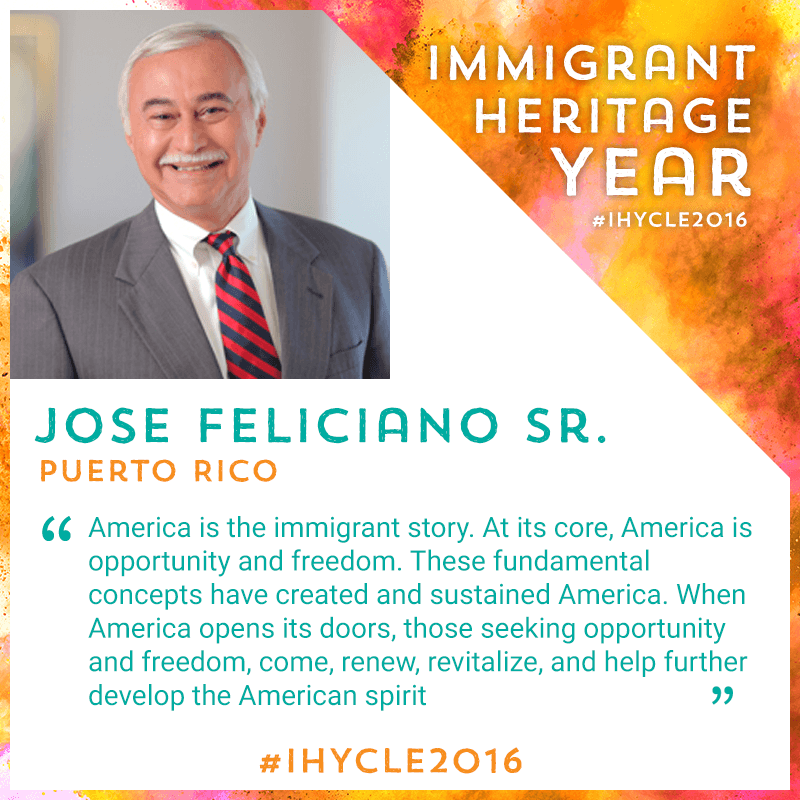
Jose Feliciano Sr.
Where are you from?
I was born in the hills of Puerto Rico in a small town called Yauco.
What was it like growing up?
I grew up on the near West side of Cleveland in what now is known as Ohio City. I lived across the street from St. Patrick's school and church on Whitman Avenue. I probably served more 6:30 AM masses than any altar boy in the history of St. Patrick's Church, because I would often get to the church before the priests, sometime ringing their doorbell to get them going. I thought that by doing a good job serving 6:30 AM mass, I would get promoted to 7:30 AM or 8:30 AM masses. I found out that no good deed goes unpunished, and so for my conscientious work was awarded almost permanent duty serving 6:30 mass, because others had difficulty doing it. I learned one of the great lessons of life through this process, however: discipline and reliability.
Saint Patrick Church, a historically Irish parish, was one of the centers of my life, providing a wonderful education, CYO youth activities, athletic facilities, such as the gymnasium in the school and the outdoor basketball court, opportunities for leadership, such as coaching the CYO baseball team and serving on the parish council. Another center was the Franklin YMCA where I learned how to compete in athletics, including competitive swimming, baseball, and basketball preparing me to play and start in basketball and baseball at Cathedral Latin high school and playing on several Cleveland sandlot championship baseball teams.
The near West side was a fairly typical blue-collar neighborhood that was closely knit and watched out for one another, composed of Hispanics (particularly Puerto Ricans), Irish, Italian, Poles, and many other eastern European. It was an absolutely extraordinary supportive and loving neighborhood and community.
What brought you to Cleveland?
My parents chose Cleveland Ohio. My dad, who served the United States military for seven years, moved to Cleveland in 1952 when it was the sixth largest city in America, having nearly 1,000,000 people in the city limits. He then sent for his family from Puerto Rico.
One of his brothers was working in a steel plant and got him a job. He later worked for the White Motor Corporation for 30 years, rearing two boys who became lawyers and one girl who became a teacher.
What were your first thoughts about coming to America? Did those change?
I arrived in Cleveland at age 2 and really look upon Cleveland as my home. I have no memory of the transition.
What challenges did you face as an International Newcomer transitioning here?
The most significant challenge I faced growing up was language. I did not speak English until I was six years old. I initially started school in the Cleveland public schools, attending what was then known as Kentucky school on West 38th near Franklin. I learned as an adult, from a friend who reviewed my first grade records that I had been identified as Educable Mentally Retarded (EMR). That is when schools were practicing tracking. I transferred to St. Patrick's school after several months. There, with the help of the Ursuline nuns, I learned English rather quickly, probably in several months
Although I am a product of complete immersion, I am a very firm believer in bilingual education. I had an enormous support system allowing me to learn English so quickly. Many others, unfortunately, do not. At the end of the day, the purpose of bilingual education is to teach English, sometimes something which gets lost in the political translation.
Growing up, I aperiodically was called a “spic" and have felt the pain associated with that, but the opportunities, friendships, and love afforded to me on the near West side far outweighed that unpleasantness.
What is your occupation?
I have been practicing law 41 years and am currently a partner with the national 900 lawyer law firm of Baker Hostetler. I began my career as a legal services lawyer, where I worked for the Cleveland Aid Society for four years. Thereafter, I served as a Cuyahoga County Public Defender for three years. In 1980 at age 29, I became the first Hispanic public official, and one of the youngest cabinet level officers, in the history of the city of Cleveland when then Mayor George Voinovich appointed me the Chief Prosecuting Attorney. Thereafter, I served as a White House Fellow in the administration of President Ronald Reagan in 1984 through 1985. Thereafter, I joined the law firm of Baker Hostetler where I have worked for more than 30 years.
How have other Clevelanders made you feel welcomed?
Cleveland has been extraordinarily welcoming, supportive, and loving to my family and me, affording me a wonderful standard of living and extraordinary service opportunities, including serving as the President of the Cleveland Bar Association and serving on the boards of numerous civic organizations including the Cleveland Clinic, John Carroll University, and the Greater Cleveland Partnership to name but a few. Mostly it has given me the gift of service to my own people beginning in college working with the Spanish-American Committee, serving as their General Counsel while a legal services lawyer and thereafter, providing for the opportunity to found and serve the Hispanic Roundtable, where I am now honored to serve as chairman.
What traditions or customs do you continue to practice?
My children and I treasure the celebration of family life, particularly holidays and Sunday meals. The Puerto Rican music, the smells of tostones smothered in garlic, rice and beans, and pernil are staples in our life. Coquito, Puerto Rican eggnog, during the holidays is a must. Sundays are glorious family days of fellowship and love. Our music, particularly Puerto Rican ballads and salsa music are an especially meaningful part of our lives.
My three children all bear Hispanic names: José Celso, Rebecca Catalina, and Marisa Cristina. They all have a very clear Puerto Rican identity, and they love.
The identification and celebration of the success of outstanding artists, such as Rita Moreno, great baseball legends, such as Roberto Clemente, and outstanding political leaders such as former Sec. of HUD Henry Cisneros and current Sec. of Labor Tom Perez are a part of our lives. So is the tradition of service to Hispanic civic organizations and giving back to our community.
What do you love about Cleveland?
I love almost everything about Cleveland: the friendliness and openness of our community , the quality of life, the economic and civic opportunities, the professional sports, the museums, the theater, the restaurants, the housing, the educational opportunities, and the reasonableness of the cost-of-living just for starters.
Why is it so important to welcome International Newcomers and Displaced Personss?
America is the International Newcomer story. At its core, America is opportunity and freedom. These fundamental concepts have created and sustained America. When America opens its doors, those seeking opportunity and freedom, come, renew, revitalize, and help further develop the American spirit from Alexander Hamilton at the founding of America to the creator of Google, Serge Brin and the creator of Yahoo, Jerry Yang..
What suggestions do you have to make Cleveland a more welcoming community?
A significant objective should be to improve the atmosphere of acceptance, particularly of those who speak a different languages. Governments, particularly at the local level (the city of Cleveland, and all nearby cities, as well as Cuyahoga County) should pass resolutions encouraging International Newcomers from all over the world. The federal government, of course, needs to pass comprehensive Migration reform. There needs to be the encouragement of dual language in schools. Public signage should be encouraged in different languages in communities where there is a natural congregation of ethnic groups, such as in Saigon Plaza for the Asian community and Clark Fulton for the Hispanic community.
Land-use strategies, making all these vacant lots available to International Newcomers for sweat equity and other incentives, can help revitalize urban blight, and our urban planners need to develop aggressive strategies in this area.
Ohio needs International Newcomers for its economy and for demographics for the Census. Labor markets do not appear to be working effectively in the Cleveland area where there is relatively high unemployment yet many jobs go unfilled. International Newcomers do not take jobs away from people, they fill jobs which are unfilled. Ohio needs International Newcomers at the top of the ladder, the middle, and at the bottom. Dr. Toby Cosgrove needs more doctors at the Clinic, we need more entrepreneurs to start small businesses and grow them, and we need service workers in restaurants, nurseries, and hotels. Ohio has lost Congressman in the last two census, and we need more people in order to preserve our congressional delegation. These basic conclusions were documented and reached by the recent study of the Chicago Council on World Affairs analyzing Migration in the Midwest.
At the risk of being a one trick pony, let me comment on Hispanics. The largest minority group in the United States is Hispanics. A special strategy should be developed to encourage their Migration and Migration here. While the population the city of Cleveland has been declining, Hispanics have been increasing, thereby helping the city preservice population at or about 400,000, a very significant number four congressional appropriations.
We need Hispanics, their hard work, their drive for success, and their commitment to their family and to God. They can help renew and revitalize our area.