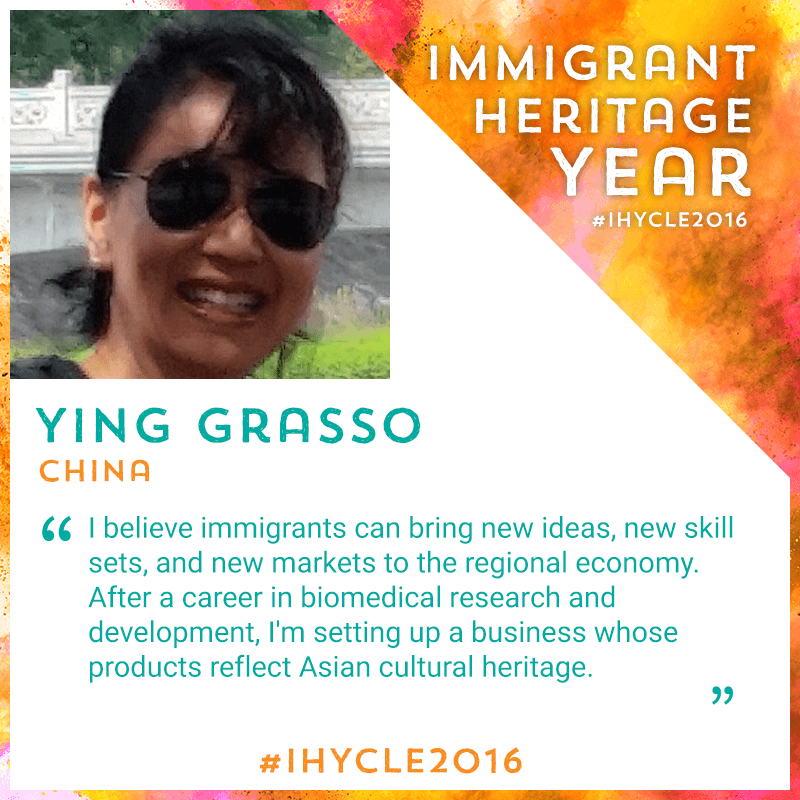
Ying Grasso
I grew up in Shanghai, China and came to the States to attend graduate school in Connecticut. After defending my PhD thesis I came to Cleveland to work at the Cleveland Clinic. Fast forward many years, now I have a family here with 2 teenage children. Both my kids have studied Chinese. My daughter has performed Chinese Classical Dance many times at the annual Cleveland Asian Festival, and I have been a volunteer. I love Cleveland - it has racial, cultural diversity, Cavs, Indians, and Browns, and world class art and music institutions. Clevelanders are friendly, open-minded, and full of entrepreneurial enthusiasm. I believe International Newcomers can bring new ideas, new skill sets, and new markets to the regional economy. After a career in biomedical research and development, I'm setting up a business whose products reflect Asian cultural heritage. I applaud the mission and effort carried out by Global Cleveland, and I look forward to more collaborations in the future.

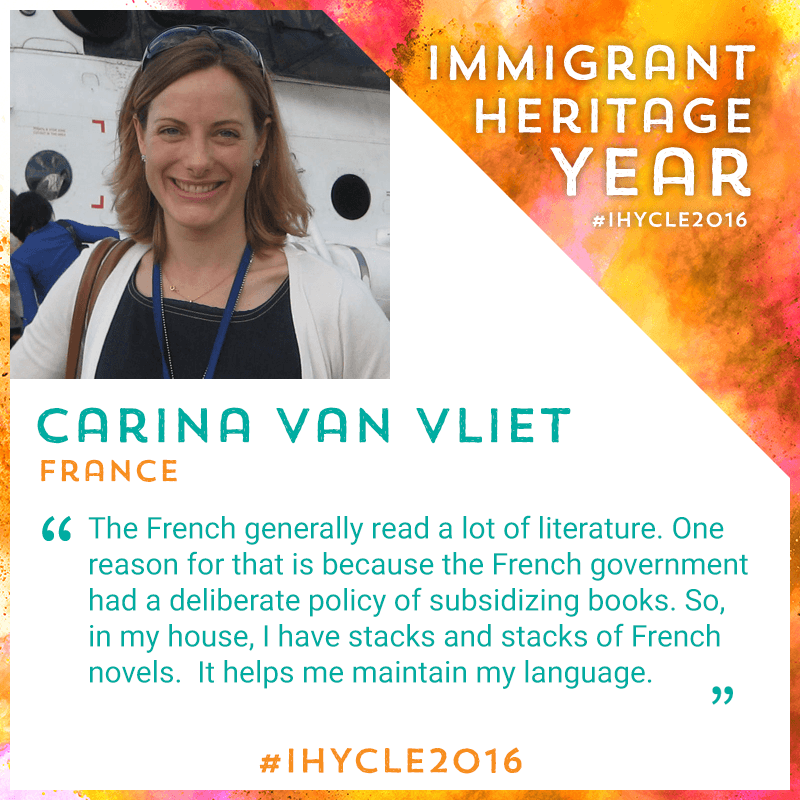
Carina Van Vliet
Where are you from?
Cannes, France
What was it like growing up?
There was a huge emphasis on academic performance. By the time I was in high school, classes were from 8:00 a.m. to 6:00 p.m., in addition to Saturday morning classes. Also, there were no school sports. All sports took place as part of a club, after school hours.
What brought you to Cleveland?
My husband is from here. I moved to Cleveland in the fall of 2014. Before I came here, I was living in New York City, where there is a large French expat community. So, I have to say, I was concerned about moving to Cleveland which does not have the same global reputation.
But, two things struck me once I got here. First, I got the sense that a lot of things were happening in Cleveland. Coffee shops, like Phoenix and Rising Star, were opening. Restaurants were opening. There were all these people with small business and non-profit ideas. There was this feeling that Cleveland is a place where things can be created and that there are few barriers to community and professional engagement – or at least much lower barriers than in New York. That was very exciting.
I was also struck by how welcoming the professional community in Cleveland was, in particular Cleveland’s professional women. When I moved, my husband had a job here, but I didn’t. I had to network to find one. People were most helpful in that search. You don’t get that in New York. It’s more competitive there.
What were your first thoughts about coming to America? Did those change?
I came to the United States when I was 17 to attend in college in Maine.
Going to an American liberal arts college was fantastic. It blew my mind. I was able to choose my classes. There was so much freedom.
I was also able to get involved in so many extracurricular things that were not encouraged in France. I became an editor of my college newspaper and got involved in student residential life, in addition to taking dance classes for college credit. I just had so much fun.
What challenges did you face as an International Newcomer transitioning here?
Americans are typically not very curious about where you come from.
They seldom ask deep questions about your cultural, social or political differences. And yet, other countries do things differently – and sometimes better – than the way things are done here. Sometimes listening to the way other people do things could offer valuable lessons learned and/or alternative models. It’s a missed learning opportunity.
What is your occupation?
I am a former UN diplomat. I currently work in business development.
What traditions or customs do you continue to practice?
Most of them have to do with cuisine. Meals are very important socially. My husband and I love hosting people for dinner. I do traditional French three-course meals, and usually serve French cheese and wine. Also, I will go to great lengths to find a bakery with a good croissant.
The French generally read a lot of literature. One reason for that is because the French government had a deliberate policy of subsidizing books. So, in my house, I have stacks and stacks of French novels. It helps me maintain my language.
I had a baby this winter, and I speak French to him too. I’m also working on getting his French papers. He’ll be a dual U.S.-French citizen.
Why is it so important to welcome International Newcomers and Displaced Personss?
I think civilizations have, traditionally, developed, grown, and transformed through cultural exchange. So it’s good for the United States to attract International Newcomers, their talents, their world views and their diversity.
With Displaced Personss, it’s simply the right thing to do, morally. It’s good for us (they are often very hard working and motivated), and it’s the right thing to do from a human-to-human perspective.
What suggestions do you have to make Cleveland a more welcoming community?
A lot of it is already in progress. If more people move downtown, then more people will interact with each other. The people who live in the suburbs and drive in and drive out each day don’t have a lot of interaction with other people. More interaction will make Cleveland more welcoming.
The more we can create a sense of community, the better. Now, that is truly a tall order. But, I think Cleveland is working really hard to figure it out.
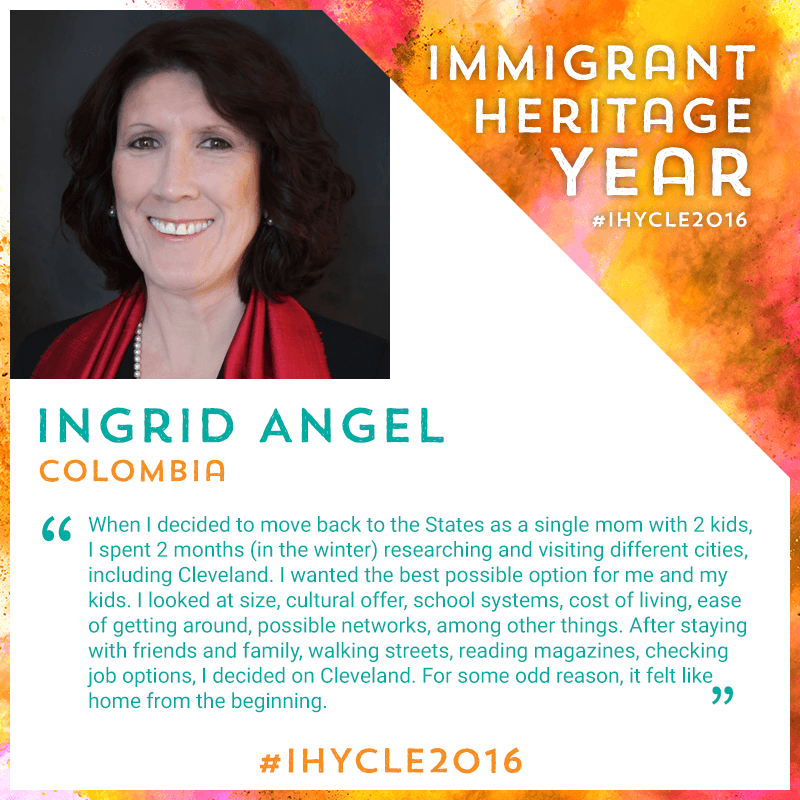
Ingrid Angel
Where are you from?
I was born in Chicago and at age 9 my family moved to Colombia, South America, where I lived for more than 30 years.
What was it like growing up?
Growing up in Colombia was great primarily because of all of the family activities. I have a large family – 92 first cousins and I know them all – AND many of us still stay in touch! Either Saturdays at my Grandmother’s house where the adults would play cards and the kids would just play or large holidays at my uncles’ country homes were always fun and are wonderful memories.
What brought you to Cleveland?
Research. Not in a R&D kind of way, but when I decided to move back to the States as a single mom with 2 kids, I spent 2 months (in the winter) researching and visiting different cities, including Cleveland. I wanted the best possible option for me and my kids. I looked at size, cultural offer, school systems, cost of living, ease of getting around, possible networks, among other things. After staying with friends and family, walking streets, reading magazines, checking job options, I decided on Cleveland. For some odd reason, it felt like home from the beginning.
What were your first thoughts about coming to America? Did those change?
I always wanted to live again in the U.S. as an adult, but didn’t have the chance. I was taking a huge risk, so I wanted to make sure I had all the information to make the best choice possible. I was not disappointed.
What challenges did you face as an International Newcomer transitioning here?
Twelve years ago the job market was very different from today and even though I had been in Human Resources for over 10 years, I had no idea how to job search here. Things were very different and I had to learn. I had a very bad experience with my first job and even considered going back. Even though I had the best possible “adjustment mentor”, life skills were also a challenge. In Colombia there is no self-service. You have help everywhere and you can only imagine my distress when in the middle of a snowstorm I didn’t know how to put gas in my rental car! I started crying at a pump until a very kind gentleman helped me.
What is your occupation?
I work for The Centers for Families and Children as the Director of El Barrio Workforce Center.
How have other Clevelanders made you feel welcomed?
I have nothing but gratitude towards Cleveland and its people. I married a Clevelander and have made Cleveland our home; that’s how welcomed I feel! I have also met so many people through work that I enjoy interacting with. Everyone is kind, warm and interested in my background.
What traditions or customs do you continue to practice?
My kids (and my husband) will not forgive me if I don’t make occasional Colombian dishes, we continue to follow soccer teams and get together with family based here in the U.S. as often as possible.
What do you love about Cleveland?
The options. If you are in the mood for downtown, there’s so much to see and do. The cultural offer is outstanding. I love the distinct neighborhood vibe of the West side, but I also love the quieter slower pace of the Eastern suburbs. The Metroparks are a gem to have in our backyard. I can go on and on. Hard to peg one thing.
Why is it so important to welcome International Newcomers and Displaced Personss?
This country was founded by International Newcomers and International Newcomers have made it great. That has never changed and never should. Diversity of perspective makes greatness.
What suggestions do you have to make Cleveland a more welcoming community?
More education on diverse communities. There is so much misinformation and misconception about certain cultures, creating ignorance and fear. We need more efforts to break down stereotypes and show the benefits of a culturally diverse community.
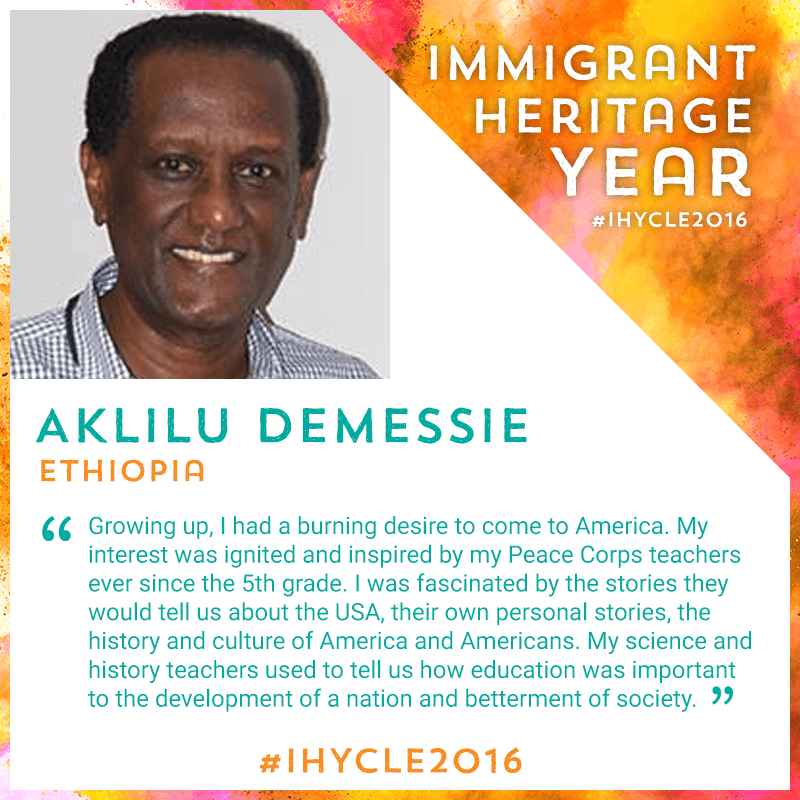
Aklilu Demessie
I am originally from Ethiopia. I came to the USA at first as an American Field Service (AFS), exchange student to attend Oberlin High School in Oberlin Ohio, in the early 1970s. As an AFS student, I lived with a host family and graduated from Oberlin High in 1971. Living with my host family and getting to know the Oberlin community, gave me an opportunity to learn the American way of life like no other experience would provide at that young age.
Upon completion of my AFS year, I returned to Ethiopia and joined Haile Selassie University (now, Addis Ababa University). However, due to student’s demonstration for political reform, the government closed the university after my first semester. I then returned Ohio to attend Case Western Reserve University where I received my undergraduate and graduate education. I am currently a Senior Engineer at United Technologies Aerospace System, Landing Gear.
Growing up, I had a burning desire to come to America. My interest was ignited and inspired by my Peace Corps teachers ever since the 5th grade, especially my science, English and history teachers. I was fascinated by the stories they would tell us about the USA, their own personal stories, the history and culture of America and Americans. My science and history teachers used to tell us how education was important to the development of a nation and betterment of society.
I believed then as I do now that our world is what we help to make it. The first contribution that one can make to one’s nation is by getting a good education. Inspired by the thoughts and ideas that had been instilled in me by my teachers; I was planning to get an education in the USA and return to contribute to my homeland at the time... However, in the mid seventies, while I was still in school at CWRU, the Ethiopian government was overthrown and the military took over and the country got transformed to a socialist state.
I was conflicted about my original plan to return upon completion of my higher education under that circumstance. During that time, I was comforted and supported by many people I had befriended in Cleveland area, in school and out in the community. The U.S government allowed all Ethiopians to stay in the country indefinitely. The rest is history.
I have lived in the in Cleveland area for over 4 decades, married with two successful children in their mid thirties born and raised in Cleveland, proud of their heritage as well as for being Americans with all its privileges. I am a Board member of the Menelik Foundation in Cleveland and an active member of the core group that has helped establish a Sister Cities agreement between the city of Cleveland and Bahir Dar, Ethiopia in 2004.That year, for the first time in history, Ethiopia runners participated in the Children’s Olympics in Cleveland. In addition, I am a member of the board of the International Community Council and Worldwide International Network (ICC-WIN) of Cleveland Ohio in which 121 countries are represented. I have served as the President of the Northeast Ohio Ethiopian Community Association (NEOECA), President of the Ethiopian Cleveland Connection (ECC) and one of the five founding Board members of The Society of Ethiopians Established in the Diaspora (SEED) which gives scholarships to outstanding high school graduates future leaders and encourages good citizenship, community service to American born kids of Ethiopian heritage as well as honors and awards adults as role models to the students on the same stage, annually since 1993.
Cleveland is a hidden treasure. If you are interested in good education, raise a family, secure good jobs and enjoy affordable living and lifestyle, Cleveland should be your destination, no matter where you come from. The universities, International Cultural Gardens (unique in the nation), the various and diverse ethnic organizations, and the diversity of the people in it are testimony to Cleveland’s’ welcoming tradition.
It is important for Cleveland to continue to attract people from all over the globe. In my view, inclusion or diversity means creating an environment or space that is designed to accommodate and benefit from various people including those with different ideas, perspectives, genders, religions and cultural backgrounds. Today’s International Newcomer is tomorrow’s asset for the City of Cleveland. I have seen Ethiopian International Newcomers come to Cleveland with nothing and now have successful businesses in health care, transportation, real estate. They are Engineers, doctors, nurses, lawyers, professors, students, blue-collar workers; serve in the Military etc. giving back to the Cleveland Community and the nation.
International Newcomers from other states need to be informed of what the city and the state of Ohio have to offer thru an outreach programs. They can be reached more effectively thru their churches, mosques, community organizations in the US as well as thru their embassies and country representatives and universities in homelands.
If the city or Global Cleveland collaborates with the various organizations within the city that already exist such as ICC_WIN, which is connected to over 120 ethnic communities, attract, welcome and retain International Newcomers, the future of our City will be leading example for the rest of the nation.
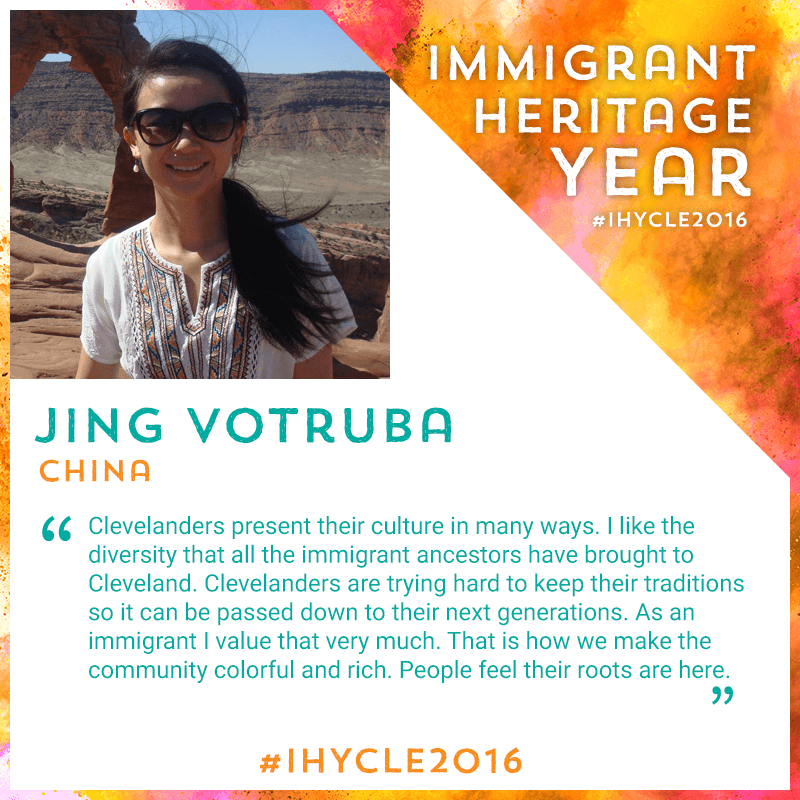
Jing Votruba
Where are you from?
I’m from Yangzhou, China.
What was it like growing up?
When growing up I was always being told I need to study hard so I can go to college and find a decent job. I felt a lot of competition pressure and not much personal interest developing opportunity until I went to college in Beijing.
What brought you to Cleveland?
New opportunities and my husband is from Cleveland.
What were your first thoughts about coming to America? Did those change?
I came to United States is to build a happy family and that hasn’t changed.
What challenges did you face transitioning here?
The challenges are/were language barriers, culture difference, different mindset/values, not easy to find a good job.
What is your occupation?
I’m working as a Mandarin Immersion Teacher at GALA.
How have other Clevelanders made you feel welcomed?
Our family and friends here are very kind and welcoming. We were invited to have dinner with them and they helped us to settle down at the first few weeks when we arrived here. Also my colleagues at GALA are very resourceful and knowledgeable helping me to know this area.
What traditions or customs do you continue to practice?
I speak Mandarin Chinese and celebrate Chinese holidays with my family and friends.
What do you love about Cleveland?
My family recently attended the Night Market in Cleveland. That was a great example to show Cleveland cares and supports different communities. Clevelanders present their culture in many ways. I like the diversity that all the International Newcomer ancestors have brought to Cleveland. Clevelanders are trying hard to keep their traditions so it can be passed down to their next generations. As an International Newcomer I value that very much. That is how we make the community colorful and rich. People feel their roots are here.
Why is it so important to welcome International Newcomers?
In my opinion International Newcomers can bring diversity that can benefit Cleveland in many ways.
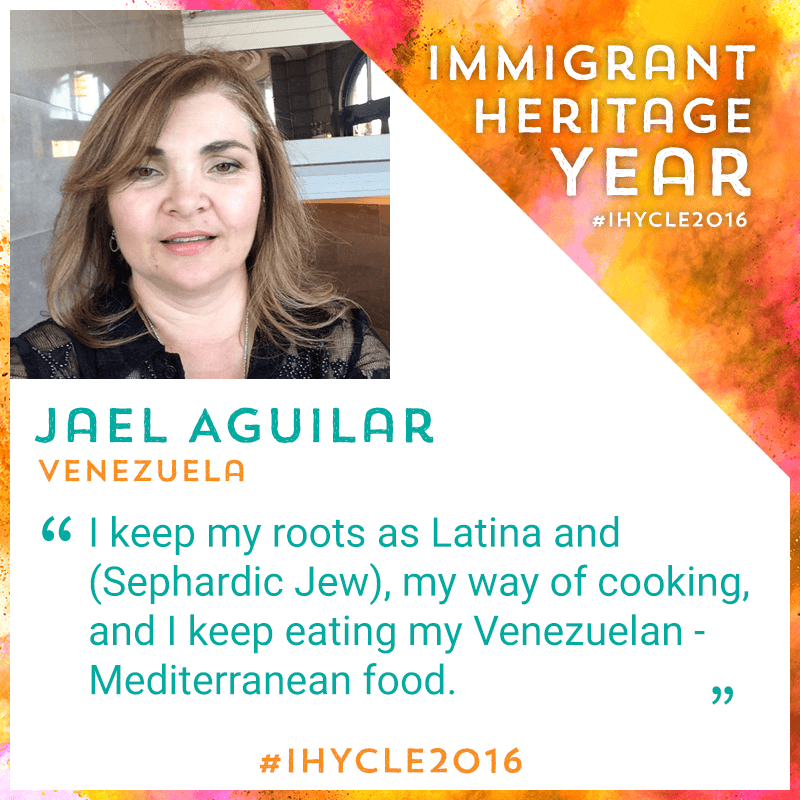
Jael Aguilar
Where are you from?
I am from Venezuela
What was it like growing up?
Growing up in Venezuela was great until I graduated from college. Government changed and most of the young professionals started looking for a way to get out of the country either to improve their education or just to emigrate because of lack to jobs.
What brought you to Cleveland?
Cleveland opened another job’s door for me.
What were your first thoughts about coming to America? Did those change?
Yes, those thought definitely changed. I had come to America a few times as tourist and I thought life in this country was easier. When I came to study I realized that living here it was totally different. One of my experiences were to see people not being patient to listen to my accent or to answer any questions I had. Throughout the 22 years I have been living in this country I have witnessed a lot of changes. I think 9-11 changed many people’s point of view of International Newcomers living in this country specially changed their view about Latinos.I have been discriminated against at work because I spoke my native language and I have also been discriminated for my accent.
What challenges did you face transitioning here?
When I came to Cleveland I decided to continue taking the prerequisite courses I needed to be able to apply to the Master for Speech Language Pathologist Program. I took two courses at Cleveland State University during Spring 2016. I started having problems with one of the courses. I decided to reach out to the teacher so I would have a better understanding of the situation. The professor didn’t like me since the beginning. He was very rude and treated me as a Special Education student. In one of my visits to his office, he suggested me to go to see my doctor because he thought I had learning disabilities or speech problems. Therefore, I would need a note from the doctor so I could barely get D as a grade. It did not matter how hard I worked for that course he finally gave me an F as a grade. Most of my classmates were caucasian, one African American, and I was the only Latina in the course. Last day of class, my classmates commented the difference on the treatment they received from him and comparing to the one he had toward me. I have never felt so discriminated during my years living in this country.
What is your occupation?
I am the Site Coordinator for Luis Muñoz Marín Dual Language Academy.
How have other Clevelanders made you feel welcomed?
I have mixed feelings about the Clevelanders. Some of them have been nice while some others has been rude making fun of me criticizing my accent in English.
What traditions or customs do you continue to practice?
I keep my roots as Latina and (Sephardic Jew), my way of cooking, and I keep eating my Venezuelan-Mediterranean food.
What do you love about Cleveland?
I love the museums, and how Clevelanders are so passionate about their local sport teams. I admire the fact that it does not matter in what part of U.S they would live, they still feel like a Clevelander.
Why is it so important to welcome International Newcomers?
When we leave our countries, we come with a lot of dreams and expectations to start a new life full of opportunities. As International Newcomers, we have to make a tough decision of leaving our parents, brothers and sisters, husband, wife, and children behind not knowing when we’ll be able to see them again. When an individual emigrate to another place could feel homesick, depressed and sometimes disoriented.
What suggestions do you have to make Cleveland a more welcoming community?
I think the Community organizations should start working together creating an educational campaign. There should be like a coalition including religious organizations, local government, police department, post office, and the local media to inform Clevelanders about the future International Newcomers coming to this city. That way people will stop being judgemental about foreigners. Also, the city should provide a flyer or booklet with information for International Newcomers in different languages where they will be able to find the list of resources they could reach out.
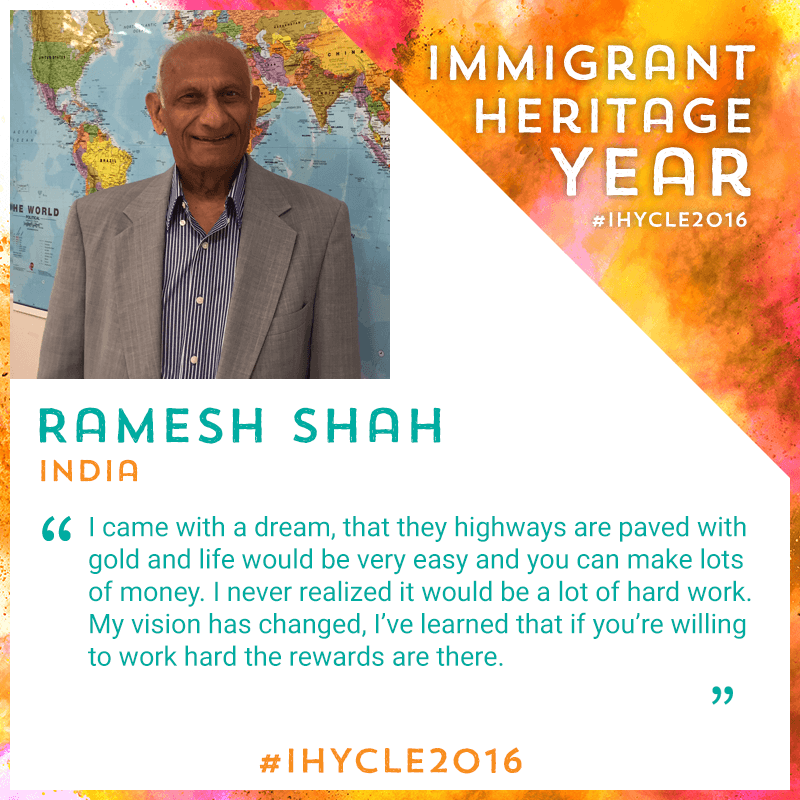
Ramesh Shah
Where are you from?
India but now I am a US citizen
What is your occupation?
I am retired, but I also teach junior achievement, global marketing and global entrepreneurship. I also do a lot of medical camps with my wife where we go to Mexico, Haiti, Honduras, Ecuador, Uganda, Kenya and India.
What was it like growing up?
I come from a low middle class family, my parents were farmers and money lenders. I grew up in a small village known as a Bardoli, India, with only 10k people. We had very few resources, no library no sports no entertainment.
Why did you choose Cleveland?
When I came to US, I came to Champagne Illinois for your masters in electrical engineering. Then I got a job in Wisconsin. I worked there for 6 years then I went back to India for a few years. When I came back, 1970 I got a job in Wickliffe Ohio. Since then I’ve been in Cleveland.
What were your first thoughts about coming to America? Did those change?
I came with a dream, that they highways are paved with gold and life would be very easy and you can make lots of money. I never realized it would be a lot of hard work. My vision has changed, I’ve learned that if you’re willing to work hard the rewards are there. This is a free country you can enjoy freedom at every point and every place but you have to earn the respect of your community. You cannot be isolated in a cubby hole coming from a different country and expect and the community to be welcome, you have to get engaged and life and people will be very fair to you.
What challenges did you face transitioning here?
- I grew up with British systems so my English was different from American English.
- I was a vegetarian I had a lot challenges selecting food once I arrived here. There wasn’t a lot of vegetarians in the 60’s
- I had to learn the basics of sports, I didn’t understand. It took me 4 or 5 years to get use to it.
What traditions or customs do you continue to practice?
We have an Indian Association in Cleveland with 10k people and we follow Indian holidays. We have temples so we go regularly to practice our religion.
How have Clevelanders made you feel welcomed?
Cleveland is an amazing city. I was welcomed and able to engage with the white and minority community. That really helped me. They were cooperative and helped me professionally.
What do you love about Cleveland?
I love that Cleveland Cavs are the champions. I love the Indians, I followed a lot when they played at Jacobs Field. I love the Browns, the arts and museums. I love parade the circle.
What’s your favorite thing to do in Cleveland?
I love the local Indian and Mexican restaurants. They have spicy food. I go to Saffron Patch.
Why is it important to welcome International Newcomers?
Our country, USA is huge smorgasbord of International Newcomers. They bring so many ideas and energy to create jobs, create products, create wealth and that’s our main strength, the International Newcomers landscape.
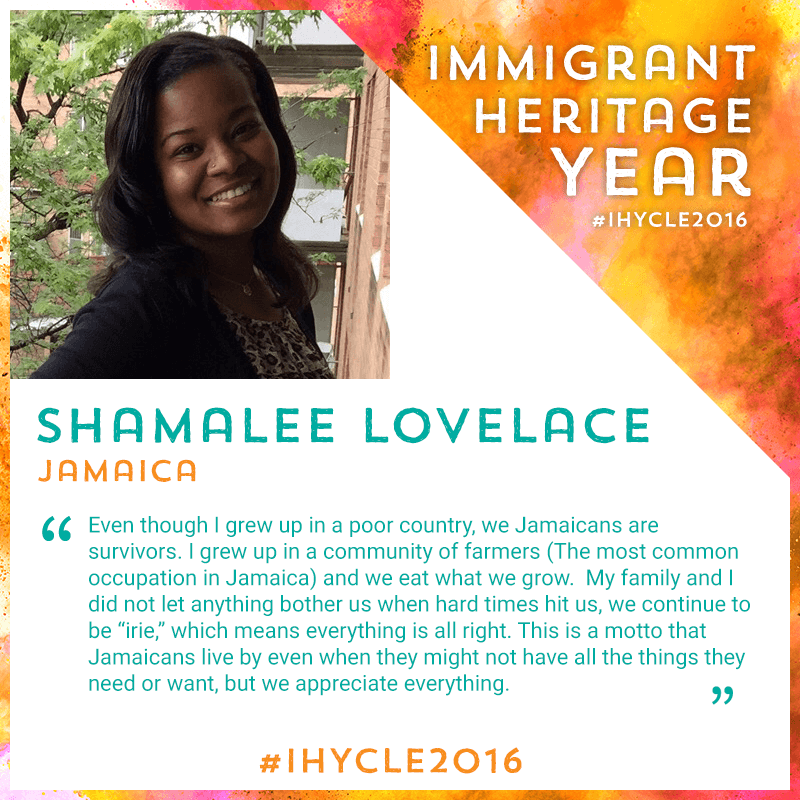
Shamalee Lovelace
Where are you from?
My name is Shamalee Lovelace, I was born and raised in a small community known as Ritchies located in Clarendon, Jamaica.
What was it like growing up?
When people hear of Jamaica they think of the beaches and having a good time but that is not always the case. Jamaica was my home for 14 years of my life and I would not change that for anything. Growing up I have faced some hard times especially financially.
Example: 1st Jamaica high school system and above is not free, it requires tuition to attend.
2nd You need money to make uniforms, in which case, everyone is wearing the same color and style for school and it’s definitely mandatory.
3rd Bus fare, I would take 2 or 3 transportation to school and there is no such thing as bus pass like what we have in the United States. For each transportation ride, it requires separate payments.
4th Lunch money
Even though I grew up in a poor country, we Jamaicans are survivors. I grew up in a community of farmers (The most common occupation in Jamaica) and we eat what we grow. My family and I did not let anything bother us when hard times hit us, we continue to be “irie,” which means everything is all right. This is a motto that Jamaicans live by even when they might not have all the things they need or want, but we appreciate everything.
I grew up in a religious home where we practice Christianity. I also grew up in a strict home; Jamaican parents are by nature very strict. In my household on a school night my sister and I were unable to watch television or go out, because what we had to do for school was the most important thing in our parent eyes. They also expected us to do our chores such as, making our beds, washing the dishes, and sometimes cook. This type of behavior is normal for the typical Jamaican household.
Why did you #Choose CLE (what brought you to Cleveland)?
Coming to Cleveland was not by choice of my own. My Grandfather lived in Cleveland and he was the one who filed for both his 6 kids and 6 grandkids to come to Cleveland and live with him.
What were your first thoughts about coming to America? Did those change?
My first thoughts coming to Cleveland was that it was so beautiful with the high rise buildings, good roads, lots of highway, and not to mention the amazing white snow. This was a change from the hot sun, the beaches, and nature (animals and trees).
My thoughts have not change but because I got so use to my surroundings I do not feel that wow factor anymore.
What challenges did you face transitioning here?
I came to the US in February 2005 when I was 14; couple months before my 15th birthday. I was scared to be enrolled in the United States school system but unfortunately it was not hard to make friends. I came to realize that the Americans are very fascinated about my country Jamaica (the food, music, language, and especially the dancing). The only challenge I faced was that both the Americans and I had a very thick accent. Most of the time I have to repeat myself and vise-versa which makes me a bit irritated and uncomfortable to speak. I did not speak to my classmates for a year because of my thick Jamaican accent, which the Americans love but I was new and I wanted to get to know them better.
The transition was not so difficult to adjust to because Jamaicans do wear the same clothes as the Americans, Jamaicans do eat fast foods (we don’t rely on it however), and we speak the same language. The only big transition for me was relocating to a different country and making new friends.
What is your occupation?
I am an Administrative Assistant at the law firm of Margaret Wong and Associates, LLC.
How have other Clevelanders made you feel welcomed?
I feel welcomed by the Clevelanders because they love and embrace where I am from, they do not judge me they appreciate me, and they do not manipulate me they teach me.
What traditions or customs do you continue to practice?
The traditions or customs I continue to practice are going to church most Sunday’s, have family gatherings, still eat Jamaican foods, speak the Jamaican language in the household (creole/patois), and listen to Jamaican music.
What do you love about Cleveland?
What I love about Cleveland is that it is very diverse, even though you can find that in every state. I love how passionate they are about sports and how it brings everyone close together. I also love Cleveland because it’s the only place I truly know and it’s my second home where all my family lives.
Why is it so important to welcome International Newcomers?
There are many opportunities for those who are willing to make a better life for themselves here in the United States. Education is affordable and government assistance is available when it comes to housing and food and much more. America has the resources to help those in need and International Newcomers are no exception.
International Newcomers are a very important part of America’s history and how they contribute to the growth of America. They are very driven and hardworking people who are trying to make a better life for themselves, their family, and for their future generations. They are human beings and they want the same goals as any Americans, so we should embrace them with open arms and treat them with the respect that they deserve.
What suggestions do you have to make Cleveland a more welcoming community?
I think Cleveland is on the right track by showcasing diversity. Cleveland is a very “colorful” metropolis but it’s actually quite segregated. Everyone tends to stay on “their” side of town.
However, I have learned that Clevelanders have a spirit that is unbreakable and the love they have for their city is unmatched. They have gone through a lot over the years, from economic struggles to professional sports struggles and they still stand strong in their confidence and hope in their city. And that attitude is contagious.
There is a lot of criticisms and misconceptions about Cleveland and I adamantly found myself defending it. Cleveland has beautiful landscapes, fun parks, historical citing, wonderful schools, etc. Moreover, the city of Cleveland is full of courageous, loyal, and determining people; thus, makes Cleveland a more welcoming place to visit or lived.