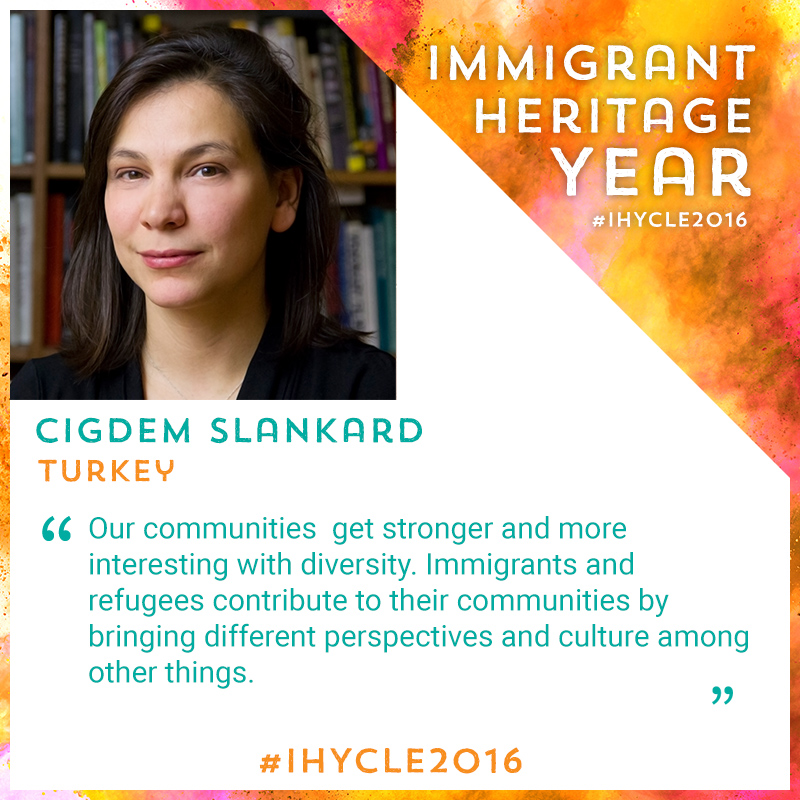
Cigdem Slankard
Where are you from?
I am from Turkey. I was born and raised in Turkey, but I come from a Crimean Tatar family who arrived in Turkey as Displaced Personss in the 1940s.
What was it like growing up?
I had a good childhood. I was fortunate to receive a good education, which allowed me to grow my world in every sense of the word. I lived in big cities, such as Ankara and Istanbul when I lived in Turkey. So I had never lived in a house with a yard until I came to the US.
What brought you to Cleveland?
My husband accepted a job at Cleveland State University and we relocated to Cleveland from Huntington, WV.
What were your first thoughts about coming to America? Did those change?
I first came to the US as a graduate student. I've always been interested in American culture. In fact, I minored in American Studies during my undergraduate study. The value of personal freedom in American culture has always attracted me. I came here to pursue a creative career and I was fortunate enough to succeed. I have lived here for the past seventeen years, a period of time during which I built my career and my family. I often say I was raised in Turkey, but I became an adult in the United States.
What challenges did you face as an International Newcomer transitioning here?
Bureaucracy and paperwork are not my strengths. The biggest challenge for me was to navigate the system and to make sure that I was doing what I needed to do.
What is your occupation?
I am a college professor. I teach Film, Television and Interactive Media production at Cleveland State University.
How have other Clevelanders made you feel welcomed?
Cleveland is a wonderful community. We were fortunate enough to find so many different friends in the past eight years. My identity as a mother and an artist has allowed to meet so many others.
What traditions or customs do you continue to practice?
Turkish food, literature, music are a part of our family life. We visit Turkey often, and also celebrate some of the Turkish holidays.
What do you love about Cleveland?
I love Cleveland's diversity, both in terms of its population and lifestyle. All the cultural institutions, educational opportunities, a rich cultural heritage and access to beautiful parks are things I appreciate. I am grateful to Cleveland Museum of Art, Cleveland Public Library and the Metroparks every time I visit their sites.
Why is it so important to welcome International Newcomers and Displaced Personss?
Our communities get stronger and more interesting with diversity. International Newcomers and Displaced Personss contribute to their communities by bringing different perspectives and culture among other things.
Why is it important to travel abroad?
The world is so much bigger than us. There is so much to to see, so much to learn. Traveling abroad allows us to not be limited by our own borders.

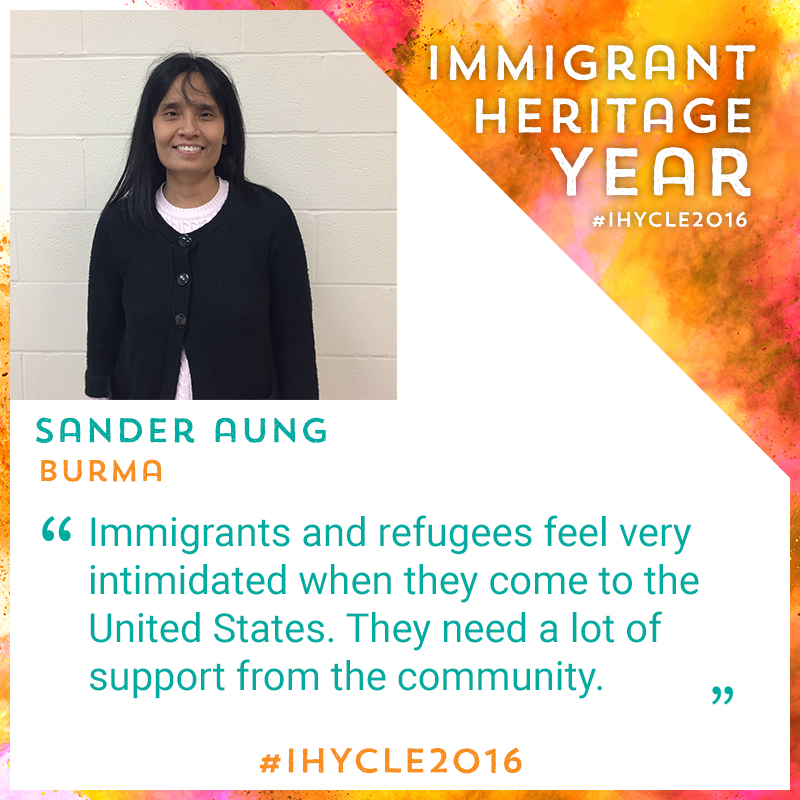
Sander Aung
Occupation:
Instructional Aide
Where are you from?
Burma (Myanmar)
What was it like growing up?
I was growing up in Myanmar and graduated from University in Physics. Our country has been under military regime for over 50 years.
Why did you choose Cleveland?
I married to a man who works in Cleveland and went to college in Cleveland.
What were your first thoughts about coming to America? Did those change?
My first impression in America was very clean and helpful to the visitors.
What challenges did you face as an International Newcomer transitioning here?
Communication and culture shock.
What traditions or customs do you continue to practice?
I continue to practice my country traditions and customs.
How have Clevelanders made you feel welcomed?
Clevelanders always greet warmly whenever they see newcomers.
What do you love about Cleveland?
We love our sport teams, and Cleveland Clinic makes us healthy.
Why is it important to welcome International Newcomers and Displaced Personss?
International Newcomers and Displaced Personss feel intimidated when they come to the United States. They need a lot of support from the community.
Why is it important to travel abroad?
Traveling abroad will expand your thoughts and ideas.
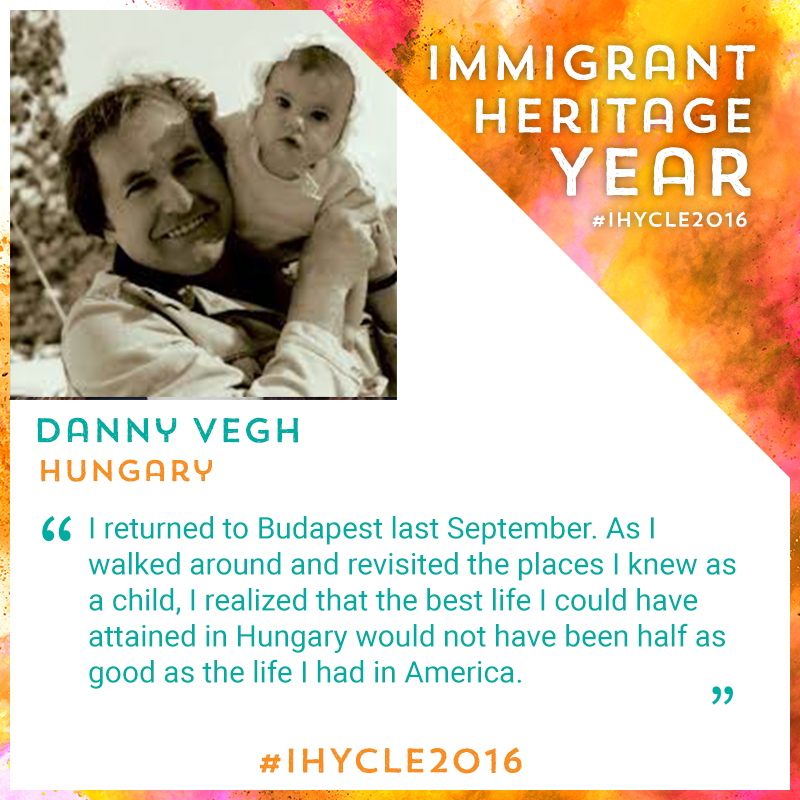
Danny Vegh
Julius Caesar famously said “When you’re in Rome, act like the Romans”. I love this quote, and I feel that when I am in America, I should act like an American. This mentality has provided me great success throughout the years and allowed me to attain the life I have today.
I was born in a suburb of Budapest, Hungary. My house had dirt floors and no running water. We got our first lightbulb when I was 16 years old. There was a church down the road from my house that had a ping pong table in its basement. I loved the sport, and it was the most popular sport in my country. It was popular in third world countries because the equipment was inexpensive. At 16 I became the boys champion. At 18 I became a junior champion. After that, I was a top-ranked player. I became nationally ranked in Hungary, which was home to the best ping pong players in the world.
I came to the United States in 1956. The first few years were difficult, and I had a hard time adjusting to Ohio. Even though Hungary is smaller and less populated than Ohio, Budapest was a far more cosmopolitan city. When I came to the United States, I worked in a factory. I started to play ping pong at a recreational center and people began to notice my skills. I began to play competitively to a wide degree of success. In 1957 I became the Ohio Table Tennis Champion. By 1958 and 1958 I was the national Champion of ping pong in Toronto, Canada. I won the Eastern Table Tennis Championship, and in 1960 I became the US Singles and Doubles US Champion of Table Tennis. I also became Canada’s Singles and Doubles Champion in Toronto as well. After my 1960 championship, I began to receive offers to partake in an exhibition.
Around this time, President Kennedy made physical fitness a priority for young Americans. I was approached by the University of Minnesota, who hired me to put on exposes in high schools and universities in 15 different states. I was thrilled by this opportunity, and my salary increased considerable! I did this for a couple of years. After this, the University of Kansas offered me a similar position, which I took as well. However, I was required to speak for eight minutes as part of the program. I didn’t speak any English at the time, and had no idea how I was going to fill this gap. William Tamko, a principal of and Eastside high school, approached me and offered to write a speech that I would memorize. I was able to recite the words, even if I didn’t know what they meant. For three years, I made speeches to thousands of people without any idea what I was saying. Over these three years, I appeared on national television 48 times, including The Tonight Show, The Michael Douglas Show, and Steve Allen’s Show.
In 1963 I became tired of traveling and staying in different hotels. I wanted to have my own business. I went to downtown Cleveland. As a former national champion of ping pong, I had a great opportunity to make a name for myself. I rented out my own space and hosted a large grand-opening event. I invited the 1936 Olympic fencing champion and my friend, the South American ping pong champion and put on an exhibition. The exhibition was promoted in the Plain Dealer and all three TV channels. The newspapers put my event on the front page of their papers. The event was a huge success! However, after this, the business was horrible. The only way I could keep the business open was to give ping pong lesson for $15 an hour at a time when the minimum wage was $1. I hardly made any money from the club because of the exorbitant rent I was paying for the property. Someone suggested that I add pool tables to my club. I followed this advice and found that pool was far more popular than ping pong. In 1963, when my lease was up, I opened a new billiards club that had a few ping pong tables in it. The club was very successful, and I had about 350 patrons visiting my shop a day.
At this location I hosted a tournament in 1971. I had to get creative about how I would get people in my doors. I hosted a tournament where people could play for free and the profits would go to charity. This tournament was advertised in the Plain Dealer for months before the event was to take place. People would come to my club and pay full price to practice for months before the tournament. The event was a huge success, and turned out to be the 4th largest billiards tournament ever.
Eventually, however, many billiards clubs began to close, including those that belonged to some of the best pool players. I was a good pool player, but not great. It would never be the career for me that ping pong had been. I realized that other players were neglecting their businesses to focus on their pool came. At that moment, I put down my pool cue and focused all of my attention to running my business.
I set up a small shop in pool room and started to sell pool tables and equipment. Unlike other companies, I set up my pool tables so that customers could play on them and get a feel for what they would be like in their homes. Pool tables were then taken directly from the warehouse to the customers’ homes. I sold hundreds of tables in this way.
I advertised my company in every way I could think of. I left business cards everywhere I went. I made pool cues with my name on them and sent them all over the world. I ordered match booklets that had my name on them, and they were distributed at drug stores all over the city. I didn’t make money off of these, but I could go all over the world and people would recognize my name.
Goodyear asked me to build a store in Akron. I opened a shop in Akron, but the building was costly to maintain, and management turned bad when I wasn’t around. When I would come to Akron to help get that shop into shape, the Cleveland store would start to struggle! Eventually, I had to make the decision to close the store in Akron in order to keep the up with the Cleveland location.
In 1979, the building where my store was located was closed and torn town. I moved my business to Lorain Avenue where I opened my first retail store. I was that location until 1992 when I moved up the street and opened a larger store at about 28,000 square feet. Business continued to be very good.
My daughter offered to work with me in 2002. Until then, she had been in law school, but decided to get her master’s degree in business once she joined my business. In 2003, we opened a new business in Akron, and in 30 days the business was in the black. Because the business was doing so well, we opened a fantastic location in Mayfield Heights in 2005. It was the most beautiful billiards location in the world. Both businesses are still there.
I returned to Budapest last September. Today, about 150,000 people live in the area in which I grew up. As I walked around and revisited the places I knew as a child, I realized that the best life I could have attained in Hungary would not have been half as good as the life I had in America. I am so blessed to have the life I have in this country.
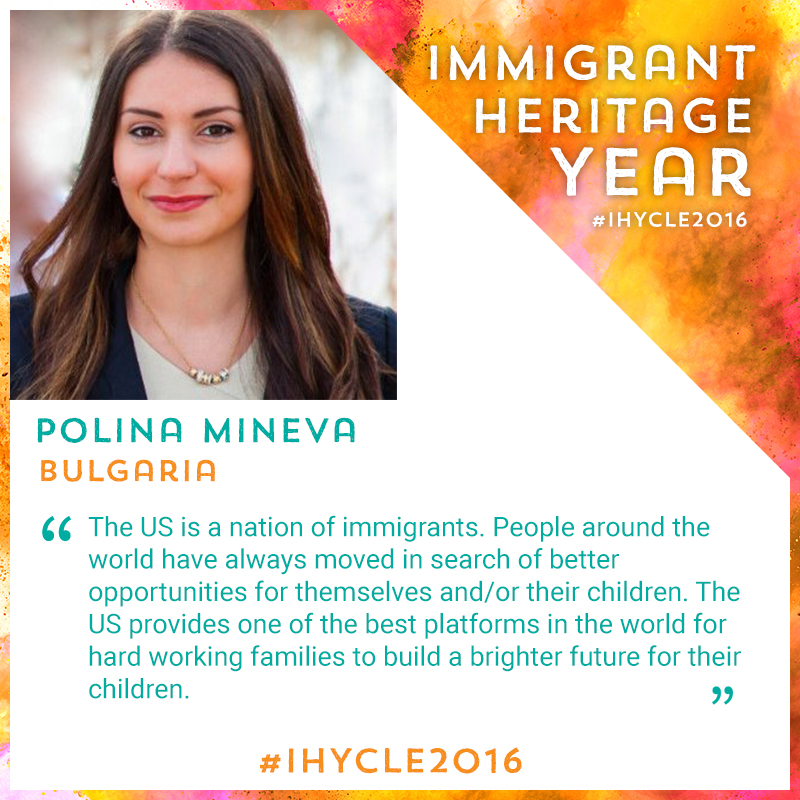
Polina Mineva
Where are you from?
I am originally from Sofia, Bulgaria.
What was it like growing up?
I was very fortunate growing up. My brother and I would spend the school year in the capital and during the summer we would stay at my grandparents’ beach house on the Black Sea. Looking back now, I realize it was my parents who were the lucky ones to get a break from us.
I remember one year we went on a two-week bus trip with my classmates to Austria, Germany, France, and Italy. I must have been only about 10 years old at the time and I remember being allowed to go only because my older brother was going with his friends as well. My parents seemed to ignore the fact that at the time he didn’t like me much so he would have gladly given me away to a stranger if the opportunity presented itself. It is despairing that kids don’t have the same opportunities to travel as freely today because of the always looming threat of terrorism.
What brought you to Cleveland?
I moved to Cleveland from Washington, DC for work about two and a half years ago. My company’s global headquarters are in downtown Cleveland and I accepted the relocation package to further my career.
What were your first thoughts about coming to America? Did those change?
There were many things which I found strange when my family and I first moved to the US that I have now become accustomed to. Our school system in Bulgaria is very rigorous so when I started 7th grade in the US I was placed in an Algebra I class. By the time I was a sophomore in high school I was in AP Calculus. I thought that American kids weren’t as smart but now I know that it’s just a difference in the school curriculum. Americans tend to focus much more on creativity and athletic ability than on math and science which is just a cultural difference. Having just recently watched the 2016 summer Olympics it comes as no surprise that American athletes always dominated the competitions.
What challenges did you face as an International Newcomer transitioning here?
My family relocated to the Washington DC area when I was in middle school and since I was relatively young my transition was fairly smooth. Of course, there was a culture shock in the beginning and a language barrier but as a child it is easy to assimilate quickly. Fortunately, we moved to one of the most diverse areas in the country and I never felt much like an outsider.
What is your occupation?
I work in Global Mobility. I am currently a lead manager for our International Destination Services department.
How have other Clevelanders made you feel welcomed?
I have to say that growing up on the East Coast made my transition to the Midwest quite easy. I was amazed by how nice and friendly people are here. My coworkers had a big welcome party for me on my first day in the office and it wasn’t just my department, the whole company was there! They had these huge posters and everyone had written down their favorite things to do in Cleveland and their favorite places to eat. Almost three years later and there are still a few places left to cross of the list! I can honestly say that if it wasn’t for the people and the friends I have made here I would have moved back to DC a long time ago.
What traditions or customs do you continue to practice?
In Bulgaria we celebrate Name days. Every Bulgarian name, which is associated with an Eastern Orthodox saint, has a specific date on which it is celebrated. On August 15th it is Holy Virgin Mary’s Day so you call everyone you know by the name of Mary or Maria to wish them a happy name day. Although it was originally a religious practice it has turned into just another reason to get together and throw a party for your family and friends. My mother’s name is Maria which is one of the most popular names in Bulgaria. She has four name days during the year which is probably why she has insisted on keeping this tradition.
What do you love about Cleveland?
There are so many things I have learned to love about this city. I love the comradery, especially during sporting events. I love how affordable it is and that as a young professional I can afford to both work and live downtown. I love that I can walk to see a Broadway show in Playhouse Square or walk to one of the three stadiums downtown to watch a game! And last but not least I love how hospitable Clevelanders are.
Why is it so important to welcome International Newcomers and Displaced Personss?
The US is a nation of International Newcomers. People around the world have always moved in search of better opportunities for themselves and/or their children. The US provides one of the best platforms in the world for hard working families to build a brighter future for their children. It is upsetting that the word alone Migration has such negative connotation in so many people’s minds. There are so many great minds around the world, why shouldn’t they be allowed to contribute to our economy and society?
Why is it important to travel abroad?
Traveling abroad allows you to learn so much about another culture so quickly. It is one of the richest experiences you can have. Although on the surface it may look like you’re learning about another country’s history, art, architecture, culture, religion, traditions, etc., in reality you’re learning much more about yourself. Traveling abroad exposes you to new experiences and new people and the way you interact with those people allows you to peer into your own psyche and confront your own judgments. Ultimately, we realize that we’re not very different from one another after all.

In Medias Res
October is awesome. Our world championship team shared their golden ringed joy, our incredible baseball team began the journey to the World Series, and Global Cleveland held the national stage for its work in welcoming newcomers and bringing prosperity to international and native born alike.
In two separate weeks, Global Cleveland was able to share best practices here and learn of best practices nationally in visits with delegations from Buffalo and in Philadelphia.
While in Buffalo with leadership from The City and County and in dialogue with the leadership in Buffalo we learned a lot, taught a lot and came away with the same understanding here and in Philadelphia.
1. No city/community has finished the book definitively on how to welcome newcomers from the Displaced Persons, new sworn in citizen, international student, globalizing business perspective, but here in The Land we have a lot going for us on many fronts
2. The most successful cities are the ones that work with people coming to welcome more, and the fact is the more a city and community focus on economic development the more people want to come to that place
3. The opportunities that Welcoming and Attracting afford are immense and filled with as many opportunities for the international entrepreneur as they do for people who are born and raised in the United States.
Global Cleveland is lucky to have the staff and board it does. It's also lucky to partner with you. I can say this with no hesitation: there is no other organization that does what we do and there is no greater city and county in which to build a more welcoming global community.
Thanks for continuing on with us.

Ben Promploy
Where are you from?
Thailand
Occupation:
Unemployed, but works at Tree Country Bistro family restaurant
What was it like growing up?
It was a lot of responsibility. I was there as a kid so I didn’t have to do much. I went to school but my parents had a lot of responsibility. In Thailand without education you can’t have a future, there’s nothing you can do but here that’s different.
Why did you choose Cleveland?
I came to Cleveland for more opportunities. My parents came here to open a restaurant and I came here to get a better education.
What were your first thoughts about coming to America? Did those change?
I always thought there was more opportunity and it is. There’s more freedom. It was exactly what I thought it would be, I knew exactly what it would be like.
What challenges did you face as an International Newcomer transitioning here?
Language was the biggest barrier for me and adjusting to the system. How school works here is completely different from here. Home you wore uniform, 8-3:30 which here that is like private school.
What traditions or customs do you continue to practice?
I still believe in my religion but I don’t practice holidays or anything specific. I follow my parents lead.
How have Clevelanders made you feel welcomed?
I came from Boston and I liked it, but Cleveland is nice. I went to Beachwood high school and they always welcomed foreign people, I was always treated nice.
What do you love about Cleveland?
I love the suburbs in Cleveland, I like the countryside.
What’s your favorite thing to do in Cleveland?
I like to see the museums.
Why is it important to welcome International Newcomers and Displaced Personss?
There’s more opportunity for them, everyone wants to seek more opportunity and be the best they can be. We should accept them and try to understand them.
Why is it important to travel abroad?
It’s important to learn about other countries and cultures.

Happy Dog Takes on the World: The Next President’s Foreign Policy Inbox
Regardless of which candidate prevails on November 8, the next President of the United States (U.S.) will inherit a complicated international landscape and mounting global problems.
The Syrian civil war shows no signs of ending, with a U.S. brokered cease-fire having recently failed and ISIS continuing attacks in the Middle East and around the globe. The United Kingdom will begin Brexit talks with the European Union in early 2017, testing the strength of both a key ally and stability of a key trade partner. Meanwhile, the U.S. relationship with China continues to betray tensions, as Chinese trade and military ambitions grow. And while Latin America is dealing with the fallout from the end of its commodities fueled boom, Migration out of the African continent continues unabated.
What should the main international priorities be for the next U.S. President? Join us, the City Club, International Partners in Mission, and the Northeast Ohio Consortium for Middle Eastern Studies (NOCMES) for a free conversation on the foreign policy issues facing our next president.
Panelists include:
- Anand Gopal, journalist and author of No Good Men Among the Living: America, the Taliban and the War Through Afghan Eyes
- Kathryn Lavelle, Ph.D., Ellen and Dixon Long Professor in World Affairs, Case Western Reserve University
- Qingshan Forrest Tan, Professor of Political Science, Cleveland State University
- This discussion will be moderated by WCPN host/producer Tony Ganzer.
Location: The Happy Dog, 5801 Detroit Avenue, Cleveland, 44102
Date:
November 10
Time:
7:30 pm - 9:00 pm
Global Cleveland Alumni: Grant Gravagna
This summer, I had the incredible honor of serving as a research associate at Global Cleveland. I couldn’t be more grateful to have had the chance.
Over the course of a quick three months, this job opened my eyes to a number of the region’s individuals and organizations that had previously been unknown to me (take the Ukrainian Museum-Archives, for instance).
In addition to other responsibilities, I assisted in producing Global Cleveland’s International Newcomer Heritage Year series, in which a different Cleveland-area International Newcomer is featured each day. The wide-ranging contributions made by so many members of Northeast Ohio’s international community are nothing short of astounding.
Cleveland is a city of welcoming, and each and every day, the experts at Global Cleveland do just that. They enthusiastically attract and welcome global newcomers to this fair city.
While the staff often works behind the scenes, the effects of said work are constantly observed, particularly in the form of new, international neighbors. When Cleveland’s international community is strong, we all benefit.
For the good of this region, the efforts made by Global Cleveland are efforts that should continue for years to come.

Rock The Pitch
Rock The Pitch's primary focus is to help create a layer of support for early stage entrepreneurs and small businesses, whom we refer to as “The Grinders”. By doing this, we hope to create a polished, smarter, and more prepared entrepreneur, allowing us to collaborate with other local funding opportunities and agencies to help these entrepreneurs move forward in obtaining their goals.
I believe we have a fragmented system that simply needs to be fused together with more collaboration and less competition. We all have a similar goal: to help startups and small businesses grow and succeed. We will use Rock the Pitch events to raise capital for micro funding through Investors, sponsors, ticket sales, and donations. The goal is to work together with organizations like Jumpstart, ECDI, SBA, Health-Tech Corridor, City of Cleveland as well as private investors and some of the nations leading VCs to build a fund that will fill this very early stage gap that exists in our region. These organizations have incredibles tools and support for entrepreneurs and small businesses and play a huge part in making RTP's mission come to fruition. It’s a win win for everyone involved. I was blessed to have an Angel like Fred Geis take a chance on me when no others would, and I never forget that. Starting a company is tough and I hope my experiences both good and bad can help others.
The Oct 29th event will be the RTP kickoff discussing how we will be a major cog in the wheel of early stage support for our local startup community. We will also be helping all participating startups by providing micro funding and early stage advisor support. We will have hands-on advisors & partners from Red Point Ventures, Jumpstart, ECDI, Health Tech Corridor, Smartshape, McCarthy, Lebit, Crystal & Liffman Co lawfirm, Cleveland Department of Economic Development and more. This will have a very “Townhall Meetup" feel allowing entrepreneurs to express what they are going through within our region and give the local agencies a chance to share how and where they can help. We have some very intriguing start-ups showcasing from tech to a food truck and it's so exciting seeing what kind of talent we have in our region.
Bi- National Convergence at the US/Mexico Border
18. 18 people affiliated with the InterReligious Task Force on Central America (IRTF), traveled to the desert in Nogales, a town which straddles Arizona and Sonora earlier this month.
IRTF is a Cleveland based non-profit founded by people of conscience and faith after the martyrdom of two Cleveland women in El Salvador by U.S. trained military in 1980. Carrying on the legacy of other human rights defenders, IRTF educates, advocates, and organizes for peace, justice and systemic transformation through nonviolence. The Task Force works to change international policies, corporate actions and consumer behaviors that undermine justice.
1,000s. Thousands converged at the US/Mexico border to participate in the first Bi-National Convergence, which was organized by School of Americas Watch. SOA Watch’s longtime mission has been to close the infamous School of the Americas (SOA) which has trained thousands of military personnel in Latin America that have subsequently carried out egregious human rights violations against their own people.
After the US House of Representatives voted to defund the SOA in 1999, the Pentagon renamed it to the Western Hemisphere Institute for Security Cooperation (WHINSEC). For over 25 years a weekend vigil with annual participation nearing 20,000 people, has been held at Ft. Benning, GA to remember the thousands killed by graduates. IRTF has facilitated the participation of thousands from Ohio.
78,000+ In 2016, over 78,000 (the majority of whom come from Honduras, El Salvador and Guatemala) have crossed the US/Mexico border and many more have been apprehended at the Mexico/Guatemala border. U.S. Customs and Border Protection apprehensions in the past twelve months totaled approximately 409,000, up 23% from the previous year. To better understand the root causes of Migration and address broader societal militarization, grassroots efforts were made this year to mobilize at the border. Our experience taught us about how neoliberal economic policies and the militarized “War on Drugs” have displaced thousands of Displaced Personss seeking to escape drug- and gang-related violence, as well as state sponsored violence.
In Nogales, and many other areas along the border, Mexican and US culture have been woven together. This fabric has been torn apart by laws that have created economic, social, and legal apartheid. The Obama administration has deported more than 2.5 million people, more than any other administration in US history. We hope all of those who support Global Cleveland, decide to become more informed and get engaged in issues of global justice. To get involved visit IRTFcleveland.org or join us on November 6th from 4-8pm at Beaumont School as we learn from Marlen Sanchez, agroecology expert from the Association of Campesino Workers in Nicaragua.