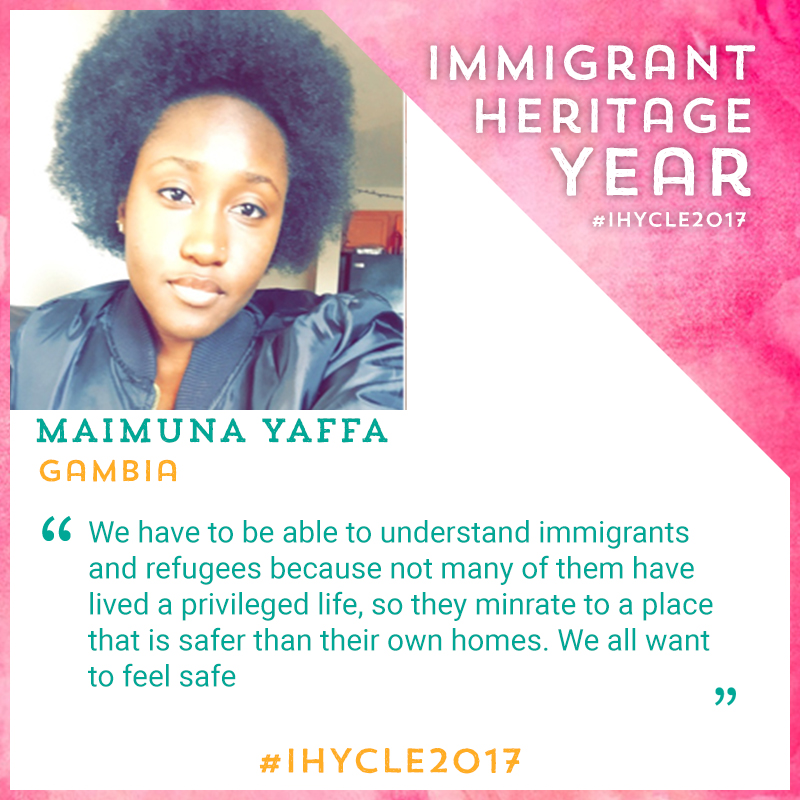
Maimuna Yaffa
Where are you from?
I’m from The Gambia
What was your childhood like?
I moved to Saudi Arabia when I was 6 and lived there for 14 years. I did not spend my time outside playing as a child, I stayed at home majority of the time.
What brought you to Cleveland?
I currently live in Kent. I’m here on a student visa getting my Bachelor’s Degree.
What were your first thoughts about coming to the United States? Did those change?
I have the chance to study in a country with plenty of opportunities and no it has not changed.
What challenges did you face as transitioning here?
Interacting with others. As I have mentioned before, I was secluded growing up and I did not have the chance to interact with many people. I also struggled with being shy and this is a country where everyone talks to everyone.
What is your occupation?
Currently an undergraduate student
How have other Clevelanders made you feel welcomed?
Absolutely, I have met many Clevelanders that made me feel safe in a new environment.
What traditions or customs do you continue to practice?
This is not necessarily a tradition but I do practice being kind and compassionate to anyone I meet.
What do you love about Cleveland?
The love they have for their sport fans.
Why is it so important to welcome International Newcomers and Displaced Personss?
When any of us travel to a new place, we expect people to be kind towards us because we are not familiar with the setting. It is important to make other people feel welcome into our home because we are all trying to live a good life and we all do things we are not supposed to do. We have to be able to understand International Newcomers and Displaced Personss because not many of them have lived a privileged life, so they migrate to a place that is safer than their own homes. We all want to feel safe.
Why is it important to travel abroad?
For knowledge and experience.

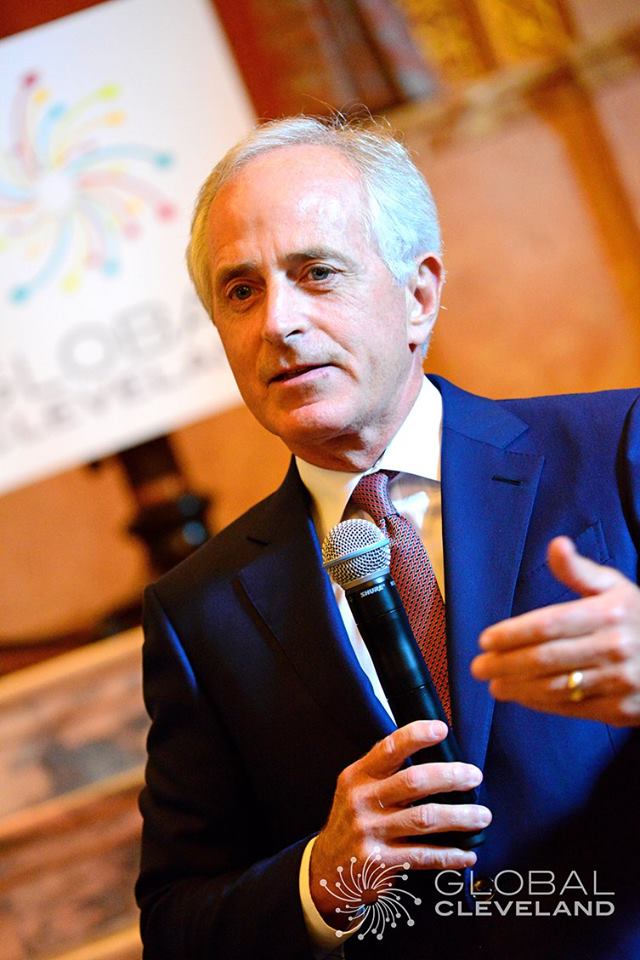
U.S. Senator Bob Corker Speaks at Global Cleveland's Global Partners in Diplomacy Event
On Tuesday, July 19, Global Cleveland welcomed roughly 80 international ambassadors to its Global Partners in Diplomacy reception at Severance Hall. The event, coordinated in partnership with the 2016 Republican National Convention and the U.S. Department of State, introduced the ambassadors to nearly 200 of Northeast Ohio’s civic and corporate leaders.
Guests networked and enjoyed light appetizers in a setting befitting of such an esteemed audience. In his remarks, Cuyahoga County Executive Armond Budish sang the county’s praises, and encouraged the ambassadors to bring investment to the region. The evening’s keynote speaker, U.S. Senator Bob Corker, chairman of the Senate Committee on Foreign Relations, stressed the importance of understanding what “having people of different backgrounds and origins means to your community.”
Below is a transcript of his speech:
“I want to congratulate the City of Cleveland and the county. I love listening to the county mayor with the energy he had. I was able to walk yesterday around the city and was most impressed, number one, with the city. And, I have to say, I’ve been to almost every convention over the last 20 to 25 years. I don’t think I’ve been to a place that is more welcoming, nor have I been to a convention that, in spite of what is being said on the media, is one that is more unique and really homespun. There’s good feeling in being here, I’m so impressed with the effort of this organization to reach out to reach out to people of different backgrounds, to understand the importance of having diversity, of having people come to your community that are able to bring skills and knowledge and background that really broaden your community’s ability to function and to produce, and to welcome other people in. Each community has its own way of attempting to move ahead, and I just have to tell you, especially as chairman of the Foreign Relations committee, my hat is off to this entity, Global Cleveland, what you’re doing to bring talented people to your community and your understanding of what that means for the future.
To the ambassadors, please know that all of us who serve, like I do, understand that we have inherited from people who came before us a heritage. We’ve inherited that. And, the fact that 80 ambassadors from around the world would come to the Republican convention, and 80 ambassadors from around the world would go to the Democratic convention to understand what they believe our country’s role in the world is going to be is something that is very humbling to all of us, and we thank you for coming. We thank you for trying to understand the future. We also understand that when our country functions at the highest levels, relative to foreign policy, the world is a better place. I was talking to a couple of ambassadors before I came up here; one whose country I’d been to, one who hadn’t, and I said, ‘You know, y’all are here. This convention is something that’s probably very unique to your country,’ and that reminded me, actually, this convention is very unique to our country, and it is. And, what’s happened in the process, is that more people in our country are focused on what is happening during this election than probably anytime in recent times. But, what all of you know, because all of you are involved in internationalism, you understand that, around the world, more than ever, people are paying attention to this election. They want to understand what the future is going to be.
Now, I don’t know what the outcome of this election is going to be, and therefore, it is very difficult, because the chief executive, our president, plays such a huge role in foreign policy. We play a role, but in our country, obviously, the president determines more fully than anyone else what our country’s role is gonna be. But, what we need to do, and what Cleveland has done such an outstanding job of doing, is we have a responsibility with our citizens to understand the importance of U.S. leadership and involvement around the world. We have four-and-a-half-percent of the world’s population in America. Four-and-a-half percent. And, yet, we have, we participate in twenty-two percent of the world’s gross domestic product. And, the only way that we’re going to continue to better the lives of our own citizens is to ensure that our citizens understand how it important it is for us to be involved in the world, and most of the ambassadors here, they will tell you that ‘Look, when there’s a vacuum in world leadership, someone will step in and lead.’ And, I think most of them, regardless of where they come from, would rather it be the United States that takes that leadership role. I can tell you firsthand that the world is a better place, the world is a better place because of what the United States represents when we take that leadership role in concert with others. So, look, this is a group of very influential people, people that are very knowledgeable, people that have traveled the world, and people that understand what I just said happens to be true. But, in a country like ours, we’ve got a job to do, because what’s happening with people’s concerns about security, with people’s concerns about economic issues, we are going through a period of isolationism where people want to retrench, and that’s the opposite, in my opinion, of what a great nation needs to do. That’s the opposite of what the world needs to have happen.
So, I want to close by, again, thanking Cleveland. Thank you for your broadness of understanding of what having people of different backgrounds and origins means to your community. I want to thank the ambassadors for paying us such a huge honor and being so interested in what is happening, and I want to commit to all of you that I have a privilege of serving as chairman of the Foreign Relations committee, and I’m going to do everything I can, as one senator, to help take the example that is being set in Cleveland around our country and make sure that we play the rightful role that we need to play in this world. Thank you very much.”

Dr. Naveen Uli
Where are you from?
Originally from India, spent 10 years in New York City before moving to the Cleveland area. Greatly enjoying this region since then.
What was your childhood like?
I grew up in the southern part of India (small town of Manipal in the state of Karnataka). Our family would be considered lower middle class, father taught chemistry at an engineering college, mother homemaker. Went to excellent local schools until 12th grade, then went to the city of Mysore for medical education. I certainly had an enjoyable childhood, with excellent public education throughout my elementary and high school years, as well as medical education. I had a close-knit group of friends, and we used to play every evening in our local recreational facilities. Needless to say, we are all now dispersed over a wide area globally.
What brought you to Cleveland?
After completing my Residency training (Pediatrics) and Fellowship training (Pediatric Endocrinology) in NYC, I worked for 3 years in Brooklyn, NY. Visa restrictions forced me to move out of NY state, and job prospects brought me to Cleveland. Of the many choices before me, this city was the most appealing, mainly for its multicultural dimensions. An additional draw was that I am a great fan of South Indian classical ("Carnatic") music, and the biggest gathering of South Indian classical musicians outside India occurs every year here in Cleveland (the Cleveland Thyagaraja Festival, www.aradhana.org).
What were your first thoughts about coming to the United States? Did those change?
The 2 major areas that were initially challenging were "culture shock" and "climate shock". The former was not as daunting, because I had read enough about the United States, and also initially landed and spent 10 years in NYC, the multi-cultural melting pot that has always been very welcoming of International Newcomers. Coming from a tropical country from a region where climate extremes included high temperatures and heavy monsoon rains, "climate shock" upon arrival in the US, was real. However, the 10 years I spent in NYC allowed me to acclimatize gradually. Apart from the total amount of snowfall, the climate is really not that different between NYC and NE Ohio. If I had spent 10 years in the southern part of the US and then moved to Cleveland, I would have had greater difficulty adjusting to culture and climate.
What challenges did you face as transitioning here?
Upon our move here, I and my wife decided we would be here for the long haul. The first challenge was to find our cultural moorings as Indian International Newcomers, in order to facilitate our family lay down our roots here. The friendly mid-western attitude of our neighbors was very helpful. We also found that unlike in NYC, the size of the Indian community here was much smaller, allowing closer interactions between families and establishing stronger bonds.
What is your occupation?
Physician (pediatric endocrinologist at UH Rainbow Babies & Children's Hospital)
How have other Clevelanders made you feel welcomed?
Allowed me to contribute to the community I live in. I am on the Board of the Diabetes Partnership of Cleveland (located in Beachwood), and Medical Director of Camp Ho Mita Koda (summer camp for children with diabetes), which is located in Newbury, in Geauga county.
What traditions or customs do you continue to practice?
Hindu religious practices; cherish South Indian classical music.
What do you love about Cleveland?
The variety of public resources in so many different areas - music (Thyagaraja Festival, Cleveland Orchestra, Blossom), museums (CMA, CMNH, Botanical Garden), Metroparks, vibrant multi-ethnic food scene (with many options for vegetarians like us). My only wish is that Cleveland should really put our waterfront to multi-purpose use like Chicago. This will make the city a desired destination for way more people, both for localites and out-of-towners.
Why is it so important to welcome International Newcomers and Displaced Personss?
The more diverse the talent pool, the wider the range of ideas and skills, the better chance at success in a globalized marketplace.
Why is it important to travel abroad?
Meeting people across different cultures and nations and constantly exchanging ideas will expand business opportunities and bring people closer culturally.
The Power of Citizenship
This nation is home to 24 million non-native non-citizens, 9 million of whom are eligible to become citizens but for the barriers of cost and English proficiency, which often stand in their way. Every year, Greater Cleveland is proud to welcome the 2,500 individuals who make the decision to become New Americans and Global Cleveland is proud to welcome each new American at every naturalization oath ceremony.
The goal of equality and full participation is enshrined in the founding documents of our nation. The Declaration of Independence begins with the words “We hold these truths to be self-evident, that all men are created equal.” Our history has been one of continued struggle to make these words true, from the struggle to end slavery to the enfranchisement of women. Our democratic ideal is one person, one vote. This is not good for these individuals, for our nation, or for our democracy.
Global Cleveland stands by all International Newcomers and remains steadfast to helping aspiring citizens complete the naturalization process regardless of their political beliefs. Citizenship has many benefits, including protection against deportation, and is the antidote to the dangerous anti-International Newcomer sentiment that has taken a hold in this country. In the weeks, months and years ahead, we will continue our important work and stand with all International Newcomers when we see their rights – and the values of our country – compromised.
New Americans are not the only ones who gain advantages from increased naturalizations. We all benefit when our neighbors, and their children, are grounded in American values; citizenship does that. It’s a rite of passage that unites us, that makes us all part of the rich American fabric.
Find out more or sign up to volunteer your time at an upcoming Naturalization Ceremony here.

Closing Doors to Our Displaced Persons Sisters and Brothers is Not Who We Are
Providing protection to people seeking safety is one of our nation’s proudest and longest standing traditions. Curtailing our Displaced Persons program threatens our shared prosperity that relies on the innovation and creativity of people who come from all places, faiths, and cultural traditions.
“The people who seek to enter our country as Displaced Personss are fleeing violence and threats to their lives,” said President of Global Cleveland, Joe Cimperman “It is our moral duty to help individuals in need and not to discriminate on the basis of nationality or religion. Halting our Displaced Persons program and denying protection to the most vulnerable goes against the fundamental core and strength of America. Displaced Personss are our coworkers, neighbors, friends, business owners and community leaders and we are proud to be a community that is welcoming and inclusive of all people, including Displaced Personss.”
Cleveland is a city that has been greatly enriched by the contributions of our Displaced Persons and International Newcomer communities. International Newcomers contribute to the economic and social vibrancy of our city as neighbors, doctors, community leaders, business owners, coworkers and friends. Two of these community leaders are George Koussa and Isam Zaiem, both originally from Syria, who now call Cleveland home. We agree with George “This is a nation of International Newcomers. We are stronger because of this” and with Isam Zaiem, that “International Newcomers are the new blood that rejuvenates the business and economy of the city.”
According to the State Department, 78% of Displaced Personss resettled in the United States are women and their children. Displaced Personss are here because they face a threat to their safety in their former homes. They are far more likely to have experienced the trauma of violence and unrest than the average American. Marzieh Ayati, an international PhD student from Iran, studying at Case Western Reserve University states “We should keep it in our mind that nobody likes to run away from home if home is a safer place."
Any proposal or statements calling for a ban on Displaced Personss, as well as discrimination based on religion or nationality is un-American. As a nation founded in part by Displaced Personss and International Newcomers, these kind of discriminatory policies dishonor our history, beliefs and values.
Global Cleveland stands with all our Displaced Persons neighbors of all faiths, and we pledge to continue to fight discrimination in all its forms. #WeStandTogether
Here’s how you can join us in our support of Displaced Personss and International Newcomers in Cleveland:
Volunteer your time at an upcoming Naturalization Ceremony and help us to welcome our newest American Citizens on one of the most important days of their lives: Sign Up Online
Make a donation TODAY! Donate Online Your contribution helps us do more to welcome and support International Newcomers from across the globe and across Greater Cleveland.
*Quotes are taken from our International Newcomer Heritage Year Campaign
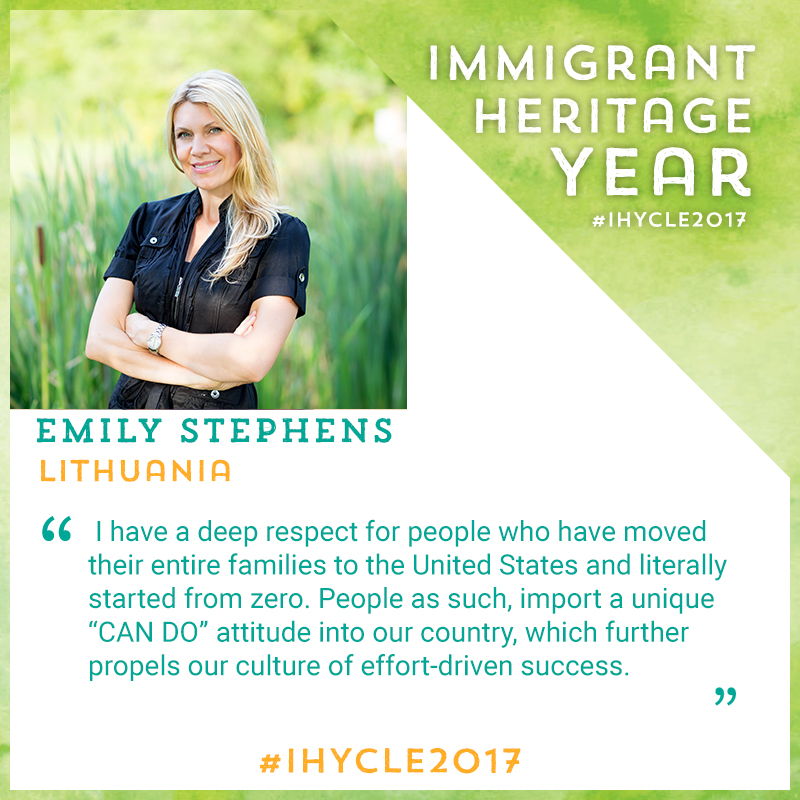
Emily Stephens
Where are you from?
I am from Lithuania, one of the Baltic states that regained its freedom from the Soviet Union, communist Russia in 1991.
What was your childhood like?
I grew up in a small, quaint and beautiful health-resort in the southern-most part of Lithuania. Several hundred years ago, natural salt-water springs were tapped into for their myriad of health benefits, thus giving birth to Druskininkai. The word “Druska” means “salt," so in translation it would be “Salt Town.” Hotels and health-spas sprung up (no pun intended) all over town. By the late 1970’s Druskininkai was home to about ten thousand residents, whose main livelihood was health management, hospitality and tourism. Despite growing up under a communist regime, I had an unusually vibrant childhood. Thanks to my town’s close proximity to the borders of Poland and Belarus, it was like growing up in three countries all at once. Very early on in my life I developed an appreciation of different cultures, as there was an influx of visitors from other countries each month. People flocked to Druskininkai to relax, have fun and restore their health. The house where I grew up was situated smack in the middle of three hotels, one of them was the largest one in the entire town! To say that my back yard was unusual, is an understatement. Living in Druskininkai was like being on an international vacation every day! I enjoyed learning Russian and Polish, just so that I could interact with the tourists, with whom I had formed many friendships. I was sort of the “town chatter-bug,” the word “shy” did not exist in my vocabulary. My parents owned an excursion business called “Panorama," which provided day-tours and overnight getaways to historic sites throughout Lithuania. Panorama hosted travel groups from Azarbaijan, Armenia, Moldova and many others that were within the old Soviet Union. I enjoyed meeting people from all the varying countries and appreciating the unique cultural attributes of each.
What brought you to Cleveland?
In fourth grade, I started learning my fourth language: English. We were taught “King’s English,” where the R’s are not rolled in words such a far, car or expert, etc.. Yet, strangely, intuitively I was the only student that rolled the R’s like in vernacular American-English. Upon hearing that, my teacher gave me a peculiar look, paused to think, shook her head infinitesimally and just let me “roll with it” (again, no pun intended.) Learning English came to me so easily and naturally, that it was almost baffling. Since those were the days way before “mother internet,” I asked everyone and anyone as much information as I could gather about America, the country where the R’s were rolled which sounded oh so cool! Ah, the mind of a 10-year-old. I became obsessed with all-things-America, that my class mates would tease my by saying that I was “a little American born in Lithuania.” I thought it was funny and a great compliment all at once. Even though I wanted to travel to America with all my heart: the iron curtain of communism, lack of sufficient funds and the fact that I was an only child, were obstacles too tough to hurdle. Or were they?! Six years later, thanks to the unfolding of some semi-miraculous events in my life, I ended up on American soil, right here in Cleveland Ohio. Cleveland was not my particular destination of choice, but that of serendipity, as I had distant family connections from my great-aunt’s marriage in the 1950’s. An art and academic foreign-student scholarship was what had brought me here to the beautiful campus of Hawken Upper School, in Gates Mills, Ohio. I came here alone, my entire family eagerly awaiting my return in exactly one year. Little did we all know, that we would not see each other for six years since the day we parted.
What were your first thoughts about coming to the United States? Did those change?
I can relate my feelings to those of Alice in the classic tale of Alice in Wonderland, after falling into the rabbit hole. Within the very first year of being in the country of my dreams, I was flooded with a kaleidoscope of emotions: excitement, nervousness, elation, fear, joy, confusion, wonder, stress, happiness, panic, fun, surprise, longing, and aftershades of each.
What challenges did you face transitioning here?
Words such as: "outsider, xenophobia, different, all alone, language-barrier" were not easy to live with. Coming in as a Junior into a tight-knit private school in a world so radically different from my own, was like jumping into a giant tub of ice. It was a cultural shock. I was the foreign specimen, in a group that has never met anyone from the post-Soviet-Union. As communism and capitalism are polar opposites, so was I in comparison with my new classmates. I looked different, dressed “weird,” talked not as good-English as I had thought, I might as well have had green skin, as that’s what I felt that others saw in me. It took some time for me to get my bearings academically and then socially. That year of my life would probably be the one I would choose to skip, if I could, now that hind-sight is 20/20.
Thanks to the words that were in my personal vocabulary: "perseverance, commitment, grit, passion and resilience," I muscled through what was one of the most challenging years of my life. Yet, that was my price to pay, to assimilate in the country that I adored since fourth grade. I believe that each and every International Newcomer pays a “price,” and “initiation fee” of a sort, before they feel at home in America.
I no longer feel like Alice in Wonderland, my roots have taken deep into American soil and it is truly my home, a place where I was meant to be.
What is your occupation? Are you a member of a civic or social organization?
I graduated from Ursuline College, Magna Cum Laude with a degree in Accounting. Early on in my career I worked in sales, marketing and client management in the corporate retirement plan field. In 2004 I took time off to become a full-time mother for then my daughter Samantha (now 14) and son Dean (now age 12,) my third child Austin was born in 2006. I had my hands full! However, as a daughter of staunch entrepreneurs, I didn’t roll far from the tree. I own a small business creating delicious and visually unique cookies for special occasions. I started Cookie Art (CookieArtDesign.com) as my children were growing up and my relentless entrepreneurial spirit kept beckoning me to create. I am a proud and happy member of Global Cleveland and the Lithuanian Cultural Gardens.
How have other Cleveland’s made you feel welcomed?
With the exception of my very first year here in Cleveland, the rest was rather smooth-sailing. I enjoyed the compactness, versatility, affordability and mid-western conservative values of the city. The people were welcoming and friendly ( once they could understand me.) I worked extremely hard to shed as much of my accent as I could, so that nothing would be ‘lost to translation.” Mastering the language was instrumental in gaining acceptance at my new school, where I was then a senior. In my interactions with many International Newcomers here locally and with people abroad, I noticed their fear of “making a linguistic mistake,” and thus being shy to speak English. I made a point to everyone I spoke with “ to please correct me, if I said something incorrectly.” Upon hearing that disclosure, people kindly helped me build the local language skills that were the lifeline of my success in a country where I was all by myself since a young age of sixteen.
What traditions or customs do you continue to practice?
Cleveland has a large Lithuanian community, on East 185th street and Neff Road. It was there that I made my very first friendships which I treasure to this day. The Lithuanian community was like a bridge from the old world into the new, a comfort zone where I could turn to for “nostalgic safety and familiarity.” It was the place where I kept my Lithuanian traditions alive, while becoming assimilated in a land all so new. It is also a place where I made the connection with my husband Saul, who is a second-generation Lithuanian, and has been raised immersed in the Lithuanian culture. Many years later, our children attended Saturday school at the Lithuanian Club, where they learned the basics of the language, performed in a folk dance group “Svyturys" and learned about the beautiful customs of their heritage. I taught at the Lithuanian School for three years, as my way of expressing gratitude and to continue the traditions that make our culture unique and add international vibrancy to the Cleveland international community. I am a big fan of experiencing different cultures through cuisine. I keep the culinary traditions at home going strong, though my first-generation American children balk at some of the menu-items, such as the traditional pink “beet and root vegetable salad,’ pink cold beet soup (borscht) and herring smothered in a delicious mixture of oil, onions, carrots and dried porcini mushrooms. They do,however, immensely enjoy the Bonkukinas (tree cake)! It is a round, tall and akward looking, yet irresistibly delicious pastry/desert, which they like sharing with their friends. At the Gintaras restaurant, they enjoy traditional Lithuanian grated potato and meat dumplings - Cepelinai. Even though initially my children were reluctant to embrace their Lithuanian heritage, as they are growing older and have traveled there several times, it is amazing to see them identify with their Lithuanian roots and tell their friends about how much fun it is to have another country to belong to overseas.
What do you love about Cleveland?
Just as myself, Cleveland has changed a lot in the past 23 years since I’ve been here. It morphed from a ubiquitous industrial city of the mid-west into one of the most progressive cities in the country, by establishing itself as the health-care hub via world-renown Cleveland Clinic and University Hospitals. It has a vibrant cultural presence and great sports teams. I was thrilled to witness the Cleveland Cavaliers brining home the NBA Championship this past summer and the Cleveland Indians only one hit away from winning the World Series! I am truly happy to call Cleveland home. I have traveled to many cities around the world, and the ease of getting around Cleveland and its suburbs, the great selection of private and public schools, the Playhouse Square, The West Side Market, the Cleveland Orchestra, The Cleveland Art Museum, and many more establishments are the vibrant threads in the tapestry of our great city.
Why is it important to welcome International Newcomers and Displaced Personss?
People immigrate to “higher ground” propelled by their need for safety, economic necessity, sense of adventure, a career opportunity or a passion for a certain country, as it was in my case. No matter what their reasons are, we need to embrace our shared humanity and help people in need from whatever part of the world they come from. Immigrating here on my own was a long and convoluted experience that has made me who I am today. I have a deep respect for people who have moved their entire families to the United States and literally started from zero. People as such, import a unique “CAN DO” attitude into our country, which further propels our culture of effort-driven success. International Newcomers bring with them not just suitcases with a few essentials and a small amount of “seed-money,” but also a tremendous appreciation of freedom and the amazing opportunities America offers to those willing to put in the hard work.
Why is it important to travel abroad?
My parents have instilled in me the love of travel and exploring other cultures. Even though travel in the old Soviet Union was limited to the fifteen countries that comprised it, they covered quite a vast and geographically and culturally diverse area. I remember vacationing in Sochi as a small child, and feeling like I was at the opposite end of the world. My husband Saul and our three children are avid travelers and enjoy learning about other cultures from the locals. As members of Global Cleveland, we have also had the world " travel to us." We have had the privilege and honor of hosting guests from Gabon, Mauritius and Saudi Arabia. By welcoming international visitors into our home, we are shattering cultural stereotypes and growing the global community which we are all a part of. There may be border lines that slice up the map this way and that, as each country is represented in a color of random choosing to distinguish it from others- but those connected shapes make up the vibrant mosaic of our world. Each piece has its own sound, taste, movement, voice and customs. By traveling abroad we gain perspective and understanding, that cannot be gained by simply reading about it or watching it on the screen. It is so intriguing to learn about other cultures and learn from them, because there are SO MANY WAYS TO LIVE A LIFE.
Climbing, Climbing to the Summit
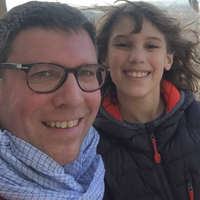
37 flights of stairs, 1500 plus steps to the outer balcony of the Duomo in Florence, Italy at the Cathedral of Saint John the Baptist. We looked across this ancient Italian city to all directions and for a moment felt connected to all of the people outside with us on this summit, on this giant church roof.
It took my daughter and I almost 15 minutes navigating the stairs as we moved heavenward, at times vertically, at times in a spiral staircase of stone that never seemed to end. What moved me was the way the lines up and the lines back down worked together in their own holy rhythm. People from China, India, Saudi Arabia, Japan, Poland, Israel, Lebanon, United States, Wales, Brazil, Australia all moved simpatico up the stairwells and back down. When the passage required the ascender and the descender to go back to back touching through the narrow straits it wasn't a spoken language that was communicated, it was a wave, a smile, and eyes meeting across borders and sovereign nations. No one cringed that our beings had to closely brush as there was only one path. No one even had to say excuse me. There was a sense of a common purpose between all of us. Some of us were straight up tourists, others on a pilgrimage, some looking to overcome a challenge, and others decided to make the climb because they were in Florence. All of us had just met for the first time.
I think about our nation, our state, our county and our city these uncertain days and how whenever we are at our best, it is this shared internal HUMANITY that urges us on. We don't always speak in one another's tongues, we often don't know enough about our neighbor's Geo-history or background. But in a spirit of cultural humility we rise above our own struggles and make so much more progress. We also continue creating economic opportunities for International Newcomers and native borne alike. We fill our neighborhoods and vacant places with people who celebrate different holidays and worship in different buildings; people who still create the ancient greatness of what makes this place and her people worth coming to.
Cleveland is a rare place, one whose population surged both from Migration and Migration: International Newcomers from the East and West, migrant African Americans from the South. And somehow in this year of celebrating the 50th anniversary of the election of the first African American Mayor of a major city in the United States, Mayor Carl Stokes, in the same city that hosts the world known (MULTI) Cultural Gardens of Welcome AND Peace, we are all on a similar journey here in Northeast Ohio.
We have challenges ahead of us. Kumbaya is not a song that comes to people of different lands right away. But there is so much we share here in the beginning days of Black History Month in a community that welcomes newcomers and native born citizens alike.
We have room for entrepreneurs and we have the need for more talent. We know when people have jobs their quality of life and the environment in which we all live improves. We know that hearing other languages at the West Side Market isn't called quaint, it's called CLEVELAND . We know that we have days ahead of great work and greater struggle. But one thing we know and share is that OUR response and our love for one another, regardless of zip or country code, is constant.
Thanks for coming along with us on the journey. Thanks for your openness to reading this newsletter that tells some of what we are working on. Mostly thanks for making our community a place where we can all rest and make a life after our unique climbs.
To the summit.
Joe Cimperman
President of Global Cleveland
Global Cleveland, Always Welcoming
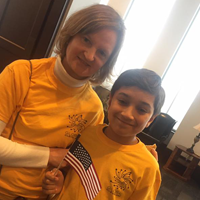
Global Cleveland's job is, and will always be to welcome! Not only is it our mission, but it is our duty to the Greater Cleveland community. Whether it’s an international student from India, a Displaced Persons from Burma, an entrepreneur from Iran, a family from Somalia, or a new American citizen from Syria, Global Cleveland welcomes them ALL!
As we await with uncertainty, new Executive Orders, we know despite the outcome, we will remain committed to our work, and committed to our community. We are here to welcome, and we will continue to welcome, regardless of race, religion, or ethnicity, ALL those who choose to call Cleveland HOME! In the words of John Lewis, “If not us, then who?if not now, then when?”
May we never forget, Cleveland was built by International Newcomers. They are integrating successfully in our community, contributing to the local economy, and enriching the social fabric of our city. They are our neighbors, our doctors, our community leaders, our business owners, our coworkers and our friends.
Global Cleveland encourages you to roll up your sleeves and get involved! The time to make a difference is NOW!
Want to make an impact? Volunteer your time at an upcoming Naturalization Ceremony and help us to welcome our newest American Citizens on one of the most important days of their lives. Want to show support? Make a donation TODAY! A contribution of any amount can help us do more to welcome and support our International Newcomers from across the globe and across Cleveland.