Everywhere I Go, I Represent Both of My Passports
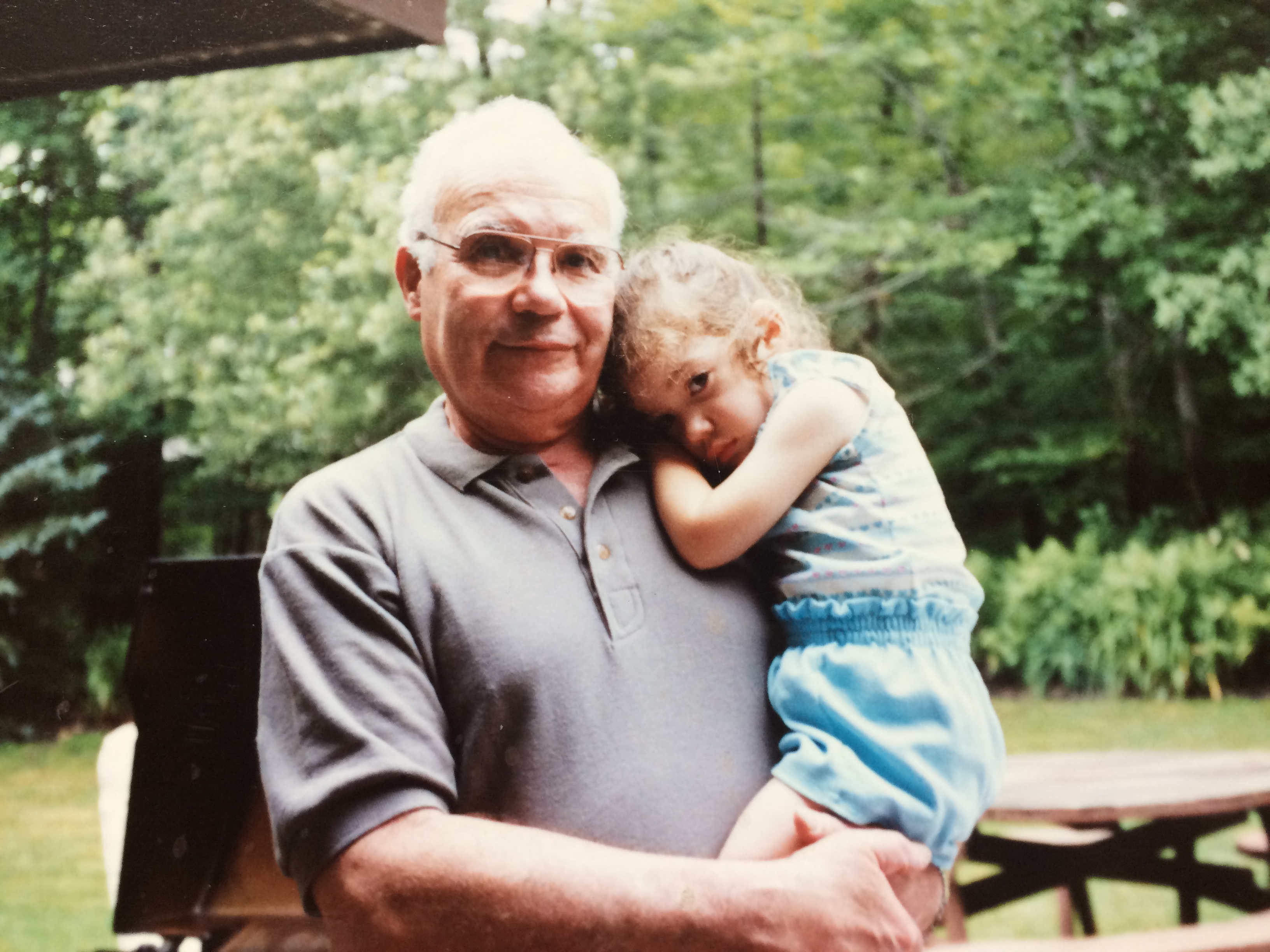
My grandfather, W. Louis Cohn was born to a prominent family in Berlin. His family was involved in various industries, from diplomacy to automobiles to music. He grew up in France and moved back to Germany during the initial years of the Nazi regime. His Jewish father, a career diplomat, was no longer permitted to represent the country abroad. As the political situation grew worse and after Jewish people were stripped of their German citizenship, his family moved to Belgium. The morning after the Nazis invaded Belgium, my grandfather was arrested for being German while walking to school and was deported before he could even notify his family. He was just 12 years old. His train, bound for Nazi Germany, stopped in occupied France and left all Jewish passengers at a concentration camp.
My grandfather spent the next year or two in various Nazi concentration camps in France before finally ending up in Mauthausen, a Nazi death camp in Austria. At that camp he knew his only chance for survival was escape and ultimately worked with a handful of fellow prisoners, aided by the French Resistance, to escape by foot. After their escape, he and his comrades walked from Austria to France, shielded by fake French documents. Having grown up in France, his accent did not give away his true German and Jewish identity.
Just weeks before crossing into neutral Spain, my grandfather and his comrades stumbled upon a group of escaped American POWs. While my grandfather’s English was basic, he was able to connect with a man who said he was from Berea, Ohio. Between having a cousin who lived in Cleveland and this new friend he met by chance from Northeast Ohio, he chose to move to Cleveland after the war.
My grandmother is also a Holocaust survivor, although she and her parents were lucky enough to escape Nazi Germany when she was 8 years old via Holland before it was too late. After living for a few months in a crowded NYC apartment, her parents were given the choice to relocate with assistance to either Pittsburgh or Cleveland. Her parents chose Cleveland.
Fast forward over a decade, after my grandfather had moved to the U.S. after fighting back against the Nazis with the French Resistence, U.S., and British armies. My grandfather had to finish high school before he was able to go to college. He studied full-time and worked full-time installing furnaces. He received a call to install a furnace in the house of a German-speaking family on the east side of Cleveland. That house happened to be my grandmother’s. He met her and fell in love. He asked her on a date. She said that she was busy and had other plans (she was a social butterfly---not playing hard to get). He returned and asked her out again. Again, she was busy. He returned a third time and told her that if she was busy again, he would never ask her out again. Luckily, she was free and they went on a date. A few months later they married, then bought a house and started their family.
One of the things my grandfather was asked about the war is why he didn’t hate Germany for what the Nazis had done to his family. He was very clear that he hated the Nazis, but that there were plenty of good people in Nazi Germany who fought back. He would talk about the people who helped his family get out, or his neighbors who safeguarded some of his family’s dearest possessions, and he was clear that not all Germans were Nazis. Because of those words, I made the decision to reclaim my German citizenship. Germany today is not the same as Nazi Germany. It’s a country that’s open, tolerant, and diverse---it reflects exactly the kind of people my grandfather talked about when explaining why he couldn’t hate the country. He was a proud U.S. citizen. He loved Cleveland and this country. But he also taught me to be proud of who I am, to look beyond the surface, and to recognize that there is good in every society—even if you have to look a bit harder to see it.
In my life, I have been fortunate to live in different states and in different countries. I have studied abroad in Spain and Turkey, lived as an expat in Colombia, and I’ve spent summers volunteering in Ecuador and Argentina. Everywhere I go, I represent both of my passports (and Cleveland too, of course!), and I relish every opportunity to connect with people from all walks of life and from every background. This outlook, shaped by my grandfather’s words of wisdom and worldview, is why I consider myself so fortunate to be able to work with globally-minded people from all over the world every day at the Center for International Affairs at Case Western Reserve University.
Cleveland is such a special place. We have people here from every country and background, all with such unique stories, passion, and potential to shape our community’s future. I thank my lucky stars that my grandparents both chose to make this special, wonderful community their own.
Written By:
Jody Bonhard
Coordinator of Communications, Office of Global Strategy
Center for International Affairs at Case Western Reserve University

Community Partner: City of Cleveland Economic Development Department
The City of Cleveland Economic Development Department, in partnership with Cleveland Citywide Development Corporation, has led the way in helping create an environment where businesses, from the very smallest mom-and-pop shops to the larger international corporations, thrive and grow. As the economic arm of the mayor’s administration, our mission is to provide assistance to businesses expanding within or locating to the City of Cleveland. Through our efforts, we seek to encourage investment which will spur job creation and increase revenues to the City of Cleveland.
What exactly does the Department of Economic Development do?
Our primary way of assisting business to start, grow or relocate to our city is through our various loan and grant programs. Our programs help to offset costs and fill financing gaps at rates that are lower and terms that are longer that traditional banking institutions. Loan and grant programs can pay for construction and renovation costs, equipment and machinery costs, as well as inventory related working capital needs. In return, we require businesses to create jobs locally through our workforce development agreement administered by Ohio Means Jobs and encourage the contracting of local MBE, FBE and CSB for construction projects to help keep our dollars local.
Navigating City Hall
In addition to our financing services, our department can assist businesses in navigating the complexities that arise as they seek to interact with various departments within Cleveland City Hall. We are more than willing and capable of assisting you with permits, business related licenses and technical assistance questions.
Connections
Public-private partnerships are vital to the growth and development of our City. That’s why our department works with a variety of both business financing and technical assistance partners who can help you develop a business plan, find financing and provide other business related services.
So whether you are having trouble identify financing that will fill the gap in your project financing, need help with a business plan or are looking to expand and need assistance identifying a new facility that will best meet your needs, we want to be your one- stop shop for all your business needs. Our professional and friendly staff is ready and willing to work with you to help your business succeed.
Call us Direct at 216-664-2406
[email protected]

Traveling to Odisha to see the Sun Temple in Konark
By William G. Barnard, IV; [email protected]; He lives with his wife Sujata Lakhe and step-daughter Samira in Chagrin Falls and has visited India seven times. His interests include Computer Sciences, Leica photography, wood-working, Arts, traveling and volunteering. His photographs have appeared in the Cleveland Museum of Arts rack card and had honorable mention in the Washington Post travel contest. He also creates art from pressed Botanical specimens.
Whenever Sujata and I travel to India we try to stop at one of the 35 World Heritage sites that can be found within the country. The attention that the UNESCO designation gives these sites makes for a trip that will have an interesting landmark and have the tourism infrastructure that allows for adequate lodgings and transportation. This is especially nice for me with my limited Hindi skills. It allows me to hail an auto in Agra and just say “Taj Mahal” and I know the driver will get me there.
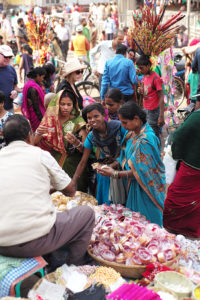
This year we traveled to Odisha to see the Sun Temple in Konark. This 13th century temple was built to represent the “chariot” that the sun god, Surya, rides across the sky every day. The chariot is defined by the seven stone horses that pull the temple on its 24 carved wagon wheels that the temple appears to ride on. Although the main sanctum of the temple and the surrounding structures have fallen the remaining Audience Hall (Jagamohana) is an impressive structure that seems to tower over the market leading up to the temple entrance. The real sights to see are not the imposing structures but the detailed and extensive carvings covering the temple. Many of the carvings show important scenes from life around the temple. Wedding processions, deities and signs of trade with foreign lands can be found covering the temple.
One of my favorite things to do in India is visiting the smaller temples that you find along the way during your trip. The more interesting ones usually have been in existence for many years and are located at a geographical landmark. Some times they have an oddity that makes the visit to the temple extra special. They are not the most interesting architecturally, but they and their surroundings tend to have a character that is difficult to ignore.
Not far from Konark we found the Ramachandi Goddess Temple that over looks an estuary at the mouth of the Kushabhadra river. This small temple with its lively market gives visitors an impressive experience of Indian life. Within the temple lamps can be lit before entering the sanctum of the temple. The lamps along with flowers and other votive items can be purchased inside the temple. The Ramachandi Temple has a very interesting feature. It has a partial skeleton of a whale shark that was found in the Bay of Bengal near the temple in 1994. The six foot tall skull of the shark was draped in garlands and treated almost as if it were a deity itself.
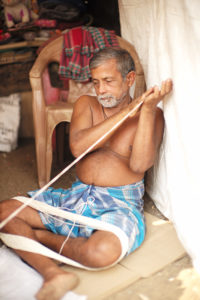
The market outside of the temple seemed low pressure compared to the stands we encountered outside of the Sun Temple in Konark. The owners would wait until you showed interest in an item for sale and the seller would engage with us. In the market we found a merchant tying bracelets he would sell for use as sacred threads to be blessed in the temple.
Not far from Konark is Puri where the famous Jagannath Temple is located. Despite the warning that non-Hindus were not permitted inside the temple by our travel guide book we proceeded to Puri. Sujata told me that she was not going to miss a chance to enter the temple when she was so close to it. I decided to make the best of the situation and bring my camera to the entrance of the temple so I could catch some of the life that was happening outside of the temple.
When we arrived in Puri we traveled down Grand Rd. a wide avenue that leads to the temple is lined by shops and restaurants. Cars and buses are not permitted within 1km of the temple so our driver parked on the street and we hired a rickshaw to the temple. At the entrance of the temple, the market that marks the end of Grand Rd. was vibrant with pilgrims, shops and rickshaws. The day that we visited on was just a typical Wednesday with no religious significance but the number of people were more than I have ever seen in front of other temples or cathedrals that I’ve visited before. This was a really popular place to be at. I wondered what it would be like when a festival that would draw more pilgrims to fill the square up. The Jagannath Temple is famous for the Rata Yatra festival which lasts for a few days. The procession in which the Gods are taken out of their shrine to visit another temple.
The priest or Pandaas, as they are called, are omnipresent. But they were silently and quietly present and not very pushy. Sujata made a contract with a traditionally, but stylishly dressed younger Pandaa. He said it would be impossible for me to enter the temple as I was not Hindu. The Pandaa also said Sujata should not mention her Marathi heritage to the priests inside the temple. Evidently the Odiya priests in the temple remember when the Maratha Empire ruled over this part of Odisha in the 17th century. Sujata told me she would meet me at a textile shop in the square in an hour and then she headed into the temple. With that I was left to explore the market on my own.
I hoped to get some good photographs of the devotees as they entered or left the temple, so I positioned myself at the exit of the temple waiting for an interesting scene to unfold. It didn’t last long for me to be chased out from the front of the temple by beggars looking for donations. I then decide to move to the shops that stood across the square from the temple. One shop that sold metal items including plates and cups had craftsmen out front inscribing items with just a hammer and punch. Many of the other stands in the market were selling bangles and devotional items for the pilgrims to buy for blessing in the temple or donating to the deities.
I worked my way the Textile shop that I was to meet Sujata at and found that the store front was elevated above the street. The area in from of the shop hosted popup vendors with their wares in baskets. This area had what seemed to be an army of barbers armed with only straight razors. There were several men getting their heads shaved when I arrived. They were being shaved before entering the temple. Some were saving the hair but most were leaving it to lay on the ground to be swept up later. One family with a little girl who was not interested in having her head shaved was crying and thrashing around violently while a very patient berber with his razor waited for the girl’s parents to hold her still.
When Sujata returned from he temple she told me of all the things she saw in there. She said that the puja and blessing included being struck on the head with two sticks by a priest. The sticks would make an audible crack when they connected with the head. So I didn’t feel too bad about not getting to go inside.
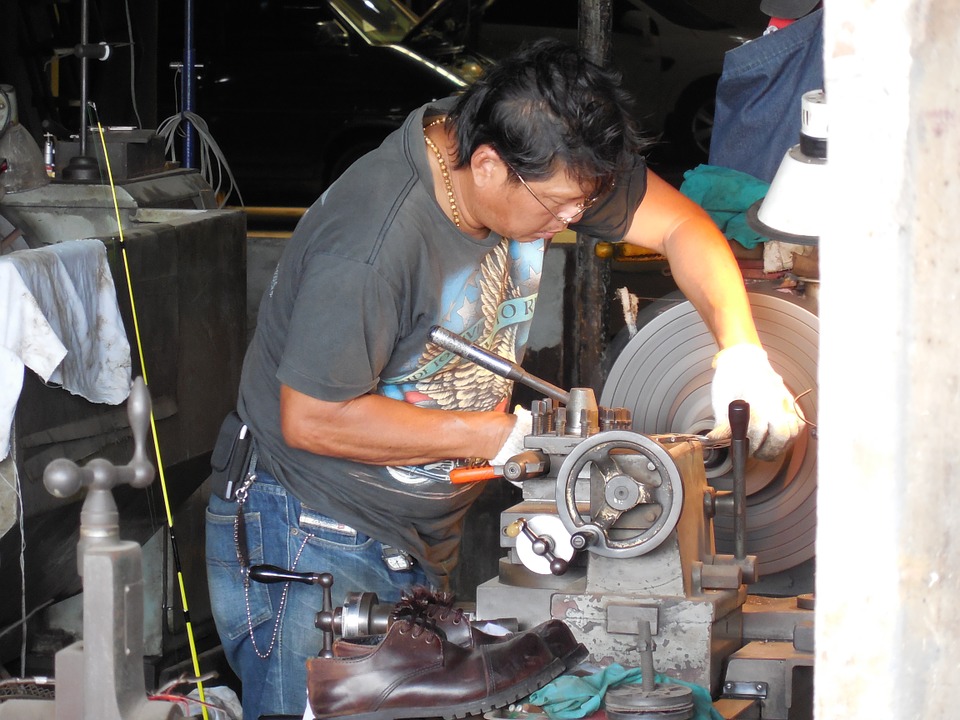
Brain Waste: A Challenge for New Americans
Brain Waste
Researchers find high-skill International Newcomers are often forced to labor at low skill jobs
It can be one of the most frustrating challenges that new Americans face. Often their academic or professional training is not recognized in their new home, and so they must labor at jobs far below their skill level.
Thus do engineers become cab drivers and doctors become physician assistants.
Researchers call this mismatch “brain waste.” A recent study by the Migration Policy Institute found it to be pervasive across the land, affecting nearly two million college-educated International Newcomers and costing communities billions of dollars in untapped potential.
Study co-author Margie McHugh, director of MPI’s National Center on International Newcomer Integration Policy, urges states and communities to take action.
“When highly qualified doctors, engineers, social workers, teachers and other professionals are unable to utilize the academic and professional skills they brought with them to the United States, nobody benefits,” she said in a press release.
High-skill International Newcomers and Displaced Personss confront several obstacles to a professional comeback, including new licensing requirements, the lack of universal accreditation standards, often a language barrier and maybe employer bias.
The researchers suggest states and policy makers help their economies be more competitive by guiding high-skill International Newcomers back to productive careers. They urge business leaders to support efforts to harmonize qualifications across accreditation bodies, and to give international talent a chance.
They also urge communities to adopt “bridge programs” that help International Newcomer professionals gain the licenses and accreditations they need to re-launch.
“This report shows that small, targeted interventions can often lead to big payoffs in reducing brain waste—and that the field is poised on multiple fronts to unlock the skills of International Newcomers and allow families, employers and local economies to benefit,” McHugh added.
The report singles out a Michigan hotline that connects International Newcomer professionals with state licensing specialists, as well as a California program that provides career counselors to help identify alternative professions for International Newcomers who likely cannot return to their previous careers.
At Global Cleveland, International Newcomers are matched with a professional connection volunteer who works in their target field to assist in navigating the process of finding or growing a career in Northeast Ohio.
You can find the complete report, Unlocking Skills: Successful Initiatives for Integrating Foreign-Trained International Newcomer Professionals, at http://tinyurl.com/unlocktalent.

Lee Kareem
Where are you from?
I am from Nigeria.
What was your childhood like?
My childhood was very nurturing and happy.
What brought you to Cleveland?
I work in Cleveland now; but I came to the United States as a Nigerian Scholarship Student at the University of Akron, from Brussels, Belgium.
What were your first thoughts about coming to the United States?
My first thoughts about coming to the United States were that of a unique chance at a superior higher education in the most technologically advanced and socially accommodating country in the world.
Did those change?
Yes, they began to change the moment I arrived in New York City! The technology advancement was and is still second to none; there was more crime, more socio-economic disparity than I had thought, but I also found out that the people were more welcoming and caring than I was led to believe.
What challenges did you face as transitioning here?
The challenges that I faced while transitioning here were the scarcity of equal opportunities to the economically and socially disadvantaged; more so for African International Newcomers. But I also learned that if you are willing and able to work hard, you can create your own opportunities and be very successful in this country.
What is your occupation?
Semiconductor fabrication, higher education, international business development and business advocacy.
How have other Clevelanders made you feel welcomed?
I am fully integrated here. I consider myself a bona fide Clevelander.
What traditions or customs do you continue to practice?
I am very active in the Nigerian American Community in Northeast Ohio.
I strongly identify with my Nigerian Culture as regards Nigerian Food, Music, Clothing, Art and frequent visits to family in Nigeria to refresh my roots.
What do you love about Cleveland?
I love the people! Cleveland people care and that care become obvious in rough times when experiencing tough and personal challenges.
Why is it so important to welcome International Newcomers and Displaced Personss?
It is important to welcome International Newcomers and Displaced Personss because it is a fundamental human right to be able to live free and pursue happiness in a safe and nurturing environment.
It is them today, it could be you tomorrow!
Why is it important to travel abroad?
It is extremely important to travel abroad to learn that 'different' is not necessarily 'bad' elsewhere; to see how others live in order to validate or reject certain perceptions or stereotypes about cultures that are foreign to mine. I can adopt some of their culture or reject some of mine without sacrificing my own identity.
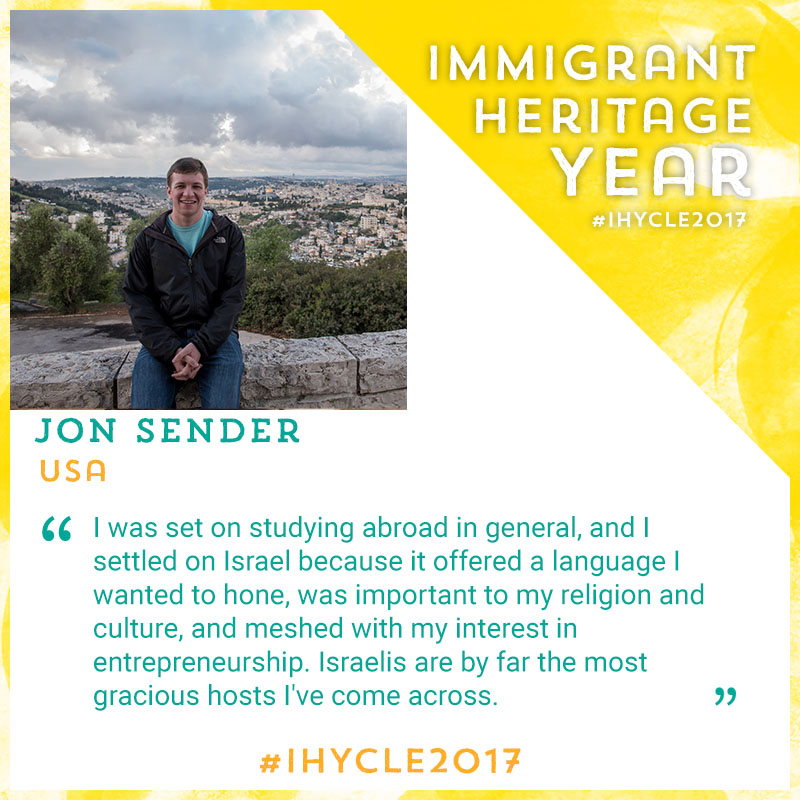
Jon Sender
Where are you from?
Cleveland, OH
What was your childhood like?
Mine was fairly average for a Jewish and middle-class child here, I'd say. I attended Jewish day school, took violin lessons, and played in an orchestra. I was pretty academically competitive as well.
What brought you to study abroad in Israel?
I had actually been to Israel before on a class trip and with Birthright, but this time I wanted to return to immerse myself in its culture and become fluent in modern Hebrew. Given my Jewish day school education, I was already quite close. I was set on studying abroad in general, and I settled on Israel because it offered a language I wanted to hone, was important to my religion and culture, and meshed with my interest in entrepreneurship.
What were your first thoughts about traveling to Israel? Did those change?
I was ecstatic and eager, knowing that I had decided I wanted to study abroad there and having planned the trip for some time. As preparation, I had begun watching Israeli TV, listening to Israeli music, and even practicing my Hebrew with locals who lived in Cleveland. As my departure approached, I became more anxious, but I knew the experience itself would only be temporary no matter what.
What challenges did you face transitioning there?
The biggest challenges I faced were getting used to the parts of Israeli society that clashed with my personality. For example, I had to learn to be more aggressive when standing in line or even shopping at a store. I also grappled with Israeli spontaneity and lack of planning in advance. Above all, I felt uneasy with the way Israelis were not transparent and took time to open up to me. However, once they did they struck me as truly genuine people.
What is your occupation? Are you a member of a sorority, fraternity, or any other civic or social organization?
I'm a graduating senior at Case Western Reserve University, and in September I will start with Deloitte Consulting in Detroit as a Business Technology Analyst. I belong to a fraternity called Pi Kappa Phi.
How did Israelis make you feel welcome?
No matter where I was or who I met, Israelis always made sure I had a place to sleep and a meal to eat. After meeting people on the street and talking to them for a bit, I received more on-the-spot dinner invitations than I can count. In their culture, it is also acceptable to come home with a friend without notice and be treated as a welcome guest. Israelis are by far the most gracious hosts I've come across.
What traditions or customs do you continue to practice?
I don't consider myself a very religious person, only attending temple on the most important of holidays. However, while growing up, my family would always hold a Friday night dinner with everyone together, a tradition known as the Sabbath meal. I try to keep it even while away at college. On occasion I attend my local Hillel, and at other times I'll cook my own version of the meal with a friend or two.
What do you love about Cleveland?
I love that Cleveland is my home. It has everything I could have asked for growing up as a kid, including good education, quality music, and friendly people. Now that I live here as a college student I realize what else the city has to offer, including an affordable cost of living, inspiring sports teams, and support for the arts.
Why is it so important to welcome International Newcomers and Displaced Personss?
I believe it is important to welcome International Newcomers and Displaced Personss because at one point in time, every family began with an International Newcomer or Displaced Persons. People move for different reasons, including fleeing wars, chasing dreams, and more. But wherever they end up, they ultimately support their society at its core. It is those who choose to come to America who appreciate it the most and end up inspiring the ones who grew up here, like myself, who simply take our country for granted.
Why is it important to travel abroad?
Seeing a new place and learning how other people live their lives offers us a sense of perspective. It shows us that others deal with problems we do not have, have solved problems we have not, and also emphasize values different than our own. Travel teaches us to have open minds and to understand that the world is a much bigger place than we imagined.
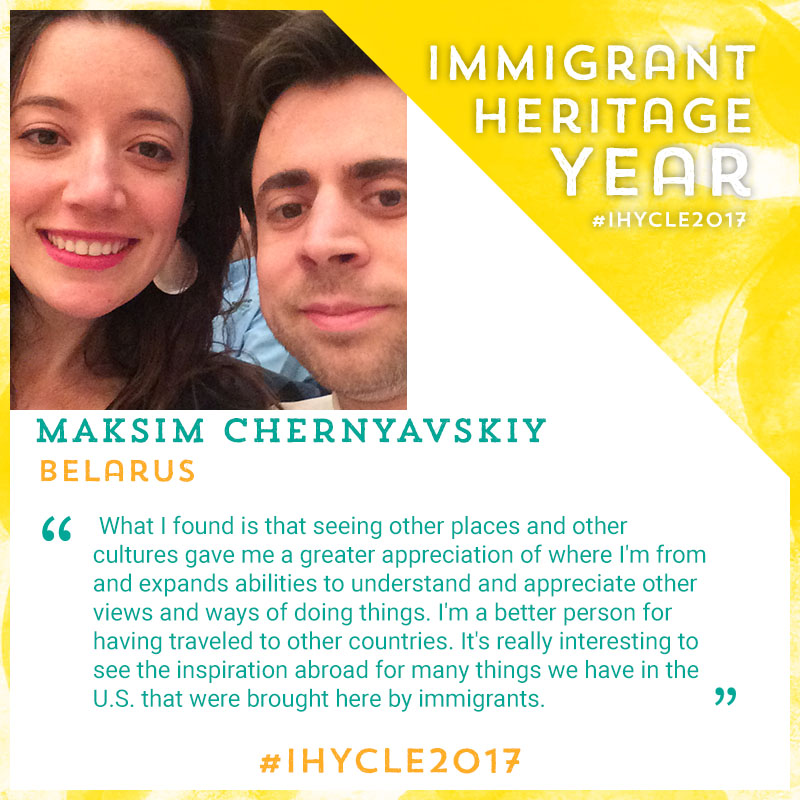
Maksim Chernyavskiy
Where are you from?
Gomel, Belarus
What was your childhood like?
I don't remember much about Belarus. We left when I was 3 due to religious persecution and environmental issue from the Chernobyl fallout. We lived 80 miles north of Ukraine. When we arrived we lived in Cleveland Heights and then moved to Mayfield Heights by the time I started first grade. When we moved to the U.S. both my mom and dad had to start careers from scratch. In Belarus, my mom was an engineer and my dad worked in dentistry. Their degrees and titles weren't recognized. My grandfather was the head inspector and engineer for power for southern Belarus. He was sent to Chernobyl to assist with the cleanup efforts. He wasn't able to get work in his career either. They started school again while working multiple jobs. As a result, they were always very focused on my education.
What brought you to Cleveland?
We had distant family connections to the city and there is a large Soviet population here.
What were your first thoughts about coming to the United States? Did those change?
I don't remember. I was too young. My family always believed that with hard work and dedication anything was possible and they heard on the radios and through hear say that you could succeed in the U.S. with hard work and determination. That was a big driver for them applying to come here.
What challenges did you face transitioning here?
Language, culture. Essentially, starting from scratch was difficult. Reputation was important in Belarus and here no one knew who we were or my family's accomplishments and qualifications.
What is your occupation? Are you a member of a sorority, fraternity, or any other civic or social organization?
I am a Business Manager for an aerospace company. I am a Fiji (Case Western Reserve University) and Summer of the Cuyahoga alumnus.
How have other Clevelanders made you feel welcomed?
I grew up here and identify first as a Clevelander, but people went out of their way to help my family transition to the culture and city.
What traditions or customs do you continue to practice?
We speak Russian and my mother cooks traditional food. We celebrate New Years, one of the most important holidays in our culture, as well as some Jewish holidays.
What do you love about Cleveland?
The people, the heart of the city, and the pride in our community and what it has to offer. Also, the friendliness of the people who will go out of their way to introduce you to and show you the city.
Why is it so important to welcome International Newcomers and Displaced Personss?
The city is made of them. This is Cleveland. This is who we are. Our main commonality is that everyone is different but open to differences.
Why is it important to travel abroad?
With work I did a lot of traveling early in my career and what I found is that seeing other places and other cultures gave me a greater appreciation of where I'm from and expands abilities to understand and appreciate other views and ways of doing things. I'm a better person for having traveled to other countries. It's really interesting to see the inspiration abroad for many things we have in the U.S. that were brought here by International Newcomers.
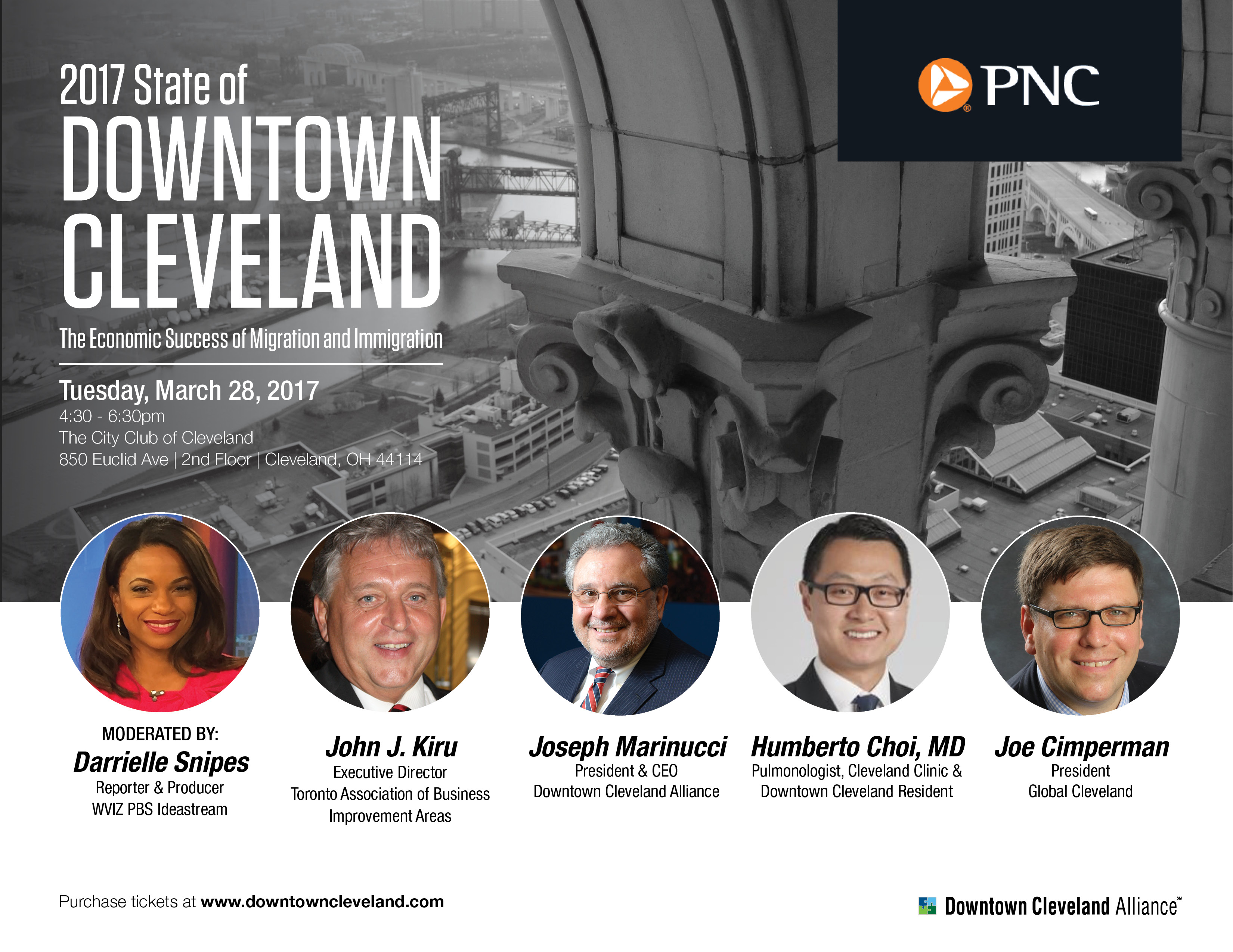
State of Downtown
2016 was a big win not just for the Cavs but also for the city of Cleveland. Downtown Cleveland had the opportunity to host the Republican National Convention, the newly transformed Public Square was unveiled, the Indians made a World Series appearance, and of course, to top it all off, the Cavs NBA Championship.
Clevelanders are anxiously waiting what 2017 has in store.
Before we rush into our expectations for 2017 let’s have a discussion on how the foreign-born population affects our beloved city. The city of Cleveland has thrived because of the importance of foreign-born population who has supplied the labor and entrepreneurial abilities needed for any city’s growth.
Ohio’s International Newcomer population has grown by 2.5 percent between 2010 and 2014. Today, Ohio is home to over 480,000 foreign-born residents. In 2014, International Newcomers in Ohio earned $15.6 billion and donated $4.4 billion in local, state, and federal taxes that year. (http://www.cleveland.com/business/index.ssf/2017/02/cleveland_International Newcomers_pay_taxes_start_businesses_create_jobs_new_american_economy_says.html) Foreign-born workers make up 6.7 percent of all entrepreneurs in the State of Ohio despite only accounting for 4.2 percent of the population.
Migration is a hot topic right now; after all it takes courage and faith to move to a different country with the hopes of making it and fitting into society. The hope of a foreign-born should show the U.S population how determined International Newcomers are, in addition to how they benefit the community from their hard work, not in the least by creating new businesses, and by generating income and taxes. With new amenities flowing around Downtown Cleveland more International Newcomers will continue to find their way to Northeast Ohio and call the Greater Cleveland area home.
For people who migrate from other countries and choose to call Cleveland home these contributions show that Clevelanders have acknowledged the fact that foreign-born residents have assisted with the growth of the economy and are welcomed in the city. A diverse city like Cleveland has various businesses, in particular, restaurants. Clevelanders are known as foodies so it would only be fitting to have extraordinary restaurants from all corners of the world, challenging Clevelanders to explore new foods, countries, and restaurants. The city is dependent on the capability to incorporate new citizens in order to spur technology, innovation, and economic development in order to compete in a highly skilled global economy.
It is not enough to look to history with regards to the importance of foreign-born population, instead, join the conversation on how Migration and international residents can create jobs and influence an energetic 24/7 downtown Cleveland.
To learn more about the impact foreign-born residents in the United Sates head over to The City Club of Cleveland, March 28 from 4p.m-6p.m for The State of Downtown.
Author:
Chiamaka Uwagba, Research Associate, Global Cleveland