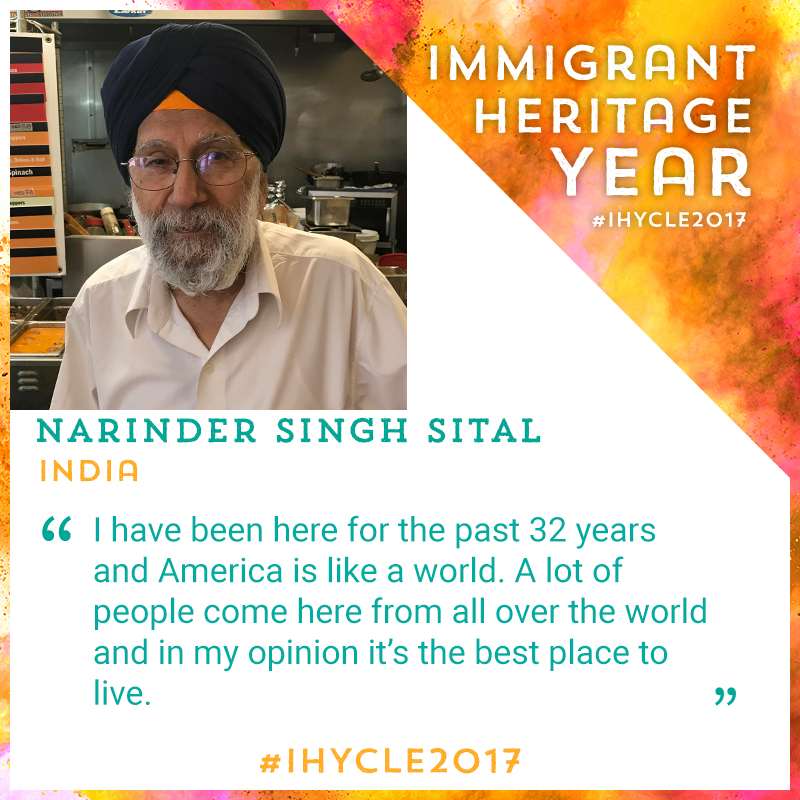
Narinder Singh Sital
Where are you from?
New Delhi India
What brought you to Cleveland?
I found a good opportunity and I came to Cleveland
What were your first thoughts about coming to the United States? Did those change?
The same thoughts….to make some money. Its okay I didn’t like it that much. I have been here for the past 32 years and America is like a world. A lot of people come here from all over the world and in my opinion it’s the best place to live.
What challenges did you face transitioning here?
Because of my identity I had little trouble but people are very accommodating they accepted us and are very friendly with us. I face no problem.
What is your occupation, or what are you studying?
I have my restaurant. I have a small Indian restaurant and me and my wife work to make some money…to live
What project or venture are you working on now that you’re excited about
I am not working on any other projects. I am about to retire now.

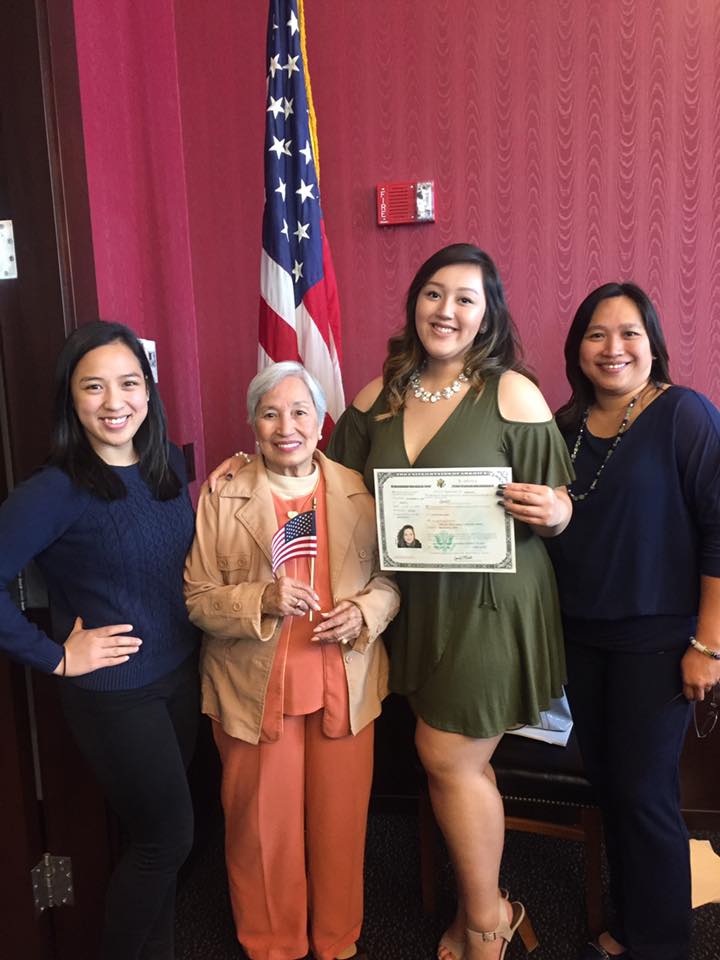
This Flag Day, Welcome New Americans
Global Cleveland invites Clevelanders to celebrate International Newcomers this flag day at a special naturalization ceremony
As part of Flag Day activities Wednesday, 32 new Americans will become citizens at the Rock & Roll Hall of Fame and Museum
Flag Day is a time to display American pride. Increasingly, it has become a day to celebrate the people who most keenly feel that pride, new Americans, and to honor the nation’s International Newcomer roots.
Greater Cleveland will partake in that emerging tradition this Flag Day—Wednesday, June 14--when the U.S. District Court holds a special naturalization ceremony at noon outside of the Rock & Roll Hall of Fame and Museum.
Global Cleveland encourages people to join us in making Flag Day a special event by witnessing a citizenship ceremony and welcoming our International Newcomer and Displaced Persons neighbors.
Thirty-two people from nations around the world are expected to sworn in as American citizens at what is sure to be an unforgettable experience at the Rock Hall. U.S. Judge Dan Polster will preside. The ceremony is sponsored by the Joint Veterans Commission of Cuyahoga County, which is celebrating the 242nd birthday of the U.S. Army.
A naturalization ceremony is a public event where International Newcomers take the Oath of Allegiance, the last step in the process of becoming a U.S. citizen. In Greater Cleveland, the oath is administered by the U.S. District Court for the Northern District, usually on the 1st and 3rd Friday of each month at the federal courthouse downtown. Sometimes the court moves the ceremony to a special location, like the Rock Hall.
As part of a broader citizenship initiative, Global Cleveland staff and volunteers attend every naturalization ceremony. They personally greet and congratulate each new American and provide them with a welcome packet of information. Our aim is to enrich community by helping our new neighbors succeed.
“Migration is not just woven into the fabric of America; it is the foundation of the American story, the source of so much of our progress,” said Jazmin Long, who directs the naturalization initiative for Global Cleveland. “We are so proud to welcome and embrace our newest Americans.”
Global Cleveland is also proud to have joined the #NaturalizeNow campaign, which has a goal of mobilizing one million people to become citizens in 2017. Learn more about the campaign at www.naturalizenow.org/
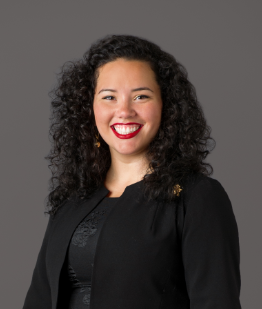
Pro Bono Patriotism: A Lawyer Learns She Has Much To Offer New Americans
By Cassandra Manna
This is an abridged version of a story featured in the May 2017 issue of the Cleveland Metropolitan Bar Journal
Growing up, my parents instilled many important things into my child-sized head: “Say please and thank you!”; “Don’t talk to strangers!”; “Maybe next year, the Browns will be good…”; and “Ohio State is better than that school up north.”
Most of us, at least those of us from Northeast Ohio, grew up hearing similar sentiments from our parents or other adults in our lives. There were two specific things slightly unique to my parents that greatly affected me once I finally graduated from law school and began the move back to Cleveland. The first was the belief that “to whom much is given, much shall be required.” The second, originating from my father’s firm belief and from research of my own, was the certainty that International Newcomers are the backbone of this great country.
I began to wonder how I could wed these two concepts. I was done with school, I had landed a job at Roetzel & Andress, and I was in my dream city. I was in a great place personally and professionally. I had been given so much and I knew I had to give just as much.
I also knew that the International Newcomer community was where I needed to give. I had just been on a tour of the Cleveland School District’s International Newcomers Academy at Thomas Jefferson (INA). The tour was inspiring and I wanted to find a way I could use my schooling to help these International Newcomer and Displaced Persons kids adjust to their new lives in a country that had given me so much and had the potential to give them just as much. I had spent my entire life reading about the International Newcomer experience.
Both of my sisters are adopted, one from South Korea and the other from China. Since I was six years old and we adopted my first sister from South Korea, I was fascinated with the idea of someone, an infant or an adult, traveling halfway across the world to start a new life. The fascination never left me.
That was when I heard about the 3Rs Program of the Cleveland Metropolitan Bar Association. The 3Rs is a landmark program connecting lawyers, judges, law students, and paralegals with high school students in Cleveland and East Cleveland schools. Through a series of in-person lessons, 3Rs volunteers help foster an understanding and appreciation of the U.S. Constitution. They also share important information about how students can achieve their goals beyond high school.
I reached out to Terrence Barry, the American Government teacher at Thomas Jefferson, to start the program in his class. There were challenges. Some of these students had been in the United States for mere days, while others had been here for years. Teaching a class about how the judicial branch works is extremely difficult when most of the students have never heard the words “judicial,” “judge,” or “judiciary.”
I offered to teach the class myself and Mr. Barry enthusiastically agreed. I understood language would be a barrier and that I would have to adjust the program to work with these specific students but I was willing to work with them because of how important I thought this program was to their education. The 3Rs was now a part of the American Government curriculum at Thomas Jefferson.
I enlisted the help of my dear friend, Sarah Smith, a lawyer in the auditing division of PNC Bank, and we began teaching. A few adjustments had to be made right away. First, we could not break out into sub-groups during the classes. English was the second, third, fourth, or, for one in particular, eighth language to many of these students. It was hard enough for them to hear, digest, and understand words while I was the only one speaking let alone if we had multiple speakers talking within one room.
Second, we had to slow down. The 3Rs curriculum provides, for example, 10 hypotheticals to go over with the class. At INA, we usually get through three hypotheticals. This is because we have to act out every part in a very dramatic manner. We also have to define terms. Many of the students did not know what the term “prosecutor” meant. Additionally, we have translators in the class. We sometimes have to wait for them to translate a particularly hefty part of the lesson before proceeding.
Besides those simple adjustments, the students wanted to learn just as much as any other high school student. Once they got comfortable they would ask and answer questions or volunteer to read aloud or act out a specific part. They brought an interesting perspective to the class that shocked us. For example, one student asked what were their rights if a fake police officer asked for their money? Sarah and I looked at each other quizzically and asked, “A fake police officer?”
The student, with murmured agreement from her classmates, explained how thieves back in her native country used to dress up as police officers and go around demanding money and threatening to arrest people if they did not comply. We had to explain (1) how that should not, and rarely does, happen here; and (2) what to do if that happens.
They provided another hypothetical based on the reality of their native country, and another, and another.
We are hoping that we can take The 3Rs program and modify it for use in other International Newcomer and Displaced Persons schools in the area. These are great students who have dreams to be artists and FBI agents and manicurists and teachers and singers and doctors. Educating them to help them fulfill these dreams is an amazing experience.
As lawyers, we have so much knowledge and so much skill to help those in our community. It can be easy to lose that awareness in the day-today grind of our careers. Making a conscious effort to step out of and away from our day-today can help benefit our community and help make us better lawyers and better people.
Cassandra Manna is an associate at Roetzel & Andress. Her practice is focused on comprehensive real estate development work and traditional M&A work for family owned businesses. She has been a CMBA member since 2016. She can be reached at (216) 623-0150 or [email protected].