The Global Economy & Northeast Ohio Business
Global Employer Summit: Realizing the Untapped Potential of Global Talent in NEO
Expert Strategies + Global Talent = A World-Class Cleveland
May 31, 2017
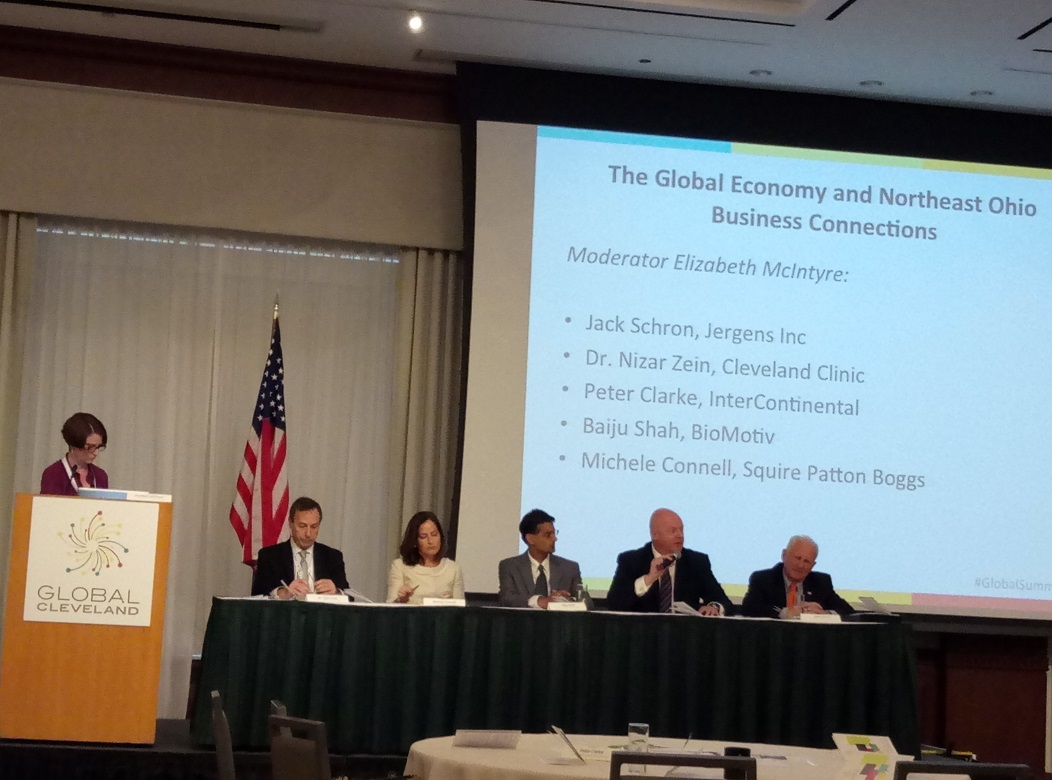
Panel Discussion: The Global Economy & Northeast Ohio Business
Moderator: Elizabeth McIntyre, Editor and Publisher, Crain’s Cleveland Business
Jack Schron, President, Jergens, Inc., and member, Cuyahoga County Council
Dr. Nizar Zein, Chief of Hepatology and Chairman of Global Patient Services, Cleveland Clinic
Peter Clarke, General Manager and Director of Regional Operations, InterContinental Cleveland
Baiju Shah, Chief Executive Officer, BioMotiv
Michele Connell, Managing Partner of Cleveland office, Squire Patton Boggs
“There is no such thing as a local business. Every business operates in a global economy, every business has global ties,” said McIntyre in kicking off the discussion. She then asked that each discussant offer a brief description of why they were on the panel.
Peter Clarke, General Manager and Director of Regional Operations, InterContinental Cleveland for the past 7 months, said that his parent company has 5,000 hotels in 100 countries, but he noted that international flavor is something they maintain at each property as well. “Right here in Cleveland, there are 36 languages spoken here, and 40 countries are represented.” He said the hotel was a strong business supporter and viewed itself as an extension of the Cleveland Clinic. “We provide a culture of service to all of our guests,” he said.
Treating international patients dates back to the first year the Cleveland Clinic was opened, said Dr. Nizar Zein, Chief of Hepatology and Chairman of Global Patient Services for the world-renowned medical facility. Being an international player has always been a part of what makes the Clinic the most diversified healthcare provider in the world. “Each year, we see about about 5,000 patients and their families, so 20,000-25,000 people each year come to Cleveland for care,” he said. “We see the sickest population in the world.” And the Clinic exports its intellectual capital as well, with facilities in Abu Dhabi, and the largest hospital in downtown London set to open in 2020; large projects are also in the works in China and Toronto.
Michele Connell, Managing Partner of the Cleveland office of Squire Patton Boggs, said her law firm was one of the Global 100, with approximately 1600 attorneys across 22 countries, with over half of those outside the US. Squire Patton Boggs was founded in Cleveland 100 years ago but didn’t have its first overseas office until 1970, she said. Today, it handles clients of all sorts and sizes, both those coming in and leaving.
Baiju Shah is Chief Executive of BioMotiv, the mission-driven development company associated with The Harrington Project for Discovery & Development, a national initiative centered at University Hospitals in Cleveland. The company’s focus is accelerating breakthrough discoveries from research institutions into therapeutics for patients. Current projects include a partnership with New Zealand University in cancer. “As a patient,” he said, “you want the best medicine developed in the world, not just Cleveland.” BioMotiv has business partnerships around the world, so his Cleveland-based team has to be competent in all aspects of business cultures.
Jack Schron, born and raised in Northeast Ohio, explained that his manufacturing firm, Jergens Inc. (no relation to the hand cream), makes things for manufacturers all across the globe. And he uses international talent for their skills. “We brought a lot of Hungarian toolmakers here during the 1990s,” he said. Today, his firm has offices in China and India. He noted his company created a business condominium in Asia to help small businesses thrive. “Now is the time to get engaged,” he encouraged the audience.
To start the general discussion, McIntyre asked about workforce development and training, and whether there were barriers to finding and hiring the right talent:
“We are always looking to assemble the best-connected talent,” said BioMotiv’s Shah. However, visa-related issues pose significant challenges to hiring the best talent trained at US institutions. He said companies in general are trying to find ways to hire the right individuals. And while he has seen some changes in recent months, there has been more noise and fury than actual change.
Squire’s Connell said there has to be 100% alignment between workforce development and training and business development overall. “Getting technical skills is critical,” she said, “but we’re missing the connection on the technical side.” She did note that the region is growing talent here in the engineering schools.
The biggest challenge to talent development of the local population, according to Schron, is that they “are missing that excitement about making stuff.” He noted that the Cleveland Clinic runs its own machine shop to make prototypes and needed equipment. To address the region’s needs, he started Tooling University, a place to teach the needed hands-on skills and encourage the mid-level talent person to come to this country. “We can start the greatest company, but we need that next tier of support,” he said. As for sponsorships and the visa lottery, Schron said he believed they are a reasonable business investment for his company.
When asked why it was important to welcome diversity, Zein noted that its necessary for business. “We’re interested in having people come to us,” he said. “Last year, patients from 130 countries came to the Clinic. It affects our reputation.” The most important factors, he said, are diversity of community and how welcoming communities are to travelers.
“My role is to hire the attitude and train the skill,” said InterContinental’s Clarke. “Our skills can be trained, but I cannot train an attitude.” His hotel offers IHG Academy four times a year where they bring people who don’t have a job into the hotel for a 6-week program, and see if they can find a skill in the hotel that they can do. The program has been successful here in Cleveland, he said, and they plan on continuing. One thing they learned from a program in China—“travelers want us to recommend things not in tourist books so they can talk about their experience in Cleveland.” And it’s critical that his team be sensitive to each traveler’s culture, he said, “things like pointing with an open hand, not a finger, so you don’t unknowingly offend the traveler…it’s a skill you can train but it needs the right attitude.”
Because patients started coming to the Cleveland Clinic in 1921, it’s very first year, dealing with international travelers has been a part of the Clinic’s DNA, said Zein. His own staff represents 20-30 countries. Because of the sensitivities around the need for and receipt of medical care, the Clinic has a formalized cultural sensitivity training for staff, including senior management. “We talk about spirituality and healthcare and talk about how spirituality affects how people accept death and illness."
Our economy is growing, said McIntyre, but only modestly. What more could be done?
Schron said there are many great assets in the region and he noted that many are doing the same things. “We need to recognize what’s happening in hospitality, medical, and manufacturing as driving factors for the region.”
Zein pointed out the correlations between so-called “global cities” and “successful cities.” While noting the difficulty in defining a “global city,” he said there are studies that have looked at the links between diversity of a city’s population—who lives there and who visits—and its economic prosperity. He cited the example of Bath, England, which for centuries has drawn medical tourists from around the globe for its natural hot springs. “Bath was the first English city to get street lights and it got sewers before London,” he said, alluding back to Dany Bahar’s (an earlier speaker) comments on Migration and the spread of knowledge.
“Centers of strength within Cleveland include the number of nonprofits doing amazing work,” Zein continued. “What is lacking is a citywide strategy that would include all three (hospitality, medical, manufacturing). Why not provide medical packages for companies to come here, or provide hospitality packages for business travelers…?”
“Global cities are poly-ethnic in nature. We are global city,” Zein said, “but we have a long way to go to be recognized as such.” And many in the room shook their heads in agreement.
The InterContinental’s Clarke noted there are intangible aspects of a successful city or region, and he posed a series of questions: “How do I feel? Do I feel safe? Do I feel welcome? Do people push me aside? Do I offend when I try to speak? Is the public transportation good? What are the WOW factors?”
Using his own transfer to Cleveland, he noted that while “Cleveland has plenty [of WOW factors],” it took his wife 7 or 8 hours to find enough to say yes to the transfer. “It’s very segregated, but we can pull it together.
“Cleveland is a very big small city,” Clarke said, “it’s got everything you want in a city, it’s just not well organized or packaged so you know where it is.”
Cleveland’s WOW factors—those things that are Cleveland’s unique characteristics—are what Squire uses to attract new junior lawyers, according to Connell. But she added a third vote to the fact things are not well organized for newcomers. “Getting them to here is difficult,” she said, “but once here, we show very well. We are welcoming for sure.
“The lack of traffic, the accessibility to the lake—where you can even surf I’m told,” she laughed, “these are things people realize the value of. These are selling points, particularly as we focus on diversity.”
“One thing we undersell,” said BioMotiv’s Shah, “is the people factor in Cleveland. When we think about moving people in, people wonder if they’ll feel comfortable: Will I be around people I’m excited to be around…future colleagues, is there a career path for me in Cleveland? All of these things matter and they are all right here.” And he agreed the marketing of the city could use some help, particularly from employers. “We need employers to be involved. We need private sector advocates. We need help with the gaps,” he said, noting the gaps in services that International Newcomers or students would find easily available in big cities such as Boston.
Noting that Cleveland reportedly has 117 distinct ethnic groups, McIntyre asked the panel if the local firms reach out to local ethnic groups as a way to draw talent from abroad.
“Absolutely, yes, we do that,” said Clarke. He said the hotel had found that an effective way to find solid employees.
The Clinic’s Zein was a bit more reserved, noting that such outreach was done on a case-by-case basis.
When an audience member asked about corporate on-boarding processes for newcomers, Connell noted that the process is dependent on “what the new person is expecting. It requires a lot more personal discussion.” She used the example of bringing someone in who’s used to living in downtown London, England, and taking the Underground (London’s subway) to work every day: “That’s going to be very different if they end up in Solon and we don’t discuss options upfront; they could end up leaving in 1 year, rather than 2 or 3 or 5. It’s definitely a challenge with limited travel options.”
“It’s also what you do with your employees,” said Schron. “It’s what you communicate to employees. We want everyone to know who is coming in and what that person’s job will be. We remind them that 15% of our business is directly related to imports/exports…so this person is also a customer and contributes to your job.
“Even in the manufacturing sector, it’s the soft, touchy, feely stuff that matters,” said Schron. “We try to get that big little city conveyed—it’s people on both sides of this box.”
All members of the panel encouraged local employers to take advantage of the talent base already here, by hiring those already here who want to stay but need to be sponsored. Employers were also encouraged to offer more internships, externships, and sponsorships, as well as offering other international business options, such as sending someone from here abroad, or using third country locations to get people closer, if not in the US proper.
--Reporting by Janice T. Radak for Global Cleveland

International Talent as a Regional Economic Driver
Global Employer Summit: Realizing the Untapped Potential of Global Talent in NEO
Expert Strategies + Global Talent = A World-Class Cleveland
May 31, 2017
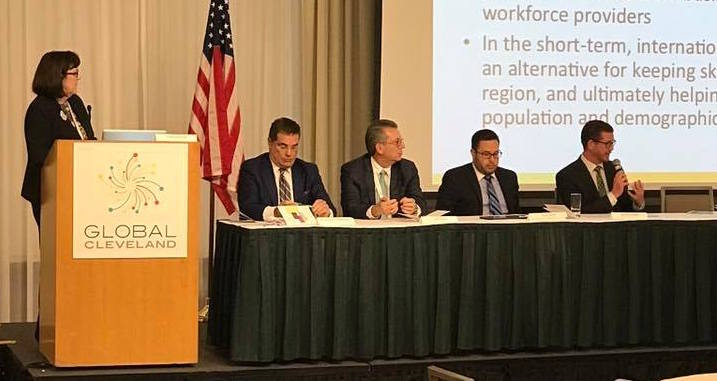
Panel Discussion: International Talent as a Regional Economic Driver
Moderator: Tracey Nichols, Director of Economic Development, City of Cleveland
Dr. Giovanni Piedimonte, Chairman, Cleveland Clinic Pediatric Institute; Physician-in-Chief, Cleveland Clinic’s Children’s Hospital; President, Cleveland Clinic Children’s Hospital for Rehabilitation
Jacob Duritsky, Vice President, Strategy & Research, Team NEO
Dany Bahar, Brookings Institution and Harvard University
Jeff Duerk, Dean of Engineering, Case Western Reserve University
To set the stage for understanding Northeast Ohio’s role in the State and the nation, Team NEO’s Jacob Duritsky explained that the 18-county region accounts for approximately 40% of Ohio’s overall economy with $212 billion annually (as of 2012); includes 4.32 million people with 1.94 million workers; covers 5 metropolitan areas (Cleveland, Akron, Canton, Lorain, and Youngstown); and represents the 15th largest market in the US.
Cleveland faces some significant challenges, which Team NEO is identifying as it updates a 2014 study for The Cleveland Foundation. The US overall labor force has grown more than 9 times faster than the labor force here in the region; there are 160,000 fewer people in the workforce today in NEO than in 2008. In addition, Cleveland’s BA attainment rate (the rate at which people attain Bachelor of Arts degrees from 4-year colleges) is 25%, compared to other growing cities where the rate is more than 30%. Moving forward into the future, 65% of all jobs will require post-secondary credentialing, meaning there is a misalignment of the degrees offered in the region and employers’ needs. In particular, 15 of 18 in-demand occupations are misaligned, meaning only 3 fields have the talent they need to move ahead.
Case’s Dean of Engineering, Jeff Duerk asked the crowd to think of the University 10 years ago: “International students were probably 2%. Today, they make up 14-15%,” he said. His predecessor never traveled outside Ohio, he told the room, “but in the past 5 years I’ve been in 15 countries—touching based with alumni, business partners, and entrepreneurs.
“It comes down to talent, and talent exists anywhere on the globe,” he said. The challenge, he explained, is whether NEO employers are willing to join the competition for international talent by participating in the H-1B visa lotteries. “Are the employers here willing to buy a ticket to participate (in the H-1B lottery)? The chances of winning over 3 years is 75%.”
“Data tell us we are facing significant shortage of physicians in this country—some states are missing every specialty—even primary care,” the Clinic’s Giovanni Piedimonte said. “There aren’t enough Americans willing to fill those positions in those locations.”
“What makes America unique is that it’s the creative engine that makes the US the leader of the world,” he said. “It’s the ability of a person to move his job from one city to another; it’s the opportunity—the concept that people who work hard can actually do well for their families. The US is a meritocracy, where people who work hard get higher and higher [on the socioeconomic ladder] and get what they deserve.
“The US has always been in global leadership,” Piedimonte said, “but there is no way we can do that if we have no internationals among us. If we lose the ability to bring the best and brightest to this country, we will not be America.”
When asked about Thinkbox, Case’s center for innovation and entrepreneurship or maker space as some call it, Duerk described the 49,000-square-foot design and innovation space as a place that allows students to take ideas in their heads and get them into their hands and work with law professors to create businesses. “It puts them on a level playing field with anyone else…. we provide resources that make this environment sticky enough to want to stay.”
“The facility encourages people to take ideas in their heads and see what the market thinks about them—will they sell? It’s open to everyone and definitely an asset to add to list of Cleveland’s WOW factors,” Duerk said.
The Brookings Institution’s Dany Bahar told the crowd there are 3 main issues with international talent as a regional economic driver.
First, he said, migrants have the ability to leave and go to other cities and expand markets—and we want them to come here to do that. Second, International Newcomers are entrepreneurs who create jobs. And third, their diversity of skills spreads and creates knowledge.
There is a relevance for public policy favorable to Migration, he said, because migrants are necessary to grow economically as a country and he pointed to the fact that risk capital tends to be invested locally. He told the crowd that Israel encourages this by investing $7 for $1 invested locally. “Why do they do it?” he asked, “because they get returns.”
But Israel’s public policy also plays another role: it sends a message. “Being allowed to fail,” Bahar said, “it’s part of the process…entrepreneurs need to know there is a safety net and they can start again. And they will start again and again in the same place when they know that safety net is there.”
Team NEO’s Duritsky said that what attracts internationals to an area is business fundamentals. “They want a place that’s inclusive, that has an element of openness and opportunity,” he said, “but we could do more.” He noted that it’s against the law in Ohio to put government dollars into a company, but other states have gotten around their own such laws and Ohio needs to figure out how, lest we lose out.
Duritsky also said there are regional issues in terms of locations, and that the coasts may doing better, but it may be that those entrepreneurs need to be closer to Asia or Europe. In response, other states are looking at their existing International Newcomer talent pools already and trying to better integrate them locally. He said the report referenced at the opening of the session is meant to identify the misalignment so solutions could be sought. “We want to explore how we can better connect people already here.”
The report is also looking for policy perspectives. “We don’t have a building inventory [of what’s available], we have aging infrastructure, we have talent we can’t get to jobs (center city to Solon),” he noted. So, they are beginning to look at existing bus routes, at how to upskill existing talent, and everything in between.
“The elephant in room, however,” interjected Bahar, “is the immensely broken Migration system in the US. There is a huge talent pool already here that could be exploited if we could fix the system.” He noted that employers are not willing to pay the price for the H-1B visa process and he lamented the fact that the system doesn’t break down skills, but rather uses a one-size-fits-all approach. “Canada and Australia make it easy for migrants to work there,” he said.
Duerk agreed the process was problematic and noted that Case had hired a person to help students navigate the US Migration system and to work with employers to get funding to do so.
--Reporting by Janice T. Radak for Global Cleveland
The Economics of Global Migration
Global Employer Summit: Realizing the Untapped Potential of Global Talent in NEO
Expert Strategies + Global Talent = A World-Class Cleveland
May 31, 2017
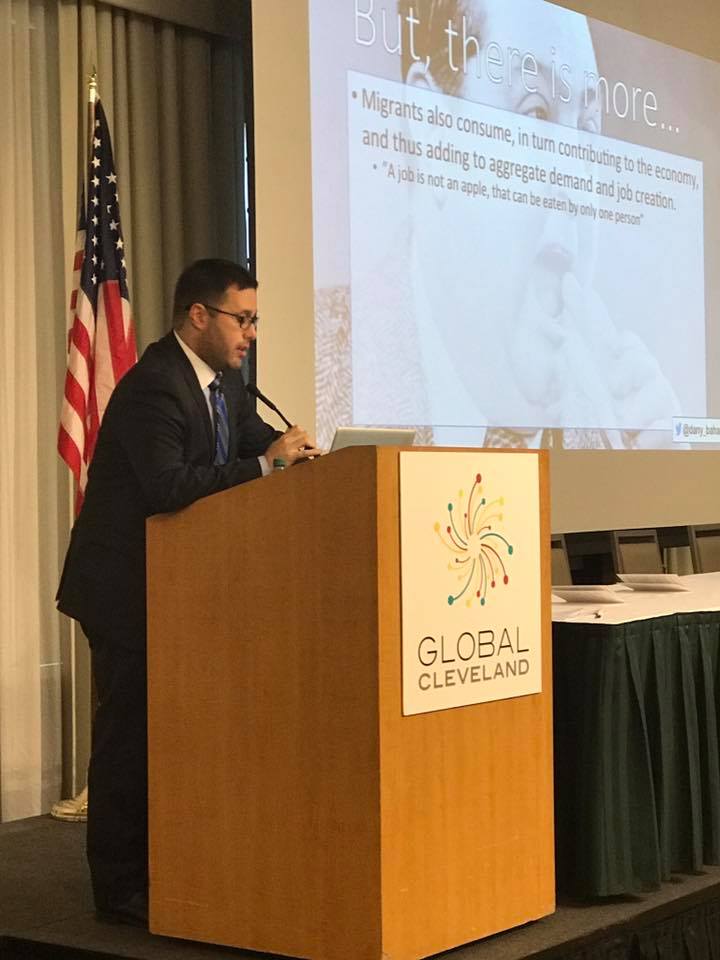
Dany Bahar, PhD Brookings Institution, Harvard University Center for Development
After a brief introduction by Global Cleveland President Joe Cimperman, Dany Bahar, PhD, of the Brookings Institution and the Harvard University Center for Development, told the crowd he was there “to wake you up.” He told the group that, contrary to current rhetoric, Migration plays a critical role in the global economy. His research focuses on how International Newcomers diffuse knowledge around the globe and create jobs in their wake.
Migrants represent 15% of the US population, yet make up more than 27% of entrepreneurs in the United States. Bahar used the example of Siracha sauce, an Asian hot sauce that has become ubiquitous throughout the US. The US manufacturer, Huy Fong, was founded in 1980 by David Tran, who named the company after the freighter that carried him and 3,000 other Displaced Personss from Vietnam to California in 1978. Today, Huy Fong has nearly 200 employees and its annual sales exceed $60 million per year. Bahar went on to explain that new businesses (those less than 5 years old) have created ~1.5 million jobs per year for the past several decades.
What about the effect on local wages? That depends, he said, on whether the International Newcomers are complements or substitutes for the native or existing workforce. A 2011 study found that migrants tend to compete with migrants. And a study from 2015 showed that unskilled natives respond to increased Migration via upward skills mobility—focusing on work that makes better use of their command of English, or moving to other less manual jobs.
Bahar also noted that migrants consume just as natives, thus adding to aggregate demand and job creation on local economies. And while many illegal International Newcomers do pay taxes, they do not claim the benefits. He noted a recent report that shows the average fiscal burden of each migrant is about $1,600. But second and third generation migrants create a net positive fiscal contribution of $1,700 and $1,300, respectively.
Migrants bring diversity and diversity builds output, Bahar said. A 2016 study showed that increasing birthplace diversity of skilled International Newcomers by 1 percentage point raises long-run output by about 2%. For US firms struggling to export and invest in foreign countries, migrants can reduce the cost of doing business by providing a bridge between the 2 countries. For example, he said, a recent study showed that US states that randomly received more Vietnamese Displaced Personss in the late 1970s are larger exporters of goods and services to Vietnam today. More importantly, the study showed this is applicable to all countries and particularly for goods that are differentiated, and is applicable to investment.
Migration also plays a critical role in the international diffusion of knowledge, Bahar said, which is good, since knowledge is difficult not only to transfer, but also to acquire. “If I had a toothache, I could read all the information on the Internet and all the books and look in my mouth, but would I have the knowledge to fix it?” Bahar asked the crowd. There is knowledge in books, then there is knowledge that cannot be put on paper. “You want an airplane pilot with experience in the cockpit flying the plane,” he said, “not someone who got A’s in bookwork only.”
Crediting the works of Michael Polanyi and Kenneth Arrow, Bahar explained that productive knowledge has a large tacit component—nuances that can only be learned by doing, and that channels for transmission of tacit knowledge are limited to human interaction. So the spread of tacit knowledge relies on human minds, not written words, and migrants provide this increased level of human interaction. In turn, those interactions spur innovations on a local level and that expertise will spread as individuals move. In support, he cited examples from patent citations, which are predominantly local; the challenge multinationals have transferring knowledge with subsidiaries around the globe; the import-export growth of wine and rugby jerseys between South Africa and France; and the growth of exports from Germany after Displaced Personss from the Balkan war returned to their former Yugoslavian countries.
There is vast evidence on the positive role migrants play in the economy, Bahar said. “In the era of productivity slowdown, knowledge diffusion is the biggest challenge our economies face. It is far easier to move brains than knowledge.”
Regarding policy, Bahar noted that illegal migrants and Displaced Personss may have less to offer because of the uncertainty of their situation, which prevents them from investing. Conversely, he acknowledged the risk employers take when investing in migrants because working migrants have a better chance to go back and contribute to the development of their home countries and in turn make strong economic links with the US.
He concluded by asking, if temporary Migration is good—the employer gets the benefit of the migrant’s work product while employed, then why don’t more firms do it? The answer, which would be echoed throughout the day, is uncertainty.
--Reporting by Janice T. Radak for Global Cleveland

How to Get A Referral to Your Dream Job
Author: Chris Ng
A Jobvite study found that employee referrals have the highest applicant to hire conversion rate with 67% of employers and recruiters saying that the recruiting process was shorter. But how do you get a referral from someone in a company where you have no 1st-degree connections?
There are two ways you can go about in doing this. One is by cold messaging/emailing people who work at the company, and the other is by finding someone in your network who knows someone else in that company. Essentially, finding a 2nd-degree connection where your mutual colleague is willing to introduce you to the other person.
But before we get into how to ask for a recommendation or a referral, you need to do your due diligence regarding the company and the role you are looking for in your next play.
5 Gripes Referees Have With Referral Seekers:
- Cold referral seekers
- Not serious about switching roles
- Not inquiring about a particular position
- Being demanding
- Asking what the trick is
1) Cold referral seekers
No one likes getting messages from someone we do not know asking for a favour. It is generally a bad idea to come out of the blue and ask a person for a referral when they have never worked with you professionally. A bad referral would prove detrimental to an employee’s reputation in the company, which is why there is quite a hesitation towards referring someone whose skills you cannot vouch for (also, is it really a referral if you do not even know that person?).
Instead, try to find mutual connections to bridge an introduction towards the referee. Otherwise, show that you are interested with specific examples rather than buzz words and rote messages.
2) Not serious about switching roles
Asking someone to take time out of their day to help you get a job at their company is a big ask. Even for a colleague, you have worked with in the past, this is a cumbersome process at most companies. If you end up making it to the funnel make sure to update your referee on your status and if you found out any deal breakers that would deter you from joining their company. Keep in mind, especially for millennials, where you work can be your identity so be sure to do so tactfully.
Changing jobs is an important life event, being transparent with your contact would serve you both better as it clears the air if either party wants to move forward with the process.
3) Not inquiring about a particular position
Most companies have all the available positions online. While a number of companies do not have their job listings fully baked into LinkedIn or have positions that are not advertised yet, it is still a good idea to identify positions that are you are interested in by browsing through their online listings. At the very least it shows that you did your homework and are serious about looking for a new role.
A great way to start a conversation with a referee is to link them job postings from their company you have seen beforehand to have a common understanding of what role you are looking for.
4) Being demanding
Sometimes there are no roles available at the moment, and while it is perfectly ok to ask someone to keep you in mind if they hear anything, it is generally bad practice to harass someone to keep checking and asking if there is something available. Remember, the employee you are trying to get a referral out of is essentially the start of your interview process.
It is always a good idea to send a thank you note to your referral after the whole process even if you did not get the job.
5) Asking what the trick is
I could not count the number of times I have been asked this question personally: “What is the trick to landing a job at [company]?”. No there is no trick, no keyword, and no secret phrase that would instantly get you hired anywhere. While it is generally harmless to ask about the interview process such as how many rounds, what type of questions, and timelines - it is frowned upon to suggest that the reason why someone got hired is that they knew a trick.
A better question to ask referees about the company is the company’s mission and vision, culture deck, technologies used, and projects they are working on (that have already been launched).
Role Play #1: Cold Referral Email Template
(Good for 3rd-degree connections!)
To: [Employee]
From: [Referral]
Subject: [Employee] <> [Referral]: Looking for a role at [Employee’s Company]
Hi [Employee]!
Sorry to bother you with this random email, [explain why they are a good fit to cold email].
[Why Referral is interested in working at Employee’s company]
[Why Referral is a good fit to work at Employee’s company]
Would a call at [proposed time] work for you? You can reach me at [Referral’s Number].
Thanks,
[Referral]
[LinkedIn Profile URL]
[Email]
[Phone Number]
Role Play #2: Cold Referral Asking Message
(The right way to ease in a request to that colleague you haven’t talked to in years!)
[You]: Hey [Referee]! How have you been? How has [Referee’s Company] been treating you?
[Referee]: Hey [You]! I’ve been good how about you? Work has been great - love it here!
===
[You]: So I have recently been looking for new opportunities and thought [Referee’s Company] would be a good fit because [List Reasons Why]. I am particularly interested in these roles: [URLs to Jobs]
[Referee]: Sounds great! Our referral process is [Explanation of How-To of the Referral Process].
===
[You]: Thanks! I just did all the steps :) Will update you as I move along the pipeline!
[Referee]: No problem!
Role Play #3: Introducing A Referral Email
(How a 2nd-degree connection can help you get to that hiring manager!)
To: [Employee], [Referral]
From: [Introducer]
Subject: [Employee] <> [Referral]: Introduction
Hey [Employee],
[Something about the referral and why they would be a good fit]
Hey [Referral],
[Something about the employee and why you would like to work there]
You both do your thing!
Best,
[Introducer]
===
To: [Employee]
BCC: [Introducer]
From: [Referral]
Subject: RE: [Employee] <> [Referral]: Introduction
Thanks [Introducer], moving to BCC!
Hi [Employee]!
Thanks for taking the time to talk to me!
[Why Referral is interested in working at Employee’s company]
Would a call at [proposed time] work for you? You can reach me at [Referral’s Number].
Thanks,
[Referral]

Referrals are key to any organisation’s growth. Do not underestimate the importance of your connections in the search for your next role. I even got my first full-time position through an employee referral!
Please comment below if you have any other best practices on asking for a referral from someone inside and outside your network!

Employee Referrals Remain Top Source for Hires
Employee Referrals Remain Top Source for Hires
Indeed delivered 72 percent of interviews and 65 percent of external source of hires in 2016.
Author: Roy Maurer
percent of all hires overall in 2016 and 45 percent of internal hires, recently released data show.
Job search engine Indeed again ran away with the external source-of-hire crown (65 percent), producing twice as many hires as all other top branded external sources combined, according to the annual Sources of Hire report released by Chicago-based talent management software company SilkRoad.
[SHRM members-only toolkit: Introduction to HR Technology]
The study analyzed data from more than 14 million applications, 655,000 interviews and 329,000 hires, aggregated from more than 1,000 participating companies and collected through SilkRoad's applicant tracking data.
"Employee referrals have proven success," said Amber Hyatt, SHRM-SCP, vice president of product marketing for SilkRoad. "Employee referrals have excellent conversion rates from interview to hire, as well as typically longer tenure with the organization. Recruiting teams are very aware of the benefits of leveraging employee referral programs to cost-effectively recruit, speed the time to hire and secure top talent to fill hard-to-fill positions."
Even though studies consistently show that employee referrals improve quality-of-hire and retention rates while lowering hiring costs, they are still underutilized.
"I find most organizations spend the least amount of money marketing and automating their referral program than any other single source they have," said Tim Sackett, SHRM-SCP, president of HRU Technical Resources, an IT and engineering staffing firm headquartered in Lansing, Mich. "Yet, it's their No. 1 source and their No. 1 quality-of-hire source."
After referrals, internal moves (21 percent) and recruiter-sourced hires (19 percent) make up most of the remainder of internal sources of hire.
Indeed Rules External Source of Hire
Indeed strengthened its position as the top external source-of-hire resource for employers, climbing from 58 percent of external hires and 52 percent of external interviews in 2015 to nearly two-thirds of all external hires and almost three-fourths (72 percent) of all external interviews last year. When internal and external hires were combined, Indeed nearly overtook referrals at just under 30 percent.
But while Indeed does have bragging rights in both hires and interviews, another interpretation of the data signals a misallocation of resources, according to Sackett. "Indeed does drive a ton of traffic and for many companies that's organic traffic, so you can't beat that," he said. But he cautioned that "If you're interviewing a ton from a source because you get great traffic, but you don't make many hires, it's a greater waste of time than those sources where you get a high interview-to-hire ratio."
He sees a similar problem with LinkedIn, which along with CareerBuilder was found to generate the most jobs and interviews after Indeed, though at much lower percentages.
"When I ask most companies to give me their No.1 spend, LinkedIn is almost always their largest single purchase when it comes to the source of hire, even though it's No. 7 overall," Sackett said, referring to the SilkRoad data. "If your single biggest spend is on LinkedIn, yet it's not your single biggest source of hire, you're being taken," he added.
Hiring from Outside vs. from Within
In general, external sources—whether online job boards, recruiting agencies, campus events, job fairs or walk-ins—produce the majority of interviews (62 percent), compared to internal sources such as careers sites, in-house recruiters and employee referrals (38 percent). Yet, it takes four times as many applications from external sources to get to the interview stage and twice as many interviews for a job offer. Internal sources ultimately produced 52 percent of hires in 2016, compared to 48 percent from external sources, according to the report.
"We expected to see a better conversion rate for internal sources as they produce a more well-informed applicant," Hyatt said. "Top internal sources like recruiter-sourced efforts, current employees, employee referrals and even applicants that have researched the organization on the careers site are more well-versed on the organizational culture. These applicants have more proactive insight into whether or not they are a right fit for the organization."
Hyatt added that the need for diversity of thought and additional skill sets outside the current team's makeup will continue to be an advantage for external candidates.
Job Seekers Are Online
The study found that online sources such as careers sites, job search engines, job boards and social media sites produce substantially greater recruitment results than offline sources like recruiting agencies, campus events and job fairs. Online sources produced 86 percent of interviews and 72 percent of hires in 2016.
"These findings only further cement that we live in a digital age and applicants are consumers that want an online experience that is convenient to their schedule, easy to use and provides real-time communication," Hyatt said.
Was this article useful? SHRM offers thousands of tools, templates and other exclusive member benefits, including compliance updates, sample policies, HR expert advice, education discounts, a growing online member community and much more. Join/Renew Now and let SHRM help you work smarter.
To read the original article, click here.
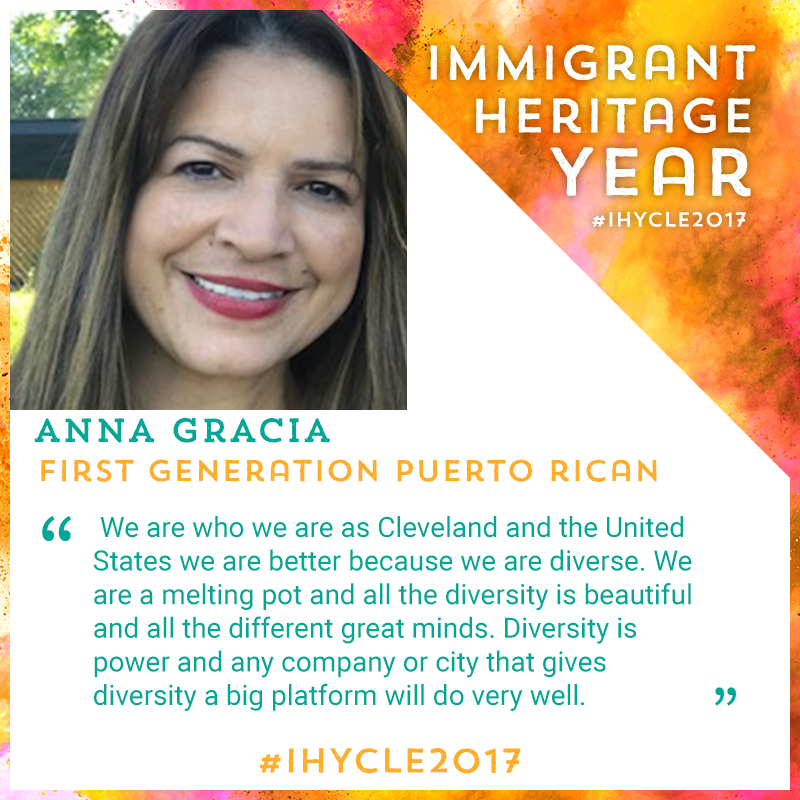
Anna Gracia
Where are you from?
I was born and raised in Chicago and then when I was like 5-years-old my parents moved from Chicago to Puerto Rico because my mom missed Puerto Rico so bad and then we went and my dad tried getting a job but the job he had didn’t pay enough. We were there for a year, I remember going to pre-school in Puerto Rico and then we couldn’t make it over there and we had to come back to the States.
What was your childhood like?
My mom missed Puerto Rico a lot so everything in the house was Puerto Rican like the music, the TV was always in Spanish stations; my mom will speak to us in Spanish, thank God if not I wouldn’t know it because it’s a blessing in my life. So inside the house it was like been in Puerto Rico.
What brought you to Cleveland?
I am reporter and I had an agent who got me a job at Channel 5 and we have been here for 20 years.
What challenges did you face transitioning here?
I had to go to kindergarten in Chicago, so I learned Spanish first and when I had to go to kindergarten there was no bilingual back then it was just straight English. So I couldn’t understand anybody. Thank God I was young enough to pick up English after a week or so.
What is your occupation?
I do two things; I have a show, which I am really excited about. It’s about elevating the Hispanic community and I have business with United Healthcare, I sell medical insurance to seniors. I have done very well and I have nine people under me so I train everybody so they go all over northeast Ohio and do that.
What traditions or customs do you continue to practice?
During Christmas in Puerto Rico Santa does come but the big one is January 6th, which is the three king. So the big deal over there is the three kings so the three kings that came to Jesus they actually come and give you gifts. My mom brought the tradition when we lived in Chicago. So we would have to put grass and water for the camels.
What do you love about Cleveland?
When we got here everybody was so welcoming and loving. We have friends that are like family to us; I love the diversity in Cleveland I think we need to do a better job of showing all the diversity that is out here and sharing their story.
Why is it so important to welcome International Newcomers and Displaced Personss?
We are who we are as Cleveland and the United States we are better because we are diverse. We are a melting pot and all the diversity is beautiful and all the different great minds. Diversity is power and any company or city that gives diversity a big platform will do very well.
Why is it important to travel abroad?
Sometimes I think we get comfortable where we are. Especially if you live in a nice neighborhood or just used to your surroundings you have to kind of break out and get out of your comfort zone and get to know people and that way, I believe you are more accepting when you get out and travel and get to know people.
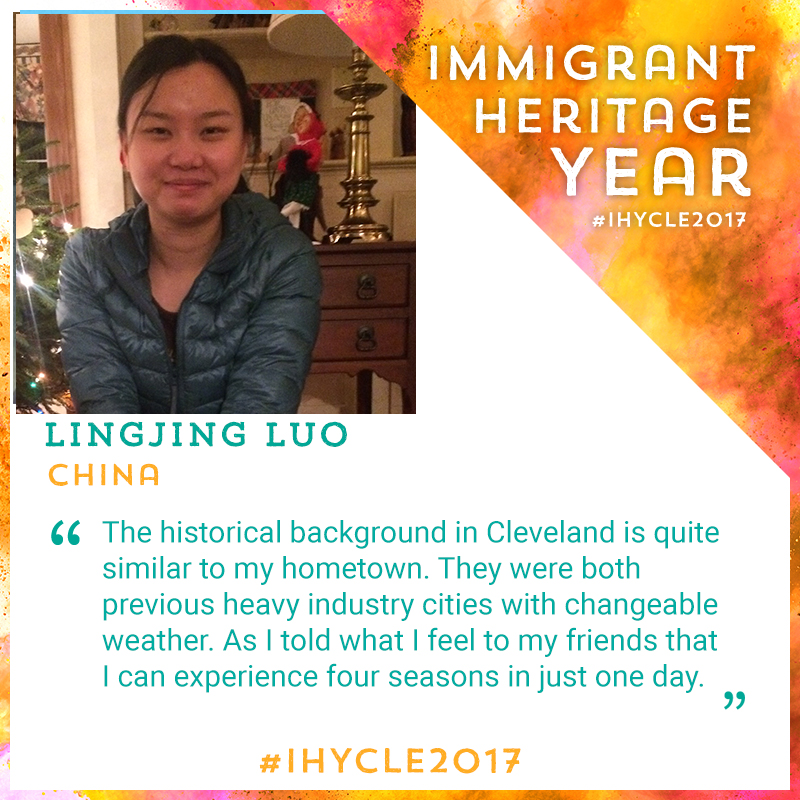
Lingjing Luo
Where are you from?
I am from Chongqing, China.
What is your childhood like?
I was educated as a good-behaved child with positive thinking and easy-going personality. Even though I was bore in a common family where my parents were both blue collar workers, my parents raised me with their endless love and care. They let me feel I am always beloved and well-educated in hope for I will be the one who can share my love and care with people in need.
What brought you to Cleveland?
Can I shout it aloud without hesitation that my love for English and my dream of becoming an excellent English teacher brought me here? LOL
What were your first thoughts about coming to the U.S.? Did those change?
I came here to practice my English and to pursue my dream of becoming an excellent English teacher to the extent that my students love me and my colleagues respect me.
No, my dream and pursuit never, ever changed.
What challenges did you face as transitioning here?
Luckily, I had little challenges here physically and mentally. To be truth, I even did not feel the 12-hour time difference when I arrived in Cleveland; I used to buy Kirkland nuts though B2B websites. Furthermore, I learn English by picking up new words and the cultural background in American shows.
However, the only regret for me is the oral English has not built to meet my expectation as an English teacher.
What is your occupation?
I am now a graduate student in CSU in TESOL program.
How have other Clevelanders made you feel welcomed?
My classmates and professors here are nice. They let me feel comfortable and relaxed when I talk with them even though sometimes it was hard, to understand due to language barriers.
What do you love about Cleveland?
The historical background in Cleveland is quite similar to my hometown. They were both previous heavy industry cities with changeable weather. As I told what I feel to my friends that I can experience four seasons in just one day. In this way, Cleveland let me feel like I am in my hometown.
Why is it so important to welcome International Newcomers and Displaced Personss?
Firstly, let them feel acceptable in a brand-new community. Secondly, it is essential to create opportunities to let them know each other and build connection with new friends.
Why is it important to travel abroad?
To meet new friends, to have new opportunities, to lead promising future.