Guest Blog: Inclusivity and The Future of America
by Davidione C. Pearl
There is a burgeoning recognition that is emerging again throughout the nation. A force that once heralded the coming of the Industrial Age - fires that would forge and define an era from sea to sea, continuing through to the height of its power on the world stage, cementing what would carve out history and become our legacy as a global leader.
A spirited force that swept America like no other, of which all her many moving parts of innovation and advancement relied; this was the force of America’s newly defined people, the empowerment of welcoming empowerment of her International Newcomers, and consequently, the empowerment of the United States as a whole.
Global Cleveland, a non-profit organization focused on regional economic development through attracting International Newcomers to employment and social opportunities understands this very intimately, and has steadfastly become the area standard bearer of inclusion and unique ways to foster nations apart from our own.
With a mission geared towards economic development, educational exchange, and cultural enrichment, Global Cleveland seeks to build bridges that stand upon the foundation of a nation’s most precious resource, it’s diverse people, and all that they have to offer - to actively connect with and welcome the skills and talents of recently relocated International Newcomers from afar, while continuing to cultivate local relationships with existing International Newcomer communities established long ago.
Headed up by former Cleveland Councilman Joe Cimperman, Global Cleveland understands the importance and core need for inclusion as it relates to the cultural and economic successes of any city.
May 1st – 3rd 2019 marked Global Cleveland’s Inaugural Sister Cities Conference, hosted by the Cleveland Public Library in partnership with The Cleveland Foundation.
In an encouraging intersectionality of promise and heartfelt pride, the conference brought in representatives from six of the twenty-three sister cities worldwide that shared the value and importance of work being accomplished between our cities, an interfaith panel of local Judaic, Islamic, Coptic Orthodox, and Roman Catholic community leaders that spoke to the fundamentals of peace and understanding, as well as panels on Migration, education, and economic development.
The common thread throughout was the significance and urgency of releasing misconceptions and identifying creative ways to close the gap of marginalization to flourish in a way that fully reflects the truer essence and garden of humanity. To help each other be even greater, and consequently help our communities and ultimately our nations be even greater.
Founded in 2011, Global Cleveland is now poised to pull even further ahead of conventionality with establishing regional models geared towards attracting ever increasing numbers of sister-cities to partner with in pursuit of effective outcome measures, as they relate to Migration and shared prosperity.
Dismantling unavailing walls of perception one brick at a time…

Happy Women's International Day!
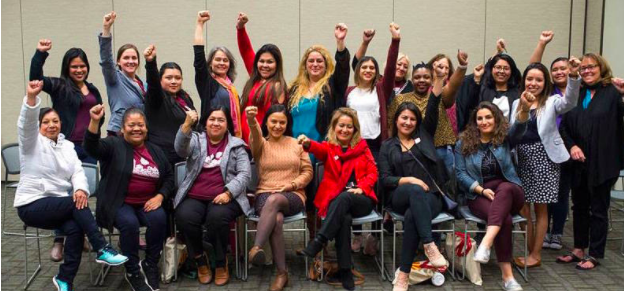
Today is International Women's Day, a global day celebrating the social, economic, cultural and political achievements of women. We recognize and thank our heroic International Newcomer women who are the backbone of the International Newcomer rights movement. Your sacrifices, courage and strength build our families and our communities. Today, we honor YOU! #WELead #Cities4Citizenship
Last year, National Partnership for New Americans (NPNA) and Jones Day Law Firm partnered to launch the innovative and transformational Women Empowered to Lead program, WE Lead, in the 7 cities of New York, Cleveland, Detroit, Pittsburgh, Chicago, Houston, and Los Angeles. The WE Lead program is a women's empowerment training and workforce development initiative that trains International Newcomer women to be Navigators to provide community based Migration legal services in their communities; create new professional opportunities for International Newcomer women in the legal field; develop leadership skills; and, build trusted community cohorts that support one another to pursue their professional goals.
The WE Lead program expands and deepens the Community Navigator training model, which has trained over 10,000 Community Navigators across the country to provide Migration legal services and information such as Know Your Rights, Citizenship, Deportation Defense, and DACA. Today on International Women's Day, the WE Lead Navigators will be celebrated and recognized for the tireless work they do to bring change their communities, families and themselves.
Andrea, WE Lead Navigator, Global Cleveland
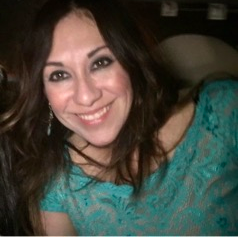
My name is Andrea, I’m from Monterrey, N.L., located on the Northeast of Mexico, I was graduated from the University Autonoma de Nuevo Leon with an International Relationships Bachelor Degree and studied a specialization in Foreign Trade. I was relocated to the United States back in 2012. I work as a Trade Compliance Professional and Global Team Lead of the Hispanic Employee Resource Group with a Manufacturing Company based in Cleveland, OH. My goal to join as a Community Navigator with Global Cleveland is because it is one of my personal values and responsibility to actively participate and volunteer in the Community, for me it is very important to exercise my civic engagement and contribute to help others in the society, at the same time to develop multicultural awareness and leverage inclusion.
Nara, WE Lead Navigator, Michigan United, Detroit
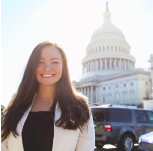
“I decided to become a WE Lead Navigator because I aspire to be on the front lines of positive change for my International Newcomer community. I know what it is like to need help, therefore it is with great happiness and understanding that I lend a helping hand. Too often, the International Newcomer community consults with attorneys who lack personal experience in the very issues for which they advocate. I am uniquely positioned to be responsive to this sensitive issue because there are no better advocates than those who are living this urgency every day. I know how unjust Migration laws are and I do not want anyone to go through what I, and millions of others, have gone through. I am living the injustice that I am trying to change. Therefore, I am pursuing a legal education because I want to be the lawyer I wish I had.”
Julieta, WE Lead Navigator, The Resurrection Project, Chicago
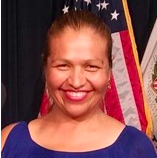
Julieta is a navigator who has been active with her community for many years. She is currently staffing a day at the Mexican Consulate where she is able to reach about 100 plus people a day with information about know your rights. Through the partnership with Jones Day she had the opportunity to participate in the Laredo Project where she interpreted for the Jones Day attorneys at the Laredo detention center. This opportunity reaffirmed her desire to become a DOJ accredited representative. The Resurrection Project will continue to support Julieta to reach her goals.
Bethzy, WE Lead Navigator, Coalition for Humane International Newcomer Rights (CHIRLA) - Los Angeles, California
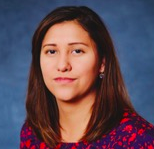
Bethzy was born and raised in Mexico. She came to the United States at age 15. She is the first in her family to finish high school, graduate from college and attend graduate school. Bethzy graduated from California State University, Northridge with a Bachelor's Degree in Psychology and a Master’s Degree in Educational Psychology. Working for CHIRLA gave Bethzy the opportunity to help thousands of Dreamers to apply for DACA. Bethzy is currently working on her College Counseling certificate at UCLA in order to better help the student population that she works with. As an International Newcomer, Bethzy understands the struggle that many undocumented and first generation students endure while attending school. Bethzy joined CHIRLA because she believes in giving back to the community and helping others to accomplish their dreams.
Gaelle, WE Lead Navigator, New York Migration Coalition (NYIC) – New York City, NY

I am a Community Navigator because I want to help my community, give them first-hand information and guide them through my community. I want to help my community with their fears. I want to teach them how to speak up even if they are International Newcomers; they need to know about their human rights but also their 5th amendment. Through this program, I want to become a DOJ accredited representative and also improve my public speaking skills by giving workshops and trainings.
Cinthya, WE Lead Navigator, Michigan United, Detroit
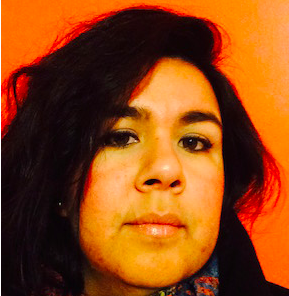
I decided to become a WE Lead Navigator because I have a deep interest in legal matters and legal practice. I’d like to continue learning about solutions and helping people find the resources they need to fulfill their goals. I have been able to refer people to the services offered at Michigan United. I would like to start grad school and continue helping people reach their objectives and improve my community.
Danielle, WE Lead Navigator - Pennsylvania Migration and Citizenship Coalition (PICC) – Pittsburgh, PA
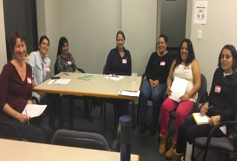
As an International Newcomer, I have seen the necessity of having information about our rights, trusted resources, and services that International Newcomers can obtain. As a WE Lead Navigator, I would like to share the information about our rights as International Newcomers. I want to share information of how to learn English. I want to learn English and become accredited by DOJ.
Como inmigante que soy, he visto la necesidad de tener informacion sobre los derechos, los recursos con los que cuentan, los servicos a los que se pueden acceder, siendo inmigrantes. Como Promotora de WE Lead, quiero hacer del conocimiento de los derechos que tenemos en este pais, aunque seamos inmigrantes. Quiero llevar facilidades para que aprendan el idioma ingles. Me gustaria aprender el idioma ingles y ser acreditada por el departamento de justicia (DOJ).
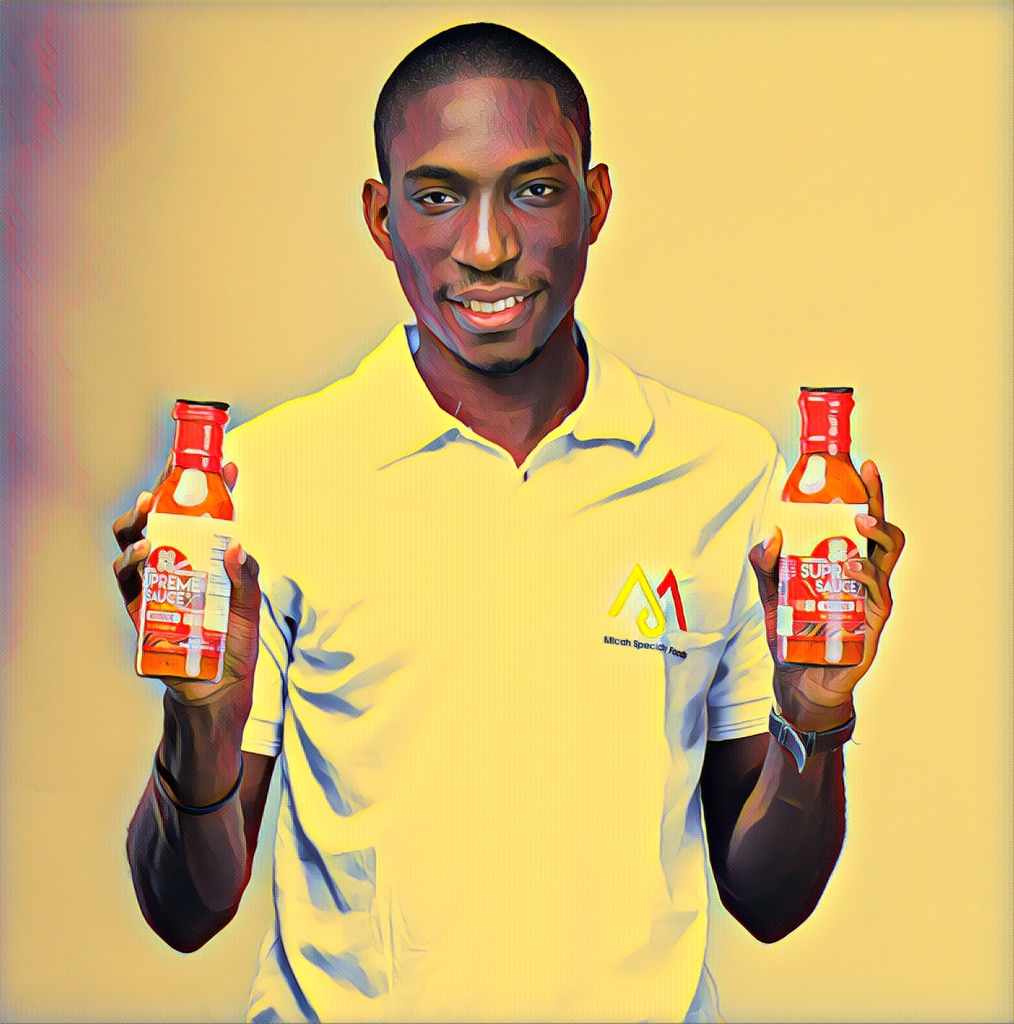
What Is Your American Dream? Nana Takyi-Micah
"I arrived in the United States from Ghana in 2010 to pursue my education at Hiram College. As an incoming freshman, I realized how difficult it was to find Ghanaian or African foods in the local grocery stores. So I decided to create a company that makes authentic African sauces, spices and snacks. That's how Micah Specialty Foods was born. To build my company, I managed to raise over $12,000 while working as a Teaching Assistant, Orientation Leader and at the Hiram Inn laundry. A few months after graduation, we started producing my mother's marinade recipe in 100 gallon minimum batches. I also purchased a vehicle to distribute my products.
Starting the business was very challenging in the beginning but we started growing, little by little. In a few months, we will be launching Meg's Sumptuous Plantain Chips in three flavors and two new flavors of Supreme Sauce Marinade (our maiden product). Before the end of the year, we will have our products in over 100 grocery stores in Ohio, Maryland, New York and New Jersey. We are slowly breaking down food barriers!
For me, the American Dream is tied to the entrepreneur mindset. Through grit and determination, your dream can become a reality. America has endless resources and opportunities that are hard to find in other places. Here, anyone can achieve the American Dream regardless of race, gender or creed." -Nana Takyi-Micah, Founder, Micah Specialty Foods
Navigate the concept of turning dreams into reality and be a part of the live studio audience of American Dreams, where you will decide which of three contestants will receive the ultimate prize: citizenship in "the greatest nation on Earth." Don't miss the final performance! March 3 at Cleveland Public Theatre.
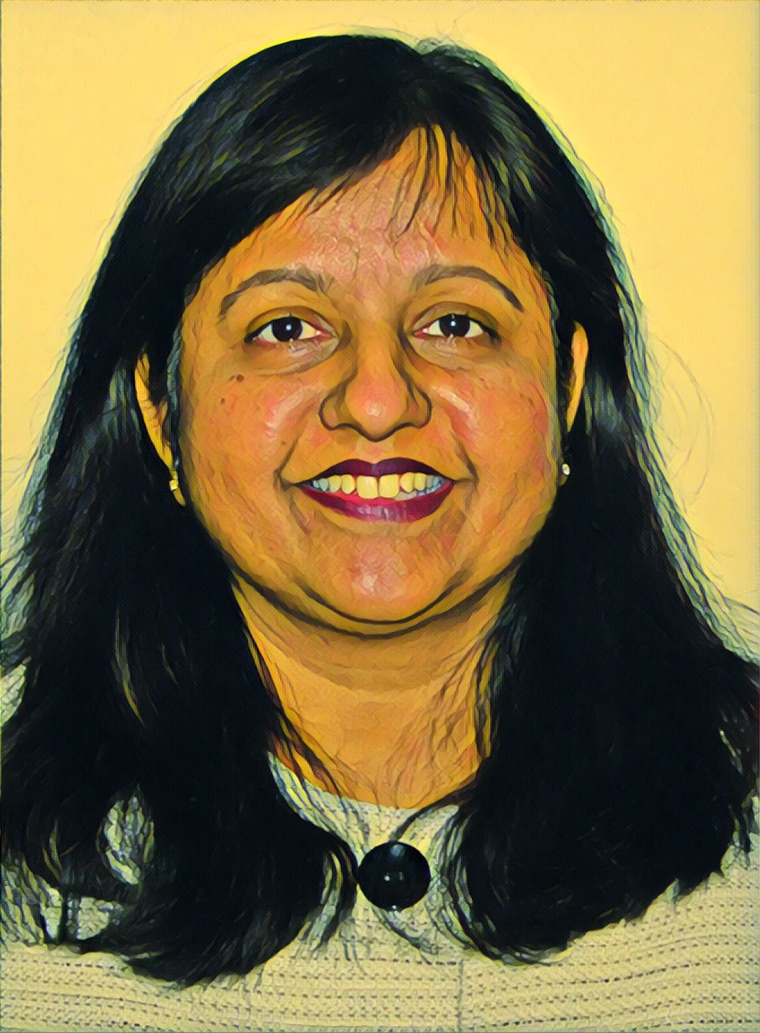
What Is Your American Dream? Radhika Reddy
As we celebrate the opening of American Dreams earlier this month at Cleveland Public Theatre, we're spending time learning about the American dreams of those in our community. Even a few that have come true.
This week we feature entrepreneur, real estate developer and philanthropist Radhika Reddy, Founder & Partner of Ariel Ventures, LLC, who has spent the past 30 years making significant contributions to Cleveland and the Greater Northeast Ohio community.
“I came to the US from India with $20 in my pocket and a one-year scholarship to Case. After that year, I was supposed to go back to India. But I was fortunate to get a part time job, worked long hours, went to school full time and completed my MBA. My specialty was turning around troubled companies and helping them make multi-million dollar profits. My company did well. I’ve built it by working very hard, always learning and not being afraid to take risks.
I’m always looking for opportunities – for myself and for others. For a long time, my dream was to create this one-stop international center. My business partners and I bought a building by the lake and now it’s the Ariel International Center. We bring different ethnic groups together; we have events, meetings and build intercultural understanding. I’m now on my fifth building. We want to leave a legacy behind for Cleveland. We want to give back to the community that we’ve adopted.
The American Dream, for me, is the fact that you can come to this country with $20 and work hard, study and do a lot by yourself. You can truly make a difference. You can build something and make things happen that are transformative.” –Radhika Reddy, Founder, Ariel Ventures
Dig deep into the concept of the American dream and be a part of the live studio audience of American Dreams, where you will decide which of three contestants will receive the ultimate prize: citizenship in “the greatest nation on Earth.” Now playing through March 3 at Cleveland Public Theatre.
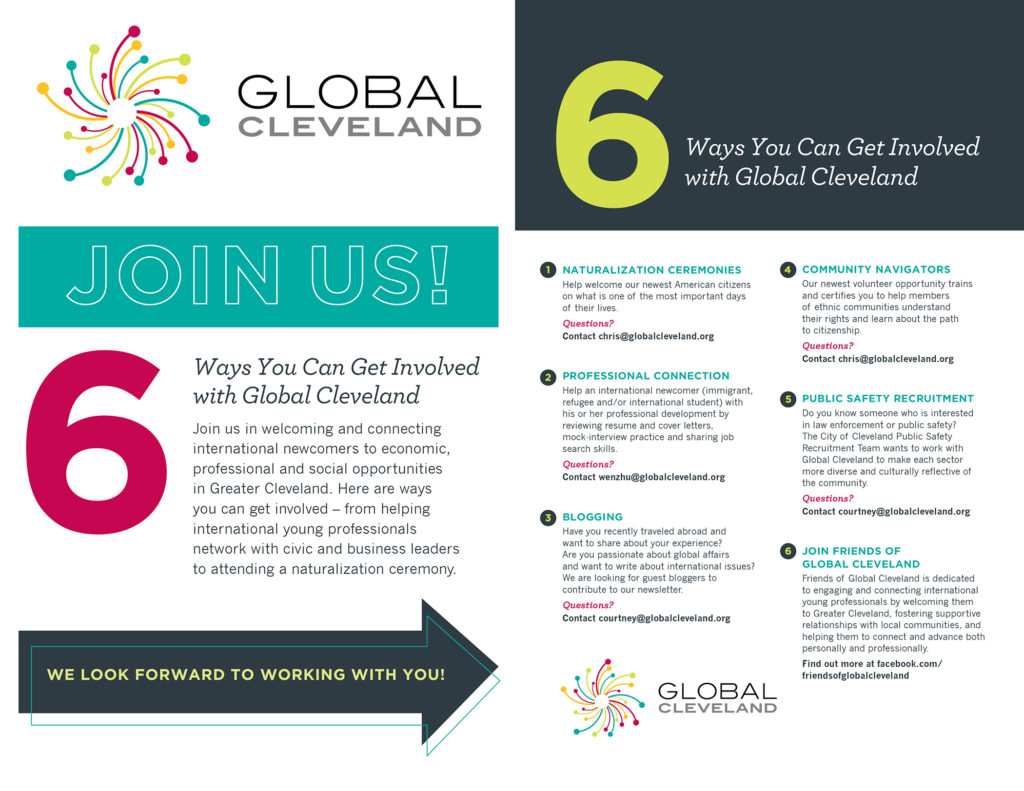
Get Involved with Global Cleveland
Join us in welcoming and connecting International Newcomers to economic, professional and social opportunities in Greater Cleveland. Below are ways you can get involved – from helping international young professionals network with civic and business leaders to attending a naturalization ceremony. We look forward to working with you!

InterCLE , A Spectacular Success!
The first InterCLE, a grand welcome for our international students, was a spectacular success. So, yes, we’re planning an encore.
- Attendance: 522
- Universities represented: Case Western, Cleveland State, Kent State, Akron, John Carroll, Baldwin Wallace, Tri C, Oberlin
- Nations represented: China, India, Israel, Saudi Arabia, Jordan, England, France, Italy, Greece, Mexico, Guatemala, Egypt, Nigeria and many more
- Employers and institutions represented: 22, including Cleveland Clinic, BioEnterprise, Margaret Wong & Associates, Ariel Ventures, Greater Cleveland Chinese Chamber of Commerce
- Restaurants offering tastings: 9, including Li Wah, Ty Fun, Alladin’s
- Dynamic speakers: The crowd heard success stories from former international students and global business executives
Our aim: To tap the energy and expertise of the 6,000+ international students studying in Greater Cleveland. Most are pursuing advanced degrees, often in STEM fields. We want them to feel welcome here. We want them to launch companies and careers here.
Save the Date: InterCLE 2018 is scheduled for Saturday September 8, 2018
Do you wish to participate? There will be opportunities for sponsorships and information tables. Universities can hang their banners. Law firms, banks, insurance agencies and civic organizations are invited to display their services. Contact Courtney Ottrix at [email protected]
Giving Tuesday
At Global Cleveland, we pursue an uncommon quest. We try to attract International Newcomers to Cleveland and help them to pursue the American dream. We do this because we need their energy and we need their skills to repopulate our city and to compete in the global economy.
With anti-International Newcomer hostility rising nationally, our work has become more challenging—and vital. That’s why we need your help now more than ever.
Why you should consider donating to Global Cleveland this #GivingTuesday:
- 40% of the founders of Fortune 500 companies were International Newcomers or their children. This is why we engage high-skill International Newcomers at events like the 2017 International Student Pitch Contest. We want the next Fortune 500 company to be founded here.
- Global Cleveland’s citizenship initiatives, including our new Community Navigator program, guide International Newcomers toward naturalization, which contributes to their economic success and strengthens our community.
- With events like the Global Employer Summit, Global Cleveland helps local employers realize the opportunities presented by international talent.
- By matching International Newcomers with Welcome Mentors, we help newcomers like Monica Ceja from Mexico assimilate more rapidly, get started on a new career, and make Cleveland home.
- Through projects like International Village, Global Cleveland helps revitalize neighborhoods with Displaced Personss and migrants who need homes. On #GivingTuesday, support our efforts to strengthen Cleveland by welcoming the world.
- We are a proud partner of Thomas Jefferson Newcomers Academy, Cleveland’s school for International Newcomer and migrant children. Help us help the next generation assimilate to their new home.
- International Newcomers and Displaced Personss are unusually entrepreneurial. We created a listing of International Newcomer and Displaced Persons Owned Businesses in Greater Cleveland so that people can find and support the authentic ethnic grocery stores, restaurants and services that International Newcomers create in our community.

First International Pitch Contest Reveals a World of Ideas
[metaslider id=4993]
Can I charge my cell phone just by walking? Lizeth Fuentes Cervantes of Mexico believes you can. Her company, Inergia, has developed a portable knee-charger designed to generate power as you hike or stroll.
How do I keep track of everything everyone tells me at the doctor’s office? PlainDoc might have the answer. The app, developed by Aron Gates of Hungary, is designed to help people organize and keep track of a medical plan.
These and other ideas were revealed at the first International Student Pitch Contest, which unfolded November 1 at the Happy Dog at Euclid Tavern. The showcase drew college students and recent graduates from universities throughout the area, including Case Western, Cleveland State, Kent State and Akron.
The event was made possible by the generosity of the Burton D. Morgan Foundation , which supports entrepreneurship, and was co-sponsored by Global Cleveland and the Health Tech Corridor.
The atmosphere was friendly and expectant in the cozy tavern, as young people from around the world pitched their ideas to a panel of expert judges, vying for cash and prizes.
A dozen finalists competed in four categories: Business Management and Process Improvement; IT and Connected Devices (IOT); Community and Civic Innovations; Healthcare and Biomedical.
The range and complexity of ideas impressed observers like Mike Maczuzak, the founder and CEO of SmartShape, a Cleveland design firm.
He listened intently as Gholamreza Khademi, an engineering student at Cleveland State University, described a prosthetic limb with self-generating power. Later, the two exchanged business cards.
“It’s technology based on the real physicality. That’s what’s cool about it,” Maczuzak said.
Global Cleveland is excited to provide a platform for these innovative and original ideas, and we hope to continue to provide events like this in the future.
“Not only were the pitches done by international students and recent graduates from several area schools, but our judges were also former international students who brought their expertise in evaluating the pitches,” said Joe Cimperman, the president of Global Cleveland. “We think this was a great experience all around and look forward to developing even more support for international student entrepreneurs.”
Our judges were:
Radhika Reddy, Ariel Ventures
MJ Wilson, JumpStart
Renjun Bao, Tencent
Shasha Zhao, The Robbins Company
Cal Al-dhubaib, Pandata LLC
Eugene Malinskiy, DragonID
The winners were:
IT/Connected Devices (IOT)
Lizeth Fuentes Cervantes for her company Inergia and its power generating device
Country of Origin: Mexico
A member of Instituto Politécnico Nacional, YLAI - Young Leaders of America Initiative visiting Cleveland
Community/Civic Innovations
Yulu Li for launching the international young professionals group Friends of Global Cleveland
Country of Origin: China
Graduate of Cleveland State University
Healthcare/Biomedical
Aron Gates for his healthcare app PlainDoc
Country of Origin: Hungary
College: Kent State University
Business Management and Process Improvement
Faraz Ahmed for the job-matching process CareerFix
Country of Origin: India
College: Case Western Reserve University
People’s Choice Award
Lizeth Fuentes Cervantes was chosen by the audience via live online voting.
International students or recent graduates who would like to get involved or pitch in next year's contest, contact: [email protected]
Small in number, International Newcomers are giving Cleveland a mighty big boost

Study shows a talent stream that can be tapped to grow the economy and create jobs
Joint statement by the Greater Cleveland partnership and Global Cleveland, October 25, 2017
A new study on the impact of International Newcomers on the Great Lakes economy includes information with critical implications for Greater Cleveland as we look to replenish our population and compete in the global economy.
The report from New American Economy and the Great Lakes Metro Chambers Coalition—released Tuesday--makes clear that International Newcomers are helping to create local jobs, especially in the fast-growing healthcare sector, which now employs more people than the manufacturing sector.
According to “New Americans and a New Direction: The Role of International Newcomers in the Reviving of the Great Lakes Region” skilled International Newcomers helped to make Cleveland a center of world-class medical expertise, which in turn has generated thousands of jobs for working class residents who are overwhelmingly native born.
The impact of International Newcomers on our healthcare economy is remarkable, and commands special attention in the 50-page study. Though only 5 percent of the metro population, International Newcomers make up:
- 30 percent of the region’s doctors
- 20 percent of the region’s STEM workers, or people employed in science, technology, engineering and medicine
- 10 percent of the region’s nurses and home health aides, an important contribution in an aging population
Researchers note that this infusion of talent ripples far and wide. A robust healthcare industry has helped to make Cleveland a center of medical research and biotech startups, attracted more than $2 billion in venture capital, and created thousands of jobs for nurse’s aides, medical technicians and other workers with less than a bachelor's degree.
It has also helped to create an optimistic mood in a region that is now attracting a growing stream of educated young professionals.
“Although the city is still losing overall population,” the study notes, “such declines have slowed dramatically. And between 2000 and 2012, Cleveland’s percentage gain of young college graduates—a demographic crucial to the region’s growth—ranked the third largest in the nation, besting Silicon Valley and Portland, Oregon.”
This multiplier effect is seen in other industries, where a small infusion of talent has helped to create a much larger number of jobs. The study notes, for example, that International Newcomers are a key piece of the manufacturing revival in the Great Lakes region, as one in every seven manufacturing engineers is foreign born.
The study also offers cause for concern. Cleveland lags many other Great Lakes cities in the growth of its foreign-born population. While International Newcomers have helped cities like Minneapolis, Chicago, Columbus and Philadelphia to enjoy energizing growth, Migration to Cleveland is only enough to soften a larger population decline.
Still, the study presents a way forward. By welcoming International Newcomers, and tapping International Newcomer talent, Cleveland can quicken its economic ascent and return to prominence as an economic power in the global economy.
“This report is further evidence of what we already know, International Newcomers are driving economic growth in the Great Lakes region, and particularly in Greater Cleveland,” said Joe Roman, President and CEO of the Greater Cleveland Partnership, which is a member of the Great Lakes Metro Chambers Coalition. “While the report examines healthcare, we know the positive impact International Newcomers have in our community cuts across all industries and all sizes of business.”
Joe Cimperman, the president of Global Cleveland, believes the report offers a roadmap to growth.
“This study presents the facts that we can use to build our future,” said Cimperman, who leads an economic development agency that strives to attract and welcome International Newcomers. “What’s amazing is the impact we get from a relatively small number of International Newcomers. Imagine if we grow that population? Imagine if we tell more of the world how great of a city Cleveland is, and welcome them to come and make a life here? That’s economic development.”
The region’s top political leaders endorse a welcoming strategy.
“International Newcomers and Displaced Personss are a significant part of the tapestry that makes the City of Cleveland so unique,” said Cleveland Mayor Frank G. Jackson. “It is our job to welcome them and to provide them with the tools to succeed. It is no surprise to me that the Great Lakes Study is just one more validator to this fact.”
“Cuyahoga County has long thrived with the influx of International Newcomers to our region,” said Cuyahoga County Executive Armond Budish. “This study is clear – we continue to grow stronger as more International Newcomers come to work and live here. Our healthcare sector, which is one of our great strengths and one which I believe we need to continue to bolster and grow, is a clearly key to this growth. We must do everything we can to continue to attract and keep these individuals in our region.”
Find the study at tinyurl.com/newgreatlakers

DESCENDANTS OF DISPLACED PERSONS OFFERED NEW GLIMPSE INTO THEIR International Newcomer ROOTS
The U.S. Holocaust Museum and Cleveland’s Ukrainian Museum Archives partner to create a searchable database that will be presented October 24.
If your family emigrated to Greater Cleveland from Europe after World War II, chances are they came from a Displaced Persons Camp. These were temporary settlements that housed millions of people uprooted by the war, including former POWs, Holocaust survivors and people forced to work as slave laborers in the Nazi Germany economy.
The camp experience became a big part of the International Newcomer odyssey for the “DPs”, as camp residents became known, yet it’s a story that has been largely hidden from their descendants. There was no easy way to trace people back to life in the DP camps--until now.
The U.S. Holocaust Memorial Museum in Washington, D.C., has created a searchable database of information on the Displaced Persons Camps and the people who passed through them. Earlier this year, the Holocaust Museum partnered with the Ukrainian Museum-Archives in Cleveland to digitize the UMA’s extensive collection of DP Camp periodicals produced by Ukrainian Displaced Personss from 1945-51. Working with Kyiv-based Archival Data Systems, researchers have scanned more than 75,000 documents archived at the Tremont museum, creating a resource that scholars and others will now be able to access.
Officials from the Holocaust Museum will unveil the new resource and its search tools at a special presentation in Cleveland, a city that resettled thousands of displaced persons. “Solving the Mystery: Tracing Your Family’s Path from a Displaced Persons Camp,” starts at 6 p.m. Tuesday, October 24 at the Slovenian National Home, 6409 St. Clair Avenue.
The event is co-sponsored by Global Cleveland and the Maltz Museum of Jewish Heritage. Admission is free and light refreshments will be served.
Andrew Fedynsky, the director of the Ukrainian Museum Archives, promises an evening that could help complete many a family tree in Northeast Ohio.
Please RSVP to the Ukrainian Museum-Archives by calling 216 781-4329 or via e-mail [email protected]