
Welcoming Week Celebrates Cleveland’s Past and Future
Global Cleveland invites residents of Northeast Ohio to celebrate Welcoming Week, September 15 to 24, by participating in events and activities that recognize the region’s International Newcomer heritage and the cultures shaping our future.
Welcoming Week is celebrated each fall by hundreds of communities coast to coast under the guidance of Welcoming America, a non-profit group that promotes multicultural inclusion. Global Cleveland is proud to co-sponsor three events that capture the spirit of the week.
On September 15, we will help The City Club welcome Kavita Pawria-Sanchez, the Assistant Commissioner of the Mayor’s Office of International Newcomer Affairs for the City of New York, to its 2017 Constitution Day Forum. She will speak about the power of citizenship at a noon luncheon. (For reservations, go to www.cityclub.org.)
Pawria-Sanchez oversees efforts to advance International Newcomer inclusion across city government. International Newcomers comprise more than 35 percent of the population of New York City and more than half of it small business owners. In contrast, Cleveland is about 5 percent foreign born.
Her office credits International Newcomers with boosting entrepreneurship, revitalizing neighborhoods, and making New York competitive in the global tech economy.
“Naturalization and citizenship is important, not just for the individuals who live here but also for the economic vitality of the city as a whole,” said Jazmin Long, who leads naturalization initiatives at Global Cleveland. “New York has shown that International Newcomers can be successfully integrated into a city, to everyone’s benefit.”
Joe Cimperman, the president of Global Cleveland, thinks Cleveland would see similar results.
“Our International Newcomer ancestors set the foundation for this great city,” he said. “We’re not New York City, but we’re still an outstanding destination for International Newcomers. We have a high quality of life and leaders who are eager to welcome new cultures.”
That welcoming spirit will be on display September 17 at the International Village Festival on Cleveland’s near west side. The festival celebrates International Village, Ohio’s first Displaced Persons-centric neighborhood.
The Metro West Community Development Organization is restoring abandoned homes and marketing them to families whose children attend Thomas Jefferson International Newcomers Academy, the city’s English immersion school.
The festival will bring together the neighborhood’s established residents and newcomers for a multicultural potluck and storytelling led by Talespinner’s Children’s Theatre. It runs from 1 to 5 p.m. at the Michael Zone Recreation Center Pavilion, 6301 Lorain Avenue.
Finally, on Friday September 22, Global Cleveland will sponsor a lunchtime meet-up at an international restaurant with old world ambience. Meet Global Cleveland staff and friends at Emperor’s Palace, the flagship of Old Chinatown, at 2136 Rockwell Avenue, Cleveland. Let us know you’re coming by emailing [email protected].

A Grand Welcome For Our International Students This Saturday!
Time for a grand welcome for our international students
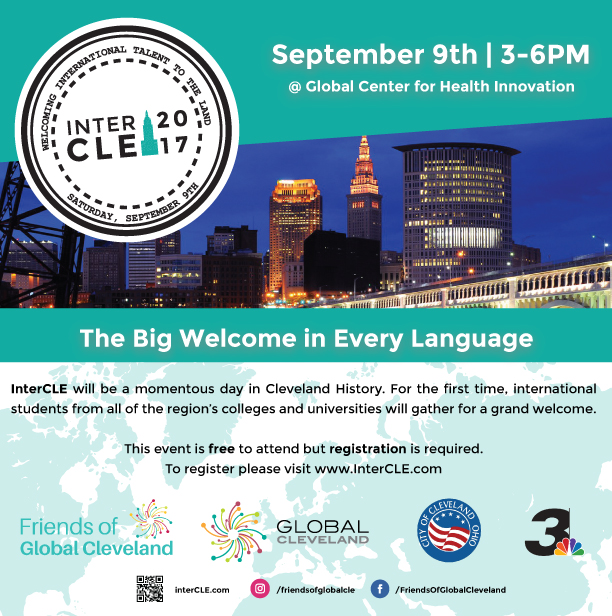
Hundreds of international students are expected to descend upon InterCLE 2017 Saturday, September 9, at the Global Center for Health Innovation.
Northeast Ohio’s international students, an economic force waiting to be tapped, are being invited to a first-of-its-kind event September 9 at the Global Center for Health Innovation in downtown Cleveland.
Young adults from around the world will descend on InterCLE 2017, where civic and business leaders will, for the first time, formally welcome them to the region. The event will feature music, food, cultural demonstrations, networking with employers and an after-party in the Flats.
Organizers hope the welcome and the camaraderie will enhance the international student experience in Northeast Ohio and entice more of the world’s best and brightest to stay on after graduation and launch careers and businesses here.
The event is being presented by Global Cleveland in partnership with the Friends of Global Cleveland—a new, international young professionals group—and with the support of the City of Cleveland.
“We have an exceptional group of international students studying in Greater Cleveland,” said Yulu Li, president of the Friends of Global Cleveland. “But too many of them go home or leave for other parts of the country after graduation. We want them to know they are welcome in Cleveland and Akron and they can have a great life here.”
Li, a native of China, earned her master’s degree in public administration from Cleveland State University in 2014 before starting her career with Hanna Commercial Real Estate’s Corporate Services Group in downtown Cleveland.
She and other Friends describe Cleveland as a city that deserves to be better known around the world.
“Cleveland has been my home for the last 10 years, and there is no place as close to my heart,” said Omar Kurdi, the vice president of the Friends of Global Cleveland.
Kurdi, who holds dual citizenship in the U.S. and Jordan, earned his bachelor’s degree in international relations from Cleveland State University in 2013 before starting his career in public relations and eventually becoming the CEO of Friends for Life Rehabilitation Services, an agency that provides services for adults with disabilities.
“Many of my friends who came as international students are now proud Clevelanders with thriving careers,” he said. “If this does not scream to the world that Cleveland is great, then I don’t know what will.”
More than 6,000 international students will arrive this fall at colleges and universities like CSU, Case Western Reserve, John Carroll, Kent State, Akron, Baldwin Wallace and Oberlin. Economic development experts say they could offer an advantage in the global economy. Compared to their native-born classmates, international student are more likely to:
- Earn degrees in the in-demand STEM fields of science, technology, engineering and math
- Be awarded a patent for an invention
- Be bilingual or multilingual
- Have contacts in global markets
Research also shows that Northeast Ohio could do a better job connecting with this talent source. According to a 2015 study commissioned by the Ohio Board of Regents, the region retains less than 40 percent of its international students. The national average is 45 percent.
By lifting the retention rate to 50 percent—which is not uncommon for major cities--the region would benefit from increased population, a better-educated workforce and job creation, researchers concluded.
“It starts with a welcome,” said Joe Cimperman, the president of Global Cleveland. “These are some of brightest minds from China, India, Israel, the Middle East and Europe. We want them to know they are welcome here and can build their lives here. We want their talent, we want their drive, and we want the companies and inventions they are going to create. It starts with a welcome.”
InterCLE runs from 3 to 6 p.m. Saturday, September 9 at the Global Center, 1 St. Clair Avenue.

Marian Wright Edelman Wins 2017 Inamori Ethics Prize
Marian Wright Edelman, advocate for children’s rights and the disadvantaged, chosen for 2017 Inamori Ethics Prize
A Washington Post profile of Marian Wright Edelman describes a scene from 1967 in which she, as a 27-year-old civil rights attorney, led Sen. Robert F. Kennedy through the Mississippi Delta to meet sharecroppers. She wanted him to see their dire conditions first-hand—especially the starving children.
Edelman “watched him try for five minutes to poke and tickle a listless baby,” she recalled for the story. “The hungry child did not respond.”
Fifty years later, the founder and president of the Washington, D.C.-based Children’s Defense Fund (CDF), which grew out of the Civil Rights Movement, remains a fierce advocate for the nation’s poor, and especially children’s rights.
For her life’s work, the Inamori International Center for Ethics and Excellence at Case Western Reserve University has chosen Edelman for the 2017 Inamori Ethics Prize, awarded annually since 2008 to honor an individual for significant and lasting contributions to ethical leadership on the global stage.
Case Western Reserve will present the 2017 Inamori Ethics Prize to Edelman during Inamori Center events on the Case Western Reserve campus, Sept. 14-15.
“Marian Wright Edelman is a hugely inspirational change agent who has been indefatigable and remarkably effective in her efforts to improve lives, especially the lives of children,” Inamori Center Director Shannon French, the Inamori Professor in Ethics and a professor at the School of Law and in the Department of Philosophy, said today in announcing the center’s 2017 prize winner.
A champion for children
Edelman grew up in South Carolina, the youngest of five children of a Baptist preacher who taught her early on about the importance of serving others and pursuing an education.
Under Edelman’s leadership, the nonprofit CDF, which she established in 1973, has become the nation’s leading advocacy organization for children and families, championing policies and programs to lift children from poverty, protect them from abuse and neglect and ensure their access to health care and quality education.
Recognized for her tireless work
Edelman has received more than 100 honorary degrees and many awards, including the Albert Schweitzer Humanitarian Prize, the Heinz Award and a MacArthur Foundation Prize Fellowship.
In 2000, she received the Presidential Medal of Freedom, the nation’s highest civilian award, and the Robert F. Kennedy Lifetime Achievement Award for her writings.
Edelman serves on the board of the Robin Hood Foundation and the Association to Benefit Children, and is a member of the Council on Foreign Relations, the American Philosophical Society, the American Academy of Arts and Sciences and the Institute of Medicine of the National Academy of Sciences.
The Inamori Center was endowed by a generous gift from Kazuo Inamori, who established Kyocera Corp. and is a global telecommunications leader and founder of the Inamori Foundation that presents the annual Kyoto Prize in Kyoto, Japan.
Good Read: The 82nd Anisfield-Wolf Book Awards
Good Read: The 82nd Anisfield-Wolf Book Awards
Karan Mahajan & the Professional Book Nerds Podcast
Now in its 82nd year, the Anisfield-Wolf Book Awards remain the only American book prize focusing on works that address racism and equity. Administered by the Cleveland Foundation, the awards have broadened their horizon in recent years to recognize international works of literature that fit the mission that Cleveland poet and philanthropist Edith Anisfield Wolf had in mind when she established the prize in 1935.
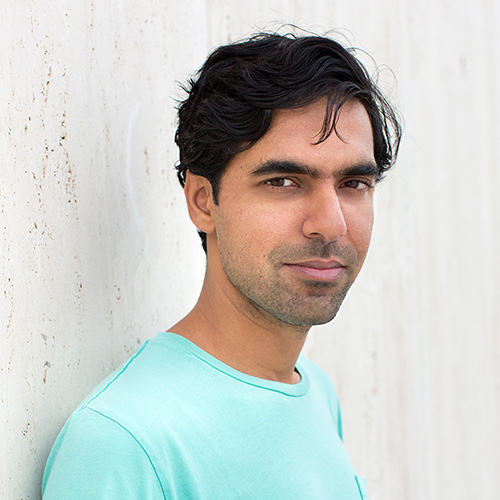
Among the quintet of 2017 honorees is Karan Mahajan, whose book, The Association of Small Bombs, was named one of the 10 best titles of 2016 by The New York Times. Just his second novel, Mahajan also received the Bard Fiction Prize for his work detailing how young men invested in forcing change in India choose to air their grievances and how that plays out in the political realm.
As part of the upcoming 2017 Book Week activities, Mahajan will be the featured guest at a live taping of the Professional Book Nerds Podcast with hosts – and OverDrive staff librarians – Jill Grunenwald and Adam Sockel.
Event Information
Friday, Sept. 8 – 1:00 p.m.
Cuyahoga County Public Library
South Euclid-Lyndhurst Branch
1876 S. Green Rd.
South Euclid, OH 44121
The event is free, but registration is recommended. Visit www.cuyahogalibrary.org/Events to reserve your spot today.
For more information on Cleveland Book Week (#CBW2017) and the Anisfield-Wolf Book Awards (#AWBA2017), visit www.clevelandfoundation.org/news/book-week/.
***Library event exact link for social or if newsletter is emailed: https://www.cuyahogalibrary.org/Events/Event-Results/Event-Detail.aspx?id=129622
*Karan Mahajan Author Photo credit Molly Winters

Community Partner: The Cleveland Leadership Center
Leadership Cleveland trains young leaders, too
The Cleveland Leadership Center is known for its programs that give senior- and mid-career leaders the knowledge and skills to enhance their community impact, such as Leadership Cleveland and Cleveland Bridge Builders. But the nonprofit center, a Global Cleveland community partner, extends its civic training to emerging leaders as well.
Young professionals who want to explore how to make a positive difference in their workplace and community can climb aboard OnBoard Cleveland.
OnBoard is a leadership and civic development experience tailored for early-career professionals. It’s designed to enhance communication skills, strengthen workplace presence, build an appreciation of local assets and an awareness of the civic realm, and build connections among employees, their organizations and opportunities to become involved in the community.
Through the OnBoard experience, participants also come to better understand critical community issues, learn collaborative leadership skills to address those issues, and find new ways to connect with civic opportunities that align with personal interests and talents.
Here’s what some recent participants said about the program:
- “OnBoard serves as a launchpad for early career professionals to develop professionally and engage civically. It gives participants the knowledge they need and mentors their skills so they can become effective members of the community.”
- “A program where I get to learn more about Cleveland's civic landscape as well as meet like-minded young professionals and network with important ‘movers and shakers’."
- “Professionally, nothing beats learning to communicate effectively with others, opening oneself up to new experiences and gaining knowledge of things that are important to you.”
The next cohort of OnBoard will launch in 2019, but those interested should contact Jill Pecoraro now for information about the application process, at (216) 592-2226 or [email protected].
OnBoard is one of several transformative experiences offered by Cleveland Leadership Center to connect, inspire and challenge individuals of all ages to make a positive community impact. For details, visit www.cleveleads.org or call (216) 592-2426.
Interview Translation: What 4 Common Questions Really Mean
Author: Sara Mccord
Acing the interview isn’t just about having the perfect canned speeches. Yes, you need to show off your experience, talents, and personality—but before answering each question, you also have to figure out what the interviewer is actually asking you.
Those seemingly innocuous questions, like “tell me about yourself” and “where do you see yourself in a few years?” aren’t just get-to-know-you conversation starters. They’re one of the key ways an interviewer will seek to uncover whether you’re the right fit for the job.
So, before you start to share your life story—or recite the same answer you gave at the last interview—it’s important to figure out what the interviewer really wants to know. Check out our guide to translating interviewer-speak, and learn how to plot your answers accordingly.
1. Question: Tell me about yourself.
Translation: Tell me why you’re the right fit for this job.
The interviewer already has your resume and cover letter, so she’s not looking for a rundown of your employment history. Nor does she care that you grew up in Boston and love to jog on the weekends. She’s looking for a pitch—one that’s concise, compelling, and keeps her attention, and one that tells her exactly why you’re the right fit for the job.
So, while this is a good time to paint a broad picture of who you are, it’s most important that you include a couple of key facts that will sell you as the right candidate.
Think about the 2-3 specific accomplishments or experiences that you most want the interviewer to know about, and share them here. You can frame your stories or tie them together using a theme or a quote, if appropriate, such as “My first boss told me that fundraising is really building relationships, and that’s the approach I’ve taken throughout my career. For example…”
It’s also a good idea to practice your answer aloud, record it, then listen to your pitch. Are you engaging? Are you rambling? Are you getting your most important points across loud and clear? (This is good advice for any interview question.)
2. Question: How would you explain our organization’s mission?
Translation: Can you be an ambassador for our organization?
Any candidate can read and regurgitate the company’s “About” page. So, when an interviewer asks you this, she isn’t necessarily trying to gauge whether you understand the mission—she wants to know whether you care about it, and she’s looking for who in the applicant pool can most effectively discuss the organization’s work and its impact.
So, in addition to doing your research on the company’s work, think about concrete ways it relates to your passions and experiences, and weave them into your answer.
Start with one line that shows you understand the mission, using a couple key words and phrases from the website, but then go on to make it personal. Say, “I’m personally drawn to this mission because…” or “I really believe in this approach because…” and share a personal example or two. For example, if you’re interviewing at a school that stresses character, share some specific character-building education activities you’ve led for students in your last job. If you’re interviewing for a position at a hospital, talk about the 5K you recently ran to raise money for leukemia or your passion for volunteering your time to help children with cancer.
3. Question: Where do you see yourself in five years?
Translation: Do you care about our work?
Hiring someone is an investment, and interviewers believe (as you would expect) that someone genuinely interested in the organization’s work will be the better hire. So, what she really wants to know is whether this particular job and company is part of your career path, or whether you’ll be jumping ship in a year once you land your “real” dream job.
So how should you answer? If the position you’re interviewing for is on the track to your goals, share that, plus give some specifics. For example, if you’re interviewing for an account executive position an advertising firm, and you know your goal is to become an account supervisor, say that. And then add specifics about the sort of clients you hope to work with, which will help your answer sound genuine, not canned—and again show why this particular company will be a good fit.
If the position isn’t necessarily a one-way ticket to your aspirations, the best approach is to be genuine, but to follow your answer up by connecting the dots between the specific duties in this role and your future goals. It’s OK to say that you’re not quite sure what the future holds, but that you see this experience playing an important role in helping you make that decision, or that you’re excited about the management or communications skills you’ll gain.
4. Question: Do you have any questions for us?
Translation: Have you really been listening?
It’s easy to go into an interview with a list of questions about the position. But the tougher part—and what the interviewer really wants to see—is whether you can roll with the punches, engage in the conversation, and ask questions that weren’t already answered over the course of the interview.
This will require some thinking on your feet. As you’re going along in the interview, be thinking which key areas—job duties, company culture, the team you’ll be working with—haven’t been covered yet, so you can target your questions there. You can also prepare ahead of time by thinking of more non-traditional questions, or ask questions targeted to the interviewer herself, which probably won’t be covered in the interview.
Try things like: What you like most about working here? What drew you to work for this organization? What do you think are the current strategic challenges facing the organization? What advice would you give to someone in this role?
Remember, there’s no “right” answer to an interview question—or at least not one that’s right for every job. But by thinking about what an interviewer is really after, you can go a long way in showing her why you’re right for the job.
To read the original article, click here.

How to Ace a Lunch Interview
Author: Kate Farrar
Preparing for an interview is nerve-wracking enough, let alone when your potential employer suggests it over a meal. What should you order? How will the conversation go? And how can you highlight your strengths and accomplishments while trying to maneuver a mouthful of chicken Piccata?
When I interviewed for my current position, I had two lunch interviews. I was a first-timer at this interview format and had little knowledge of what to expect. But I survived—and so can you. Here are a few things I’d encourage if you find yourself in my same position.
How to Prepare
Do some basic research on the restaurant in order to figure out the location, menu, clientele, and noise level. Even if you’ve been to the restaurant before, take some time to review the menu and pick out a few options you might order. It’ll reduce the amount of time you spend looking at entrée options (time that could be spent engaging your future employer!).
Next, remember that one of the hardest things about an interview over a meal is that you can’t have notes available to refer to—at least not easily, anyway. So, you’ll want to spend plenty of time beforehand outlining the key points that you want to get across and and asking questions that you need answers to.
Finally, dress the part. Though a restaurant might feel more casual than a conference room, you still want to wear interview-appropriate business attire
When to Get There
Plan to arrive 15 minutes prior to the reservation and wait for your interviewers at the front of the restaurant—this will prevent the whole, “I wonder if they have a table yet?” awkwardness. (If you haven’t met them before, do a quick Google image search so you have some idea of who you’re looking for.)
What to Order (and Not Order!)
One of the trickiest things about the lunch interview is figuring out what to order. The best thing you can do is take the lead from your interviewers. When you sit down, casually ask if they’ve been to the restaurant before and what they think are good options—hopefully their recommendations will give you a sense of an appropriate price range. If not, when the wait staff arrives, try to have your interviewer order first and choose something at that price point (or less).
Also, be sure to pick an option that will be easy to eat while you’re talking. (Hint: Forkfuls of Caesar salad are easier to maneuver than a massive, messy sandwich.)
Finally, no matter how casual your employer may be, you want to put forward your very, very best self. This means: Stay away from ordering alcohol, even if the interviewers do. If you get the job, you will have plenty of opportunities to share a drink with them—the interview is not the time or place to start.
How to Present Yourself
An interview spent sharing a meal with your potential employers is typically more of a conversation than a Q & A format. So, don't be afraid to engage in a two-way dialogue. Yes, answer questions they ask you, but also insert any questions you have where appropriate, and know that it’s OK if the conversation veers into more personal topics (e.g., “Where did you grow up?”).
That said, follow your interviewers’ lead and listen closely for when they switch from casual dialogue to questions about your fit for the position.
Also remember that one reason for having an interview over a meal is that the employer is looking at how you present yourself in this setting (and how you would represent the company in future social settings). So, be aware of all those table manners: Sit up straight, keep your elbows off the table, maintain good eye contact, and don’t forget to say “please” and “thank you.”
How to Wrap Things Up
At the end of the meal, don’t be worried about the check. The interviewers have invited you to the meal, and therefore, they’ll pick up the tab.
As the bill is being paid, make sure to ask about any next steps, which will help guide what you write in your thank-you note (yep, you need to write one after every interview—meals included!). And also take the time to genuinely thank your interviewers for their time and the meal, both as they are paying the check and as you leave the restaurant.
Having a lunch interview is a good thing—it means the interviewers are interested in spending more time with you, and it’s a great way to convey your skills and personality in a less formal environment. Be prepared and remember these guidelines, and you’ll have a great coneversatio (maybe even a great meal as well).
Photo credit: Photo of interview over lunch courtesy of Maskot/Getty Images.
To read the original article, click here.